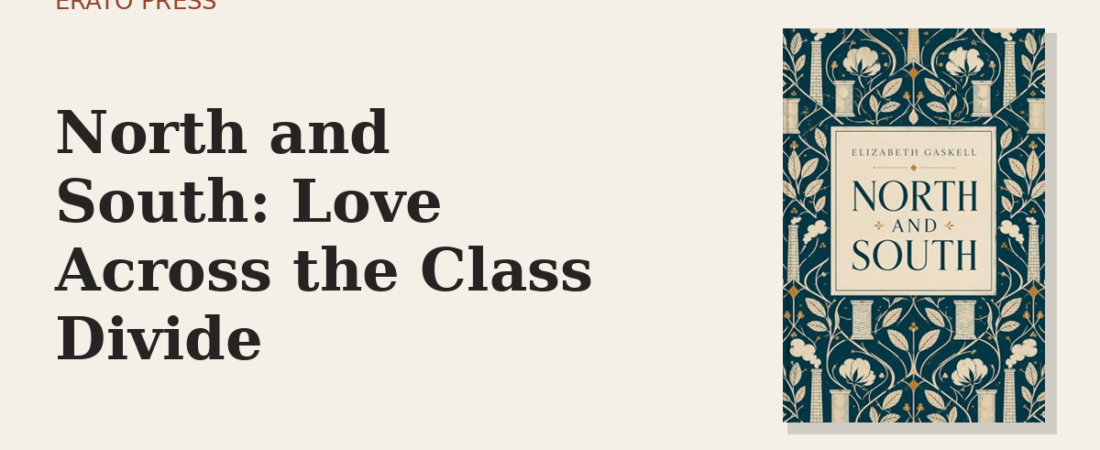
When Margaret Hale, the refined daughter of a southern clergyman, is uprooted to the smoky northern manufacturing town of Milton, she is appalled — by the noise, the poverty, the raw money-driven ethos, and above all by the self-made mill-owner John Thornton, whom she takes for a hard, grasping master of men. Elizabeth Gaskell’s North and South (1855) turns their mutual antagonism into one of the great Victorian novels: a love story that is also a serious, even-handed anatomy of industrial England, of the war between masters and workers, and of the collision between the genteel, agrarian South and the brutal, dynamic, future-making North. It is a novel that refuses easy sides, and grows wiser than either of its proud protagonists.

The two Englands
Gaskell’s title names a division that was tearing at Victorian Britain: between the old England of the rural South — cultured, settled, hierarchical, complacent — and the new England of the industrial North, where fortunes and slums were being made at terrible speed, where a man could rise from nothing to command a factory, and where masters and workers faced each other across a widening gulf. Margaret embodies the South’s values and its blindness; Milton and Thornton embody the North’s energy and its harshness. Gaskell, who lived in industrial Manchester and knew both worlds, refuses to make either simply right. Margaret must learn that the South’s gentility rests on ignoring realities the North cannot avoid; Thornton must learn that his workers are human beings with claims he cannot simply buy off. The novel is an education for both, and for the reader — a plea for understanding across a divide that still runs through every industrial society.
The strike
At the book’s center is a workers’ strike, and Gaskell’s treatment of it is remarkable for its fairness. She gives the workers real grievances and real dignity — the leader Nicholas Higgins is one of the novel’s finest characters — and she gives the masters real pressures and real arguments. She shows the violence and desperation on both sides, the way poverty and pride feed the conflict, the human cost when the machinery of industry grinds against the people who run it. Where a lesser novelist would have taken a side, Gaskell dramatizes the tragedy of a system in which decent people on both sides are set against each other, and gropes toward the radical idea that masters and men might actually talk, might recognize a shared humanity beneath the class war. It is one of the earliest and best of the “industrial novels,” a companion in social conscience to Dickens’s, but cooler, fairer, and closer to the factory floor.
Pride and its melting
And through it all runs the love story, which is really a study in pride — Margaret’s class pride and moral certainty, Thornton’s self-made man’s pride and wounded dignity — each misjudging the other, each too proud to bend, until experience and suffering wear the pride away and they meet at last as equals who have each been humbled into understanding. It is a slow-burning, deeply satisfying romance, the more moving because the lovers must change so much to deserve each other. Gaskell gives the private story and the public one the same shape: pride giving way to understanding, on the scale of a heart and on the scale of a society.
Why read it now
Because it is the great even-handed novel of industrial conflict — a book that takes both masters and workers seriously and pleads for the understanding across class that our own divided age still needs — wrapped in one of the most satisfying romances in Victorian fiction. Underrated beside Dickens and the Brontës, it is one of the wisest and most humane novels of its century.
Frequently asked questions
Is North and South a romance or a social novel?
Both, inseparably. The love story of Margaret and Thornton is also the story of the reconciliation between two Englands and two classes; Gaskell gives the private and public dramas the same arc of pride yielding to understanding.
How does Gaskell treat the workers?
With unusual fairness for her time — granting them real grievances, dignity, and one of the novel’s best characters in the union man Higgins, while also showing the masters’ pressures. She refuses to caricature either side.
Why is Gaskell less famous than Dickens?
Partly the accidents of reputation, but her industrial novels are among the finest of the age — cooler and more balanced than Dickens’s, closer to the real conditions of the factory towns she knew. Readers who discover her rarely regret it.
Read the Erato Press edition →
and watch two proud people, and two Englands, learn to understand each other.
Enjoyed this piece?
Get the next one — our essays on the classics and news of each new Erato Press edition — straight to your inbox.