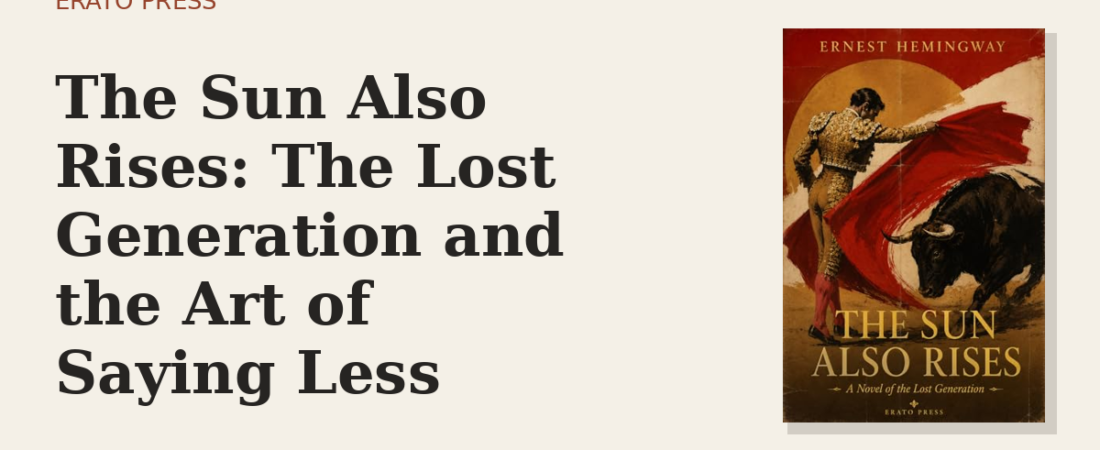
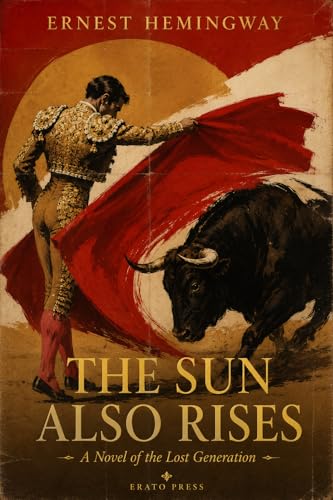
With his first novel, in 1926, Ernest Hemingway did two things that would echo through the century: he perfected a new way of writing English — spare, clipped, iceberg prose in which the deepest feelings live in what is left unsaid — and he gave a name and a face to the “Lost Generation,” the young people whom the First World War had hollowed out. The Sun Also Rises follows a group of American and British expatriates drinking, loving, and quarreling their way from the cafés of Paris to the bullfights of Pamplona, and on its surface almost nothing happens. Underneath, everything has already happened — a war that none of them can speak of has broken something in each of them, and the whole novel is the sound of people trying to live in the wreckage without naming it.
The wound that is never named
At the center is Jake Barnes, the narrator, a journalist who was wounded in the war in a way that has left him impotent — able to love Lady Brett Ashley, the magnetic, restless woman everyone desires, but unable to have her. Hemingway never states the nature of the wound directly; he lets it hang over the book, the literal embodiment of a generation’s less visible injuries. Jake and Brett’s love, real and impossible, is the novel’s aching core, and around it circles a crowd of the damaged and the drifting, filling the emptiness with drink, travel, and talk. The genius of the book is its restraint: the pain is everywhere and stated nowhere, carried entirely in the flat surface of the prose, so that the reader feels it precisely because Hemingway refuses to point at it.
The iceberg
Hemingway called it the iceberg theory: “The dignity of movement of an iceberg is due to only one-eighth of it being above water.” Strip out the explanation, the adjectives, the emotion stated outright; leave only the clean surface of action and dialogue; and the submerged mass — the feeling you did not write — will make itself felt all the more. It was a revolution in English prose, a reaction against Victorian ornateness so complete that it changed how the century wrote, and its influence runs through most modern fiction and journalism. Our guide to where to start with Hemingway traces how this style, born here, became one of the most imitated in the language.
Fiesta and futility
The novel’s long central section — the fiesta at Pamplona, the running of the bulls, the corrida — gives the book its other great subject: the search for something real and clean in a world drained of meaning. Against the aimless drinking, Hemingway sets the bullfight and the young matador Romero, who possesses what the expatriates have lost — grace under pressure, a code, a way of facing death with dignity. Brett’s brief affair with Romero, and its wreckage, measures the distance between the wounded moderns and the wholeness they can admire but not attain. The title, from Ecclesiastes (“The sun also ariseth… one generation passeth away, and another cometh”), sets the small human futility against the vast indifferent turning of the earth — endurance, not triumph, as the only heroism left.
Why read it now
Because it is the founding document of modern American prose and the truest portrait of a generation numbed by catastrophe trying to feel again — a condition every postwar era recognizes. Short, deceptively simple, and endlessly re-readable, it teaches the reader, page by page, to hear everything Hemingway is not saying, which turns out to be most of what matters.
Frequently asked questions
Why is so little explained in The Sun Also Rises?
By design. Hemingway’s “iceberg” method omits the emotion and backstory a conventional novel would spell out, trusting the spare surface to make the buried feeling felt. Reading him means learning to register what the flat prose deliberately leaves unsaid.
What is the “Lost Generation”?
The phrase, attributed to Gertrude Stein and used by Hemingway as an epigraph, names the young people who came of age during the First World War and emerged disillusioned and adrift. This novel became their defining portrait.
Is it a good first Hemingway?
It is one of the two best entries (with A Farewell to Arms), and the purest example of his early style. Short and gripping, it shows both what made him revolutionary and what made him divisive.
Read the Erato Press edition →
and hear the silence a whole generation was living inside.
Enjoyed this piece?
Get the next one — our essays on the classics and news of each new Erato Press edition — straight to your inbox.