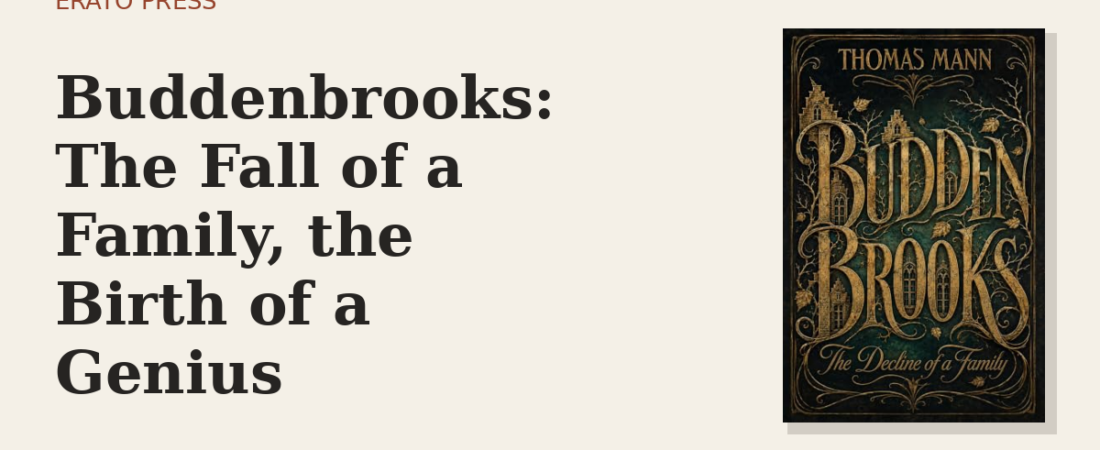
Thomas Mann was only twenty-five when he published Buddenbrooks (1901), the vast, assured novel that would carry him, nearly three decades later, to the Nobel Prize (the citation named it specifically). It is the chronicle of a prosperous north-German merchant family across four generations — their rise, their glory, and their slow, inexorable decline — and it is one of the great achievements of European realism, a book that holds a whole bourgeois world in its patient hands. But under its calm surface runs a strange and modern idea: that the family declines not because it fails but because it succeeds too well, growing, generation by generation, too refined, too inward, too conscious for the hard business of survival.

Four generations, one long decline
The novel follows the Buddenbrooks of Lübeck from the robust, confident old grain merchant who built the fortune, through his capable son, to the sensitive Thomas Buddenbrook, who runs the firm with growing effort and diminishing conviction, and finally to Thomas’s son Hanno — delicate, musical, unfit for and uninterested in the world of trade, in whom the family’s vitality flickers out. Mann traces the decline with the amplitude of a great realist: the marriages and bankruptcies, the dinners and deaths, the account books and the drawing rooms, the whole texture of nineteenth-century mercantile life rendered with a richness that makes the family feel like people one has known for years. It is a family saga in the grand tradition, and one of the finest.
The sickness of consciousness
But Mann’s originality is his diagnosis. In the Buddenbrooks, refinement is a disease. As the family grows wealthier and more cultured, it grows more sensitive, more reflective, more prone to art and doubt and inwardness — and less fit for the ruthless practicality that made it great. Thomas Buddenbrook, the ablest of them, is already half-paralyzed by self-consciousness, keeping up appearances by sheer will while his confidence rots; his son Hanno, all music and fragility, cannot survive the world at all. Mann, steeped in Schopenhauer and Nietzsche and Wagner, was giving fictional form to a haunting thesis: that consciousness and vitality are enemies, that to think and feel deeply is to be unfit to live, that the artist and the neurotic are the terminal, beautiful products of a line that has burned through its life-force. It is the theme that would run through all his work, from this first novel to Death in Venice and The Magic Mountain.
The realist novel at its summit
What makes Buddenbrooks more than a thesis is the sheer, loving completeness of its world. Mann drew on his own merchant family and his native Lübeck, and the book has the density of remembered life — the aunt with her malapropisms, the schoolboy’s dread of the classroom, the exact feel of a prosperous household’s rituals of eating and mourning and doing business. It stands in the great line of the nineteenth-century family novel and brings that tradition to a kind of summit even as it turns, at its edges, toward the modern preoccupation with decadence and decline. Few first novels have ever been so complete.
Why read it now
Because it is one of the supreme family sagas and a profound meditation on the price of refinement — the strange truth that cultures and families, like individuals, may grow too civilized to endure. Long but deeply readable, warm and ironic at once, it is the ideal introduction to the greatest German novelist of the century, and one of the last great flowerings of the realist novel.
Frequently asked questions
Do I need to know German literature to enjoy it?
Not at all. It is a warm, absorbing family chronicle that reads as accessibly as any Victorian novel; the philosophical depth is carried by the story, not imposed on it. A good translation makes it wholly approachable.
What does Mann mean by decline?
The Buddenbrooks decay not through failure but through increasing refinement: each generation grows more sensitive, artistic, and self-aware, and less fit for the hard practicality of business. Mann’s idea — that consciousness and vitality are opposed — runs through all his work.
Is it a good introduction to Thomas Mann?
The best. It is his most immediately readable major novel, and it introduces the themes — decadence, art, the burden of consciousness — that his later, more difficult masterpieces develop.
Read the Erato Press edition →
and watch a great family grow too fine to survive.
Enjoyed this piece?
Get the next one — our essays on the classics and news of each new Erato Press edition — straight to your inbox.