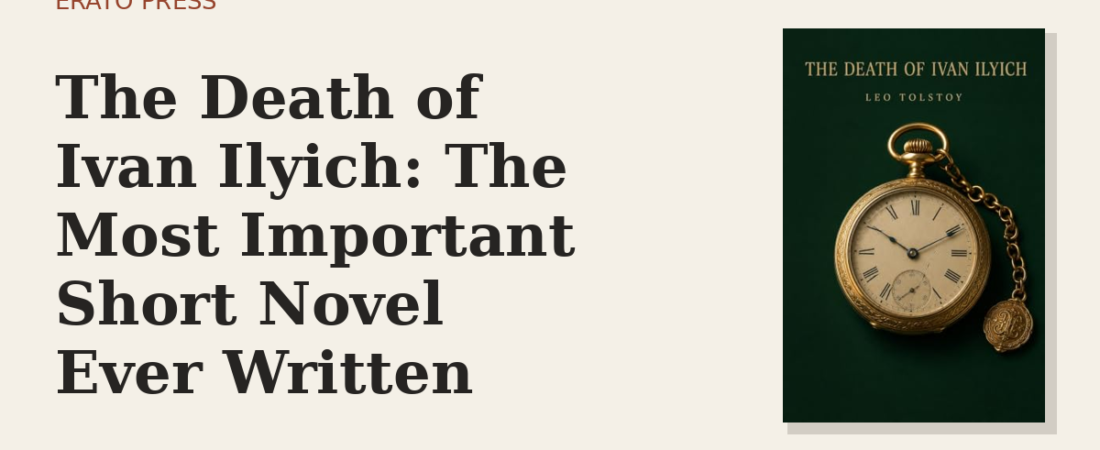
“Ivan Ilyich’s life had been most simple and most ordinary and therefore most terrible.” With that sentence Tolstoy opens the most quietly devastating short novel ever written. Ivan Ilyich is a successful judge — respectable, comfortable, correct in everything, a man who has done exactly what his society told him to do and been rewarded for it. Then he falls ill, from a trivial injury, and slowly, over a hundred pages, he dies; and in the dying he is forced to confront a possibility more terrifying than death itself — that his whole proper, pleasant, unexamined life was a lie, a long flight from the only questions that mattered. The Death of Ivan Ilyich (1886) is short enough to read in an evening and large enough to change how you live.

The horror of the ordinary life
Tolstoy’s target is not a wicked man but a normal one — and that is what makes the book unbearable and necessary. Ivan Ilyich did everything right by the world’s measure: he rose in his career, married appropriately, furnished a nice apartment, avoided anything unpleasant or intense, and arranged his life for maximum decorum and comfort. He never asked what any of it was for. And when death arrives, all of it — the career, the propriety, the possessions, the polite marriage — turns to ash, revealed as an elaborate machinery for not thinking about the fact that he would die. The novella’s terror is that Ivan Ilyich is us: the successful, distracted, comfortable modern person who has organized a whole life so as never to face the questions that a deathbed forces. Tolstoy holds the mirror up without mercy.
The lie everyone agrees to tell
The cruelest thing Ivan Ilyich suffers is not the pain but the falseness that surrounds his dying. His family and colleagues, unable to bear the truth, all pretend he is merely ill and will recover — a lie he must play along with, so that he dies utterly alone, cut off by the very propriety that governed his life from the one thing he needs, which is for someone to acknowledge that he is dying and to pity him. Only Gerasim, the young peasant servant, unashamed of death because he has not been trained to hide from it, treats Ivan Ilyich with simple honesty and tenderness — and becomes the book’s image of an unfalsified humanity. Tolstoy, who had come through his own terror of death into a radical Christian faith, is showing us that the fear of death and the falseness of a wasted life are the same disease, and that only truth can cure it.
The light at the end
And then, in the final pages, something breaks. In his last hours, Ivan Ilyich stops struggling, feels pity for his weeping son and wife, and passes suddenly out of his terror into light — “In place of death there was light.” Tolstoy, the supreme realist, ends his most unflinching look at death with a genuine transfiguration, an insistence that the wasted life can be redeemed even in its last moment by a single movement of real love. Whether one reads it as religious hope or as psychological truth, it is one of the most powerful endings in literature, and it turns the bleakest of stories into something strangely consoling. This is the late Tolstoy who had walked away from the world of War and Peace toward the stark spiritual questions that consumed his final decades.
Why read it now
Because no book does more, in less space, to make you ask whether you are living or merely arranging your life — and because its diagnosis of the comfortable, distracted, death-denying existence is even truer of our century than of Tolstoy’s. It is the perfect introduction to the greatest of novelists, and one of the few works of fiction that readers routinely say changed them. Read it in one sitting, and let it do its work.
Frequently asked questions
Is it very depressing?
It is unflinching about death, but it is not finally bleak — it ends in a genuine movement toward light and love, and most readers close it feeling clarified rather than crushed. Its purpose is not to depress but to wake.
Is it a good introduction to Tolstoy?
The best possible one. At around a hundred pages it gives you the full force of his genius — the psychological penetration, the moral seriousness, the transfiguring ending — without the commitment of the great long novels. Read it, then move to Anna Karenina or War and Peace.
What is Gerasim’s role?
The peasant servant Gerasim, honest and unafraid of death, is Tolstoy’s image of an unspoiled humanity — the one person who treats the dying man with truth and tenderness. He embodies the simple, faith-rooted goodness Tolstoy came to value above all the achievements of Ivan Ilyich’s respectable world.
Read the Erato Press edition →
and let the greatest of novelists ask you the one question that matters.
Enjoyed this piece?
Get the next one — our essays on the classics and news of each new Erato Press edition — straight to your inbox.