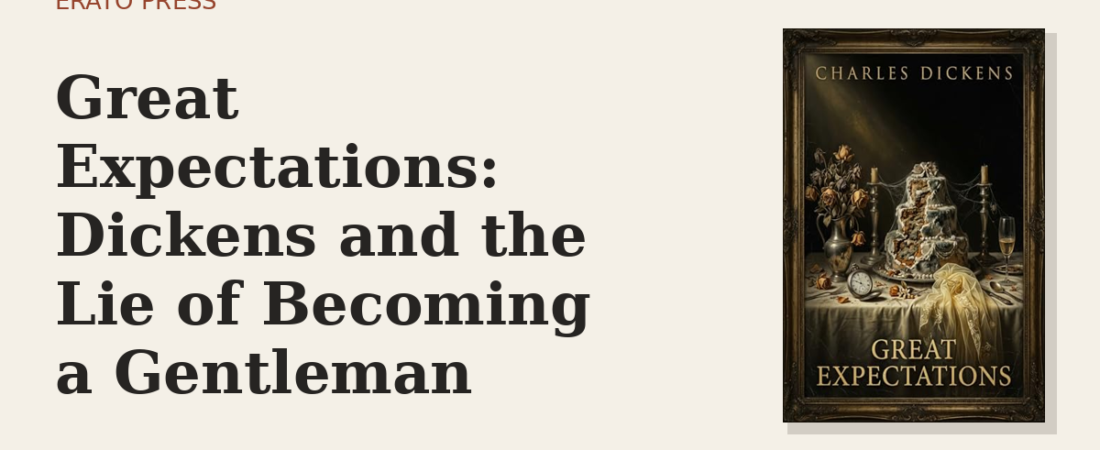
A blacksmith’s boy on the lonely marshes helps an escaped convict, is summoned to a decaying mansion to amuse a heartbroken old woman and her cold, beautiful ward, and then comes suddenly into a fortune from an unknown benefactor — with which he sets out to become a gentleman and win the girl. It sounds like the classic Victorian fairy tale of rising in the world. It is, in fact, Dickens’s most searching demolition of that fairy tale. Great Expectations (1861) is his most perfectly constructed novel and his most personal, the story of Pip’s education in the difference between the gentleman he longs to be and the good man he was in danger of ceasing to be. It is a book about money, class, shame, and the slow discovery of who deserves our love.

The shame of origins
The engine of the novel is a feeling Dickens knew from his own childhood: shame. The moment the proud, contemptuous Estella calls him a “common labouring-boy” and sneers at his coarse hands and thick boots, Pip is poisoned with dissatisfaction, taught to be ashamed of the loving, humble home that made him — of Joe Gargery, the gentle blacksmith who is the moral heart of the book. When the fortune comes, Pip embraces his “great expectations” and, with them, a snobbery that leads him to neglect and half-betray the good people of his childhood. Dickens traces the corruption with unsparing honesty, and Pip narrates his own younger self’s ingratitude with an older man’s shame. The novel’s deepest subject is the way a society organized around class teaches the poor to despise their own origins — and the long, hard road back to loving what one was taught to be ashamed of.
The secret at the heart of the money
Then comes the revelation that overturns everything, one of the great reversals in fiction: Pip’s mysterious benefactor is not, as he assumed, the wealthy Miss Havisham grooming him for Estella, but the convict Magwitch, the terrifying man from the marshes, who has spent a lifetime’s savings in the colonies to make the boy who once showed him kindness into a gentleman. The gentility Pip is so proud of was bought with a criminal’s money and a criminal’s love. The discovery detonates the whole class fantasy: the “gentleman” is the creation of the outcast, and the fine life is built on the very thing polite society casts out. Pip’s slow movement from horror at Magwitch to love for him is the moral climax of the book — the education of a snob into a human being.
Miss Havisham and the frozen heart
And over it all presides one of Dickens’s greatest grotesques: Miss Havisham, jilted at the altar decades ago and frozen ever since in her yellowed wedding dress, the clocks stopped, the wedding feast rotting on the table, who has raised the beautiful Estella into a weapon to break men’s hearts in revenge against the sex that broke hers. She is Dickens at his most hauntingly symbolic — a whole life given over to a single wound, warning of what happens to a heart that will not forgive. Her final, ruined repentance is among the most affecting scenes he wrote. Readers meeting Dickens for the first time often find this his most gripping and least sprawling novel; our guide to where to start with Dickens makes the case that it is the ideal door into his world.
Why read it now
Because it is the great novel of class shame and its cure, and because Pip’s mistake — believing that money and manners would make him worth loving, and nearly losing the people who actually loved him in the pursuit — is one every ambitious person is still in danger of making. Tightly plotted, unforgettable in its characters, moving in its final wisdom, it is Dickens’s most flawless book and one of the best novels in the language to fall in love with reading through.
Frequently asked questions
Is Great Expectations a good first Dickens?
It is arguably the best — shorter and more tightly plotted than his big sprawling novels, with a gripping mystery, unforgettable characters, and real emotional depth. Readers intimidated by Dickens’s reputation often find this the book that converts them.
What are the two endings?
Dickens wrote an original, bleaker ending in which Pip and Estella part for good, then, on a friend’s advice, a revised one that hints they may stay together. Editions differ on which they print; a good one gives you both and lets you judge which is truer to the book.
Why is it considered his best?
For its perfect construction, its psychological honesty about shame and snobbery, and its restraint — Dickens’s usual exuberance disciplined into a single, deeply felt first-person story. Many critics call it the one Dickens novel without a wasted page.
Read the Erato Press edition →
and watch a boy learn the difference between a gentleman and a good man.
Enjoyed this piece?
Get the next one — our essays on the classics and news of each new Erato Press edition — straight to your inbox.