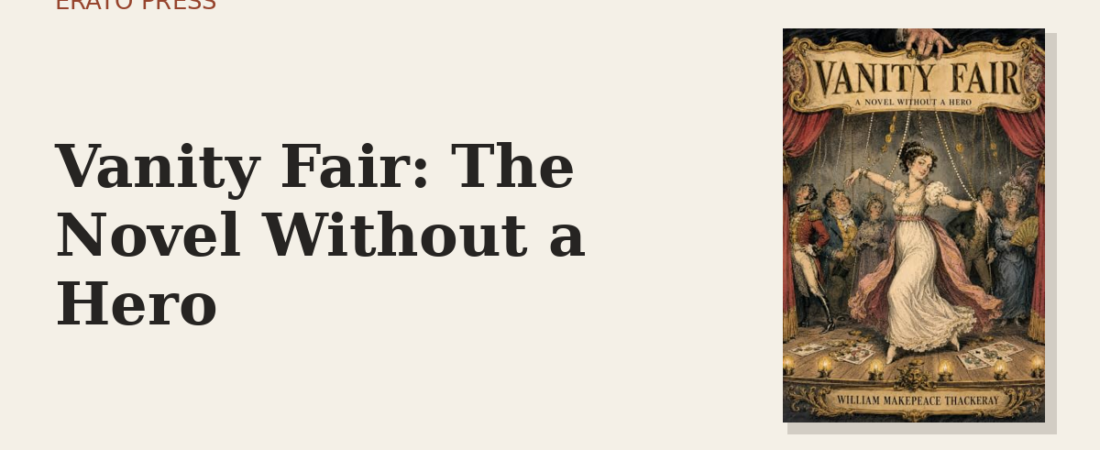
Thackeray subtitled his masterpiece A Novel Without a Hero, and the phrase is both a joke and a manifesto. In place of the noble protagonist the Victorian novel was supposed to supply, he gave English literature its most dazzling schemer: Becky Sharp, penniless, brilliant, and utterly without scruple, who lies and flatters and climbs her way up a greasy social ladder toward a respectability the novel makes us suspect is not worth having. Vanity Fair (1848) is the great English satire of a society that worships money and rank while pretending to worship virtue — and its genius is that it refuses to give us anyone clean to root for, so that we end up, half against our will, on the side of the magnificent adventuress who at least never lies to herself about what the world wants.

Becky Sharp, the anti-heroine who sees clearly
Becky is one of the great creations of the novel, and part of Thackeray’s daring is that he lets us admire her. Orphaned, poor, and clever, she looks at a world that offers a woman of her class nothing and decides to take everything by wit and performance. She is a liar, a social climber, probably an adulteress, and quite possibly a murderer — and she is also funny, fearless, and clear-eyed in a way that shames the respectable people around her. Against her Thackeray sets the gentle, passive Amelia Sedley, the conventional “good” heroine, whose virtue curdles into a kind of willful blindness. The pairing is the book’s argument: in a corrupt society, the honest fool suffers and the charming cynic thrives, and the reader who prefers Amelia to Becky has perhaps not been paying attention.
The whole of a rotten society
Thackeray’s canvas is enormous — London and Brussels, the Napoleonic Wars (the Battle of Waterloo happens offstage while the novel watches the civilians who wait for news), the drawing rooms and gambling dens and débutante balls of a whole class on the make. His narrator presides over it all as a puppet-master, stepping forward to comment, moralize, and undercut, reminding us that these are little figures in a great show of vanity, and that the show is our own. It is the most Victorian of panoramas and the least sentimental; where Dickens gives his social criticism a warm heart and a happy ending, Thackeray withholds both, and the withholding is his honesty.
The saddest sentence in Victorian fiction
For all its comedy, Vanity Fair closes on a note of desolation that has no equal in its century. “Ah! Vanitas Vanitatum,” the narrator sighs at the end; “which of us is happy in this world? Which of us has his desire? or, having it, is satisfied?” — and drops the curtain on his puppets. The whole glittering pursuit of money and status, the climbing and scheming and marrying, is revealed as vanity in the biblical sense, a chasing after wind. Thackeray had taken the title from Bunyan’s Pilgrim’s Progress, where Vanity Fair is the town of worldly temptation the pilgrim must pass through, and he made of it a mirror for the whole acquisitive society of his age — and ours. The book’s refusal of consolation is the source of its greatness: it will not pretend that the game is worth winning.
Why read it now
Because it is the sharpest satire in English of the society of appearances, and because Becky Sharp — self-made, self-mythologizing, monetizing her own charm in a world that gives an outsider no other capital — is startlingly modern, the ancestor of every ambitious striver who understands that image is currency. It is long, but it moves on wit, and it remains the funniest and the coldest of the great Victorian novels.
Frequently asked questions
Is Becky Sharp a villain?
She is an anti-heroine, and Thackeray deliberately keeps us from settling the question. She does real harm, yet the society she preys on is so hypocritical that her clear-eyed selfishness reads almost as honesty. The refusal to condemn or absolve her is the novel’s most modern feature.
Do I need to know the history?
No. The Napoleonic Wars form the backdrop, and Waterloo is a pivot, but Thackeray keeps the focus on the people who wait, scheme, and profit at home. A good edition glosses the period lightly; the human comedy needs no footnotes.
How does it compare to Dickens?
They are the two giants of the Victorian novel and near-opposites: Dickens warm, theatrical, and hopeful; Thackeray ironic, worldly, and disenchanted. Reading them together maps the full range of the age’s fiction.
Read the Erato Press edition →
and meet the anti-heroine who plays the game better than the people who made the rules.
Enjoyed this piece?
Get the next one — our essays on the classics and news of each new Erato Press edition — straight to your inbox.