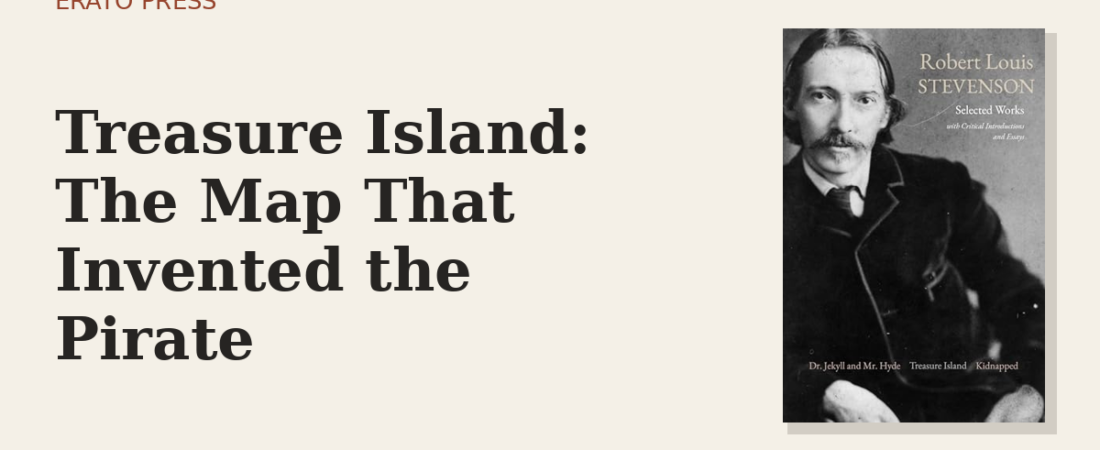
Almost everything you picture when you imagine a pirate was invented by one man, in one book, and several of the details began as a joke between a father and a stepson on a rainy holiday in Scotland. The wooden leg, the parrot on the shoulder, the treasure map with a cross marking the spot, the black spot pressed into a traitor’s palm, the buried chest, the schooner crewed by cutthroats who sing about a dead man’s chest — these are not folklore Robert Louis Stevenson collected. They are largely things he made up for Treasure Island in 1883, and they have so thoroughly colonized the imagination that we mistake his inventions for history. There were real pirates, and they were mostly squalid and short-lived. The pirate we love is a literary character, and his birthplace is this novel.

The map came first
The origin story is almost too good. Stevenson, on holiday in the Scottish Highlands in a wet summer, drew a map to amuse his young stepson Lloyd — an island, with coves and hills and the words “treasure” and a cross. The map generated the book, not the other way around. Looking at the imagined coastline, Stevenson began to see the characters who might move across it, and the names and soundings on that piece of paper became the engine of a plot. He always insisted the map was the true author of the story, that the fiction grew out of the geography, and you can feel it in the finished novel: the landscape is exact, walkable, real in a way that makes the adventure feel less invented than discovered.
That is the first thing Stevenson perfected — the treasure map itself as a narrative device. “X marks the spot,” the dotted line of the route, the chest buried at a measured distance from a landmark: this entire grammar of hidden treasure, which every pirate story and half the world’s adventure games still use, is essentially Stevenson’s design, made canonical by one book. Before Treasure Island, buried pirate gold was a vague rumor. After it, the map became the indispensable object, the promise and the puzzle that sets the whole machine in motion.
Long John Silver, the villain who refuses to be simple
The map may be the engine, but the soul of the book is Long John Silver, and he is the reason Treasure Island outgrew the boys’ adventure shelf. Stevenson built him out of a real friend — the critic W. E. Henley, robust, one-legged, magnetic — and the result is one of the great morally ambiguous characters in English fiction. Silver is the ship’s cook, genial, intelligent, endlessly likable, with his parrot Captain Flint shrieking “Pieces of eight” on his shoulder. He is also a murderer and the ringleader of the mutiny, capable of cutting a man down and then turning, in the same breath, a warm and reasonable face to the boy he is manipulating.
What makes Silver permanent is that Stevenson refuses to resolve him. Young Jim Hawkins, the narrator, never quite stops being drawn to him even after seeing exactly what he is, and the reader is caught in the same ambivalence. Silver is loyal and treacherous, tender and brutal, and the novel lets him survive and slip away rather than hang — a deeply unconventional choice that admits the charming villain is too alive to be tidily punished. Every charismatic pirate since, every rogue we are not supposed to root for and root for anyway, is a descendant of Long John Silver. He is the prototype, and no imitation has surpassed the original.
The boy’s adventure, perfected and then deepened
On its surface Treasure Island is the pure form of the adventure tale: a boy finds a map in a dead sailor’s sea chest, sails with a crew that turns out to be half pirates, survives mutiny and marooning and a fight for a fortune, and comes home changed. Stevenson tells it at a pace that has never gone stale — the apple barrel in which Jim overhears the mutiny being planned, the blind beggar Pew tapping his stick down the road, the marooned madman Ben Gunn, the black spot delivered as a sentence of death. It is, simply, one of the best-told stories of its kind, and it set the template for the genre.
But Stevenson was a far subtler writer than the adventure label suggests, and the book quietly does more than thrill. It is narrated by Jim looking back, and underneath the excitement runs a real education: the boy learns that courage and villainy can live in the same charming man, that the adults around him are fallible, that the gold at the end of the map corrupts nearly everyone who reaches for it. The treasure is found and it brings little joy; men die for it, and the survivors want to forget it. Stevenson gives a boy’s adventure the moral undertow of grown-up fiction without ever slowing the chase — which is precisely why adults reread it and find it has been waiting for them all along.
Why the invention still holds
The measure of Treasure Island is that its inventions became so universal we forgot they were invented. We assume pirates always had parrots and peg legs and treasure maps because Stevenson made the association total. He took a handful of historical scraps — the Caribbean buccaneers, the privateers, a few real names — and forged from them a complete, coherent, irresistible mythology that every later pirate story has either borrowed or argued with. The swashbuckler that followed him owes him its furniture: Rafael Sabatini and the Art of the Swashbuckler shows how the next generation took Stevenson’s seafaring rogues and spun them into the historical adventure novel, refining the costume Stevenson had cut.
A style that hides its own art
Part of why the inventions stuck is that Stevenson was a prose stylist of the first rank disguising himself as a teller of yarns. The sentences are lean, concrete, and fast, every noun doing work, and he had an unerring instinct for the single vivid image that fixes a scene forever — Blind Pew’s stick tapping on the frozen road, the blue-faced corpse of the sailor in the first chapters, Israel Hands climbing the rigging with a knife in his teeth. He could compress a whole atmosphere of menace into a phrase, and he never let description slow the forward drive of the story. Writers as different as Henry James and Jorge Luis Borges admired him precisely for this: the apparent simplicity is the achievement of enormous craft. A lesser writer with the same plot would have produced a forgettable adventure; Stevenson produced sentences children memorize and novelists study, which is why his pirate has outlived every real one.
Frequently asked questions
Did Stevenson invent the treasure map and “X marks the spot”?
He did not invent the idea of buried treasure, but he gave it the form we now treat as standard. The map he drew to amuse his stepson generated the entire novel, and his treatment of it — the marked location, the measured route to the chest — established the conventions that pirate fiction has used ever since.
Is Treasure Island only a children’s book?
It was written partly for a boy and works perfectly as a young reader’s adventure, but it is not only that. The moral complexity of Long John Silver and the corrupting pull of the treasure give it a depth that rewards adult rereading. Many writers have called it one of the books that made them want to write.
What is the “black spot”?
It is one of Stevenson’s pure inventions: a paper token blackened on one side and pressed into a pirate’s hand to deliver an official sentence of guilt or deposition among the crew. It exists because Stevenson imagined it, and it has been borrowed by pirate lore ever since as though it were genuine history.
To read Treasure Island is to watch a mythology being built in real time, by a writer good enough to make his inventions feel older than the truth. The Erato Press edition presents Stevenson’s adventure with the context to see what he created and how completely it took over our picture of the sea — the map, the mutiny, and the one-legged cook who walked off the page and never left.
Read the Erato Press edition →
Enjoyed this piece?
Get the next one — our essays on the classics and news of each new Erato Press edition — straight to your inbox.