Mark Twain called The Adventures of Tom Sawyer “a hymn, put into prose form to give it a worldly air.” It is a revealing thing to say about a book that is, on its surface, a comedy of whitewashed fences and graveyard oaths and a boy faking his own funeral. A hymn is a song of praise, and what Twain is praising — ruefully, knowingly, from the far side of adulthood — is a vanished condition: the long, idle, river-bordered summer of an American boyhood that probably never existed as purely as he remembered it, and certainly no longer existed by the time he wrote it down in 1876. The book is nostalgia, and its greatness lies in how much it knows about the limits of its own nostalgia.

This is the distinction worth holding onto, and it is the one most often blurred: Tom Sawyer is not a junior version of Adventures of Huckleberry Finn, and the two books are doing opposite things. Tom Sawyer is an idyll, a remembered Eden seen through an adult’s affectionate haze, structured as a boy’s almanac of summer pleasures. The later novel, narrated by Huck himself, leaves the village and travels down a river that runs through the moral catastrophe of slavery, and it is told from the inside, without the cushion of remembrance. To read Tom Sawyer well is to feel the comfort of the idyll and, at its edges, the first cold draft of the darker book Twain had not yet written.
An Eden built from an adult’s memory
The St. Petersburg of Tom Sawyer is the Hannibal, Missouri, of Twain’s own boyhood, recovered and gilded. Everything in it is sized to a child’s appetites and a man’s wistful backward glance: the swimming hole, the cave, the dead cat for warts, the elaborate economy of marbles and “Sunday-school tickets,” the social genius of persuading other boys to pay for the privilege of whitewashing a fence. Twain narrates all of this from above, with a grown man’s irony playing over a child’s seriousness, and that double vision is the book’s signature pleasure. We are inside Tom’s scheme and outside it at once, taking him gravely and finding him absurd.
The nostalgia is real, but Twain is not naive about it. The narration keeps reminding us that this is recollection, that the village is being remembered rather than reported, that the golden light is the light of distance. He is praising a boyhood while signaling, in his very tone, that such praise is always a little fraudulent — that the freedom of childhood looks like freedom mainly from the cage of adulthood, and that the man writing the hymn can no longer enter the world he is hymning. The book’s warmth is genuine; so is its faint, pervasive ache.
The play of children, the menace of adults
It would be a mistake to call Tom Sawyer soft. Death runs all through it, handled with a child’s mixture of terror and relish. The boys witness a murder in the graveyard; the innocent Muff Potter is nearly hanged for it; the genuinely frightening Injun Joe stalks the back half of the novel and dies, horribly, sealed inside the cave where Tom and Becky are themselves lost in the dark for days. The idyll, in other words, has a villain and a corpse and a real possibility of starvation underground. Twain understood that childhood is not the absence of fear but a particular relationship to it — the way a boy can be authentically terrified at night and back at his games by noon.
What keeps the menace from overturning the idyll is the structure: the adult world’s violence is something the children brush against and survive, not something that defines them. Tom’s worst danger ends in treasure and acclaim. This is the consoling logic of the remembered Eden, where even the graveyard and the cave become, in retrospect, adventures one walked out of. The later book would withdraw that consolation. There, a boy’s brush with the adult world’s violence — the violence of slavery — cannot be survived as a lark, because it is not aimed at him; he is its accomplice and its conscience, and there is no walking out into applause.
Tom and Huck: two American boyhoods
Huckleberry Finn appears in Tom Sawyer as a minor and marvelous figure — the “juvenile pariah,” the son of the town drunk, idolized by every respectable boy precisely because he is free of everything that constrains them: no shoes, no school, no mother, no church. He is the wild card in Tom’s ordered game. But he is a supporting player here, a flavor of freedom rather than a moral center. The genius of what came next was Twain’s recognition that the throwaway character was the one with a soul large enough to carry a great novel, and that his voice — not Tom’s borrowed romance, but Huck’s plain, unschooled, devastatingly honest American speech — was the instrument he had been looking for.
The difference is the whole difference between the two books, and readers who finish the idyll should go straight to the reckoning. Huckleberry Finn and the American Voice traces how Twain handed the narration to the outcast boy and, in doing so, invented a way of writing America from below — in the vernacular, on a runaway journey down the river, through a friendship with the escaped slave Jim that forces Huck to weigh his own conscience against everything his society has taught him. Tom plays at adventure; Huck is overtaken by a real one. The first book is what boyhood feels like; the second is what it costs to grow up.
Why the idyll still earns its place
It would be easy, in the shadow of the greater novel, to patronize Tom Sawyer as a warm-up. That underrates it. Twain was doing something genuinely difficult: rendering the texture of ordinary childhood — its boredom and superstition and social politics, its enormous seriousness about trivial things — with a comic precision no American writer had managed before. The whitewashing chapter alone is a perfect short essay on the psychology of desire, dressed as a boy’s con. The book invented a great deal of what we now mean by the American boyhood story, and nearly everything in the genre since has been written in its margins.
Its nostalgia has limits, and Twain knew them better than his imitators ever did. The lost world he sings is partly a fiction, lit by distance, walled off from the historical horror that the next book would walk straight into. But a hymn does not have to be the whole truth to be worth singing, and Twain’s is honest about being a hymn. Reading it now, with the darker sequel in view, is to watch a writer love a vanished world while quietly knowing it was never quite as innocent as the song.
Frequently asked questions
Should I read Tom Sawyer before Huckleberry Finn?
It helps but is not required. Tom Sawyer introduces Huck, Tom, and the village, and reading it first lets you feel the tonal drop into the later book’s seriousness. But each stands on its own, and many readers come to Huckleberry Finn cold without losing anything essential.
Is Tom Sawyer a children’s book?
Twain himself was unsure, and said so — he wrote it for adults remembering childhood as much as for children living it. Children enjoy the adventures; adults catch the irony playing over them. It works on both levels at once, which is part of its durability.
How dark does the book actually get?
Darker than its reputation. There is a graveyard murder, a near-hanging of an innocent man, a terrifying villain, and a long sequence of children lost and starving in a cave. The menace is real; what softens it is the remembered, adventure-from-which-one-returns frame.
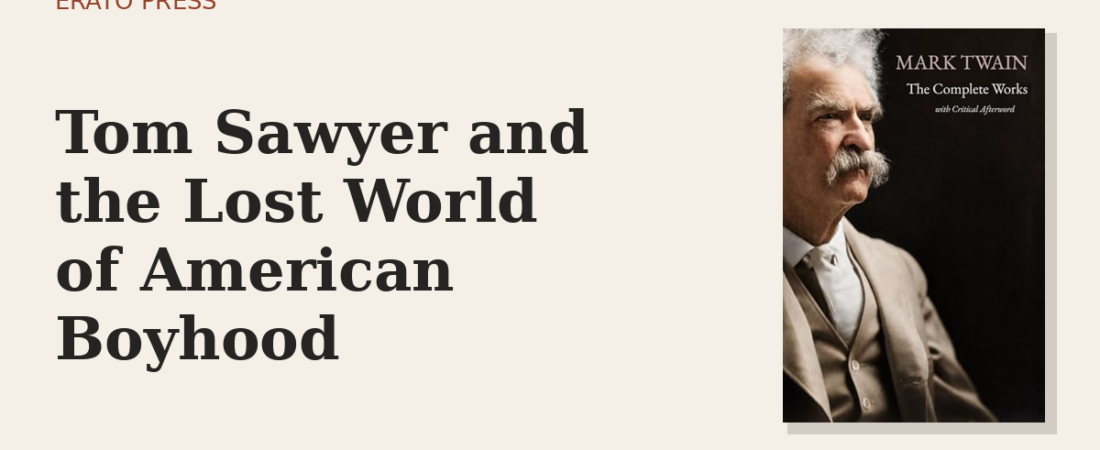
An idyll this knowing rewards an edition that reads it as literature rather than mere juvenilia. The Erato Press edition presents Twain’s text with critical apparatus that situates the book between memory and myth, traces its place in the invention of the American boyhood story, and marks the fault line where Tom’s sunlit village gives way to the moral wilderness of its great successor.
Read the Erato Press edition →
Enjoyed this piece?
Get the next one — our essays on the classics and news of each new Erato Press edition — straight to your inbox.