On the Fourth of July, 1845 — Independence Day, and Thoreau chose the date on purpose — a Harvard-educated handyman and sometime schoolteacher moved into a one-room cabin he had built on the north shore of a small pond outside Concord, Massachusetts. He stayed two years, two months, and two days. He kept accounts. He hoed beans. He listened to the Fitchburg railroad whistle cut across the woods and to the loons laughing on the water at night. And out of that stay he made one of the strangest, most quotable, most willfully provoking books in American literature: a book that is part field journal, part economic treatise, part sermon, and part extended dare. Walden is not, finally, a how-to guide for moving to the country. It is an argument — sustained over eighteen chapters and a famous handful of sentences — that most people are living the wrong life without ever having chosen it, and that the only remedy is to choose.
The thesis sits in the second chapter, in a sentence everyone half-remembers and almost nobody quotes accurately: “I went to the woods because I wished to live deliberately, to front only the essential facts of life, and see if I could not learn what it had to teach, and not, when I came to die, discover that I had not lived.” The operative word is deliberately — from the Latin librare, to weigh. Thoreau did not go to the pond to escape life; he went to weigh it, to put existence on a scale and find out what it actually cost and what, after the deductions, it was worth. That is the experiment Walden records, and it is why the book refuses to settle into either pastoral idyll or self-help manual. It is a piece of moral accounting.
The economics of the bean-field
It is easy to forget that the longest chapter in Walden is called “Economy,” and that it opens not with birdsong but with a ledger. Thoreau tells us, to the half-cent, what his house cost to build — $28.12½, less than a year’s rent on a student’s room at Cambridge. He lists the boards, the nails, the lime, the hinges. He calculates that he could support himself by working roughly six weeks a year and spend the rest reading, walking, and watching the seasons turn. This is not eccentric bookkeeping; it is the spine of the whole argument. Thoreau had grasped something his neighbors had not: that the true cost of a thing is “the amount of what I will call life which is required to be exchanged for it, immediately or in the long run.” The farmer who labors his whole life to pay off a mortgage on a house he is too tired to enjoy has made a bad trade. He has bought shelter with the very life the shelter was supposed to protect.
This is why the men of Concord struck Thoreau as figures of quiet desperation — that phrase, “the mass of men lead lives of quiet desperation,” is the book’s other most famous line, and it is an economic diagnosis before it is a psychological one. The desperation is quiet because it is dressed up as industry, as respectability, as getting on. Thoreau’s radicalism is to ask what all that getting-on is for. The bean-field he hoed — “making the earth say beans instead of grass” — was partly a joke at his own expense (he barely broke even) and partly a demonstration. He grew the beans to find out exactly how little a man needed, and having found out, he could not unsee how much everyone around him was sacrificing for the surplus.
Simplicity as critique, not lifestyle
“Simplify, simplify,” Thoreau writes — and a century and a half of decluttering manuals have taken him at his word while missing his point. His simplicity is not aesthetic minimalism or a fashionable thrift. It is a tool of perception. Strip away the inessentials, he argues, and you can finally see the structure of your own existence: “Our life is frittered away by detail.” The three meals a day, the morning newspaper, the post office where men go to collect letters that concern them not at all — these are the sediment of habit, and habit is the enemy of deliberate life. When Thoreau urges us to “drive life into a corner, and reduce it to its lowest terms,” he is borrowing the language of mathematics: he wants the irreducible fraction, the thing that remains when everything contingent has been divided out.
What makes this more than crankery is that Thoreau was writing at the precise moment American life was accelerating beyond recognition. The railroad reached Concord in 1844, the year before he moved to the pond, and its whistle haunts the book. He saw the telegraph, the factory system, the new tyranny of the timetable — “We do not ride on the railroad; it rides upon us” — and he understood that a civilization was being built that would measure its own success in speed and accumulation. Walden is the first great American protest against that civilization, written before most people had noticed it was arriving. To read it now, in an age of notifications and infinite scroll, is to find that the diagnosis has aged with uncanny precision. The pond is gone but the desperation is louder than ever.
The contradictions, and why they matter
No honest reading of Walden can ignore the objection that has dogged it since publication: Thoreau was not, in any strict sense, a hermit. The pond was a mile and a half from town. He walked into Concord regularly. His mother and sisters did his laundry and, by some accounts, brought him doughnuts. He dined at the Emersons’ table — Ralph Waldo Emerson owned the land the cabin stood on — and Bronson Alcott and other friends visited him in the woods. The image of the self-reliant solitary, living wholly by his own hands, is partly Thoreau’s own construction and partly ours.
The critics who pounce on the laundry have a point, but they mistake its weight. Walden never claims to be a documentary record of perfect self-sufficiency; it is an experiment in seeing how little is enough, and a polemic addressed to people who would never move to a pond at all. Thoreau is not selling solitude; he is borrowing it, the way a chemist isolates a variable. The cabin is a laboratory, not a monastery. The contradiction between the legend and the laundry is real, but it is also productive: it forces us to ask what we actually want from the book. If we want a saint who lived without dependence on anyone, we will be disappointed, because no such person has ever existed and Thoreau knew it. If we want a thinker who weighed his own life with merciless honesty and reported what the scale said, the doughnuts change nothing. The experiment was never about purity. It was about attention.
Why the book outlived the cabin
Thoreau left the pond in September 1847 — “I left the woods for as good a reason as I went there. Perhaps it seemed to me that I had several more lives to live, and could not spare any more time for that one.” The line is characteristic: even his departure is framed as a choice, deliberate, weighed. He spent the next seven years revising the manuscript through draft after draft, compressing two years into a single symbolic cycle of seasons, so that the book ends not in autumn, when he actually left, but in spring — with the ice breaking up on the pond and the famous parable of the bug that gnaws its way out of an old wooden table after sixty years, an image of unkillable renewal. The structure is a resurrection.
That is the final reason Walden endures while a thousand back-to-nature books have not. It is not really about nature, or economy, or even simplicity. It is about waking up. “Only that day dawns to which we are awake,” runs the last sentence, and the whole book has been an argument that most of us are asleep — going through the motions of a life we never paused to examine. To live deliberately is to be awake to your own existence while you are still in it. That is a demand, not a recipe, and it is one no amount of material progress can satisfy or retire.
Frequently asked questions
Was Thoreau really living off the grid, or is that a myth?
It is a myth, or at least a generous exaggeration — and the book itself never quite claims otherwise. Walden Pond sat a short walk from Concord; Thoreau visited town often, ate with the Emerson family, and relied on his mother and sisters for some practical help, laundry included. But the point of the experiment was not perfect isolation. It was to measure how little a person genuinely needs, and to see one’s life clearly by subtracting its clutter. The cabin functioned as a controlled experiment, not a vow of total self-sufficiency.
Do I need to read the whole book, or just the famous chapters?
“Economy” and “Where I Lived, and What I Lived For” contain the core argument and the most-quoted lines, and a reader pressed for time can start there. But the later chapters — “The Ponds,” “Brute Neighbors,” “Spring” — are where Thoreau’s prose does its finest observing, and where the philosophical claims of the opening get grounded in the actual texture of the seasons. The book is short. It rewards being read entire, slowly, the way it was written.
Is Walden a political book?
Less directly than its reputation as a nature book suggests, but it is political at the root. Thoreau’s critique of getting and spending, his suspicion of institutions, and his insistence that the individual conscience outranks social convention all flow from the same source that produced “Civil Disobedience,” written in the same years. Walden is a quieter book, but its refusal to take the going way of life for granted is a profoundly political act.
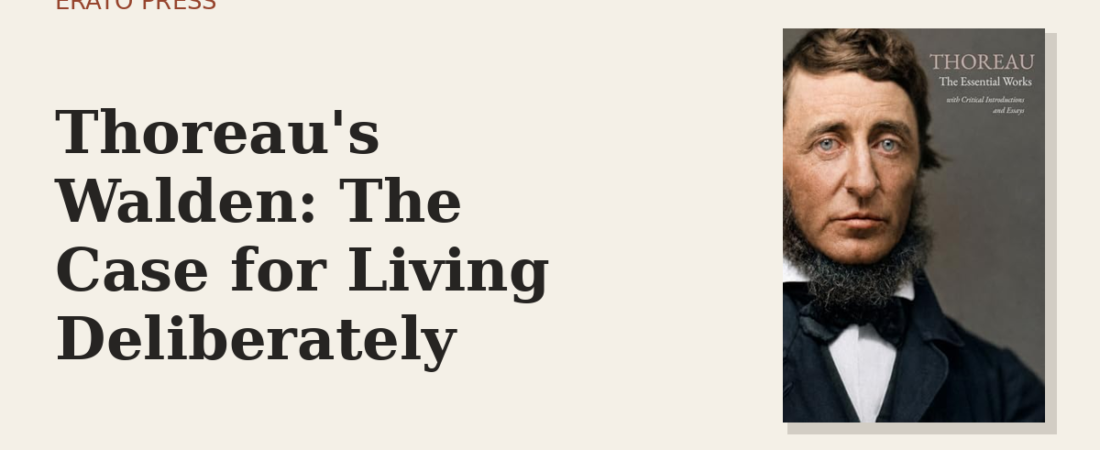
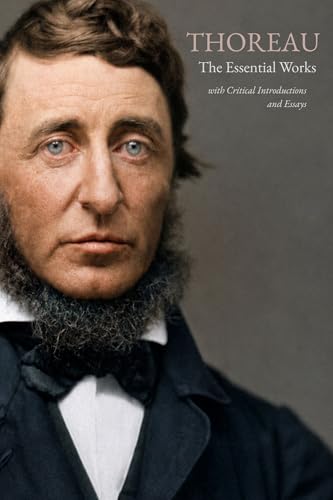
Our edition presents Thoreau’s text complete and uncut, with the kind of apparatus that lets a modern reader catch the references, the jokes, and the deliberate provocations that nineteenth-century Concord would have heard at once — the railroad allusions, the classical tags, the sly digs at his neighbors. The introduction takes the contradictions seriously rather than explaining them away, because they are part of what makes the book live. If you have only ever met Walden as a handful of inspirational quotations, the whole is stranger, funnier, and far more bracing than the fragments suggest.
Read the Erato Press edition →
and weigh your own life against the man who weighed his at the pond.Enjoyed this piece?
Get the next one — our essays on the classics and news of each new Erato Press edition — straight to your inbox.