Oscar Wilde wrote exactly one novel, and it nearly hanged him. The Picture of Dorian Gray appeared in Lippincott’s Monthly Magazine in 1890, was savaged by reviewers as poisonous and effeminate, and five years later was read aloud, sentence by sentence, in a London courtroom by a prosecutor who wanted a jury to conclude that the man who imagined Dorian must have lived him. That a work of fiction could be entered as evidence of a defendant’s soul tells you something the book itself insists on: Wilde believed art and life were not the sealed compartments his age pretended they were, and he was destroyed by the proof.

One man, two faces, and the lie of the divided self
The premise is so clean it has hardened into folklore, which is its own kind of misfortune, because the folklore flattens what Wilde actually built. A young man of extraordinary beauty sits for a portrait. Under the influence of the painter’s friend, Lord Henry Wotton, he half-wishes that the picture might age in his place while he stays forever as he is at that moment. The wish is granted by no visible machinery. Dorian remains young; the canvas, locked away in an attic, absorbs every cruelty and every year, growing into a record of corruption so hideous that its owner cannot bear to look at it.
What makes the device more than a parlor trick is that Wilde refuses to let Dorian be punished cleanly. The face the world sees stays smooth precisely because Dorian has externalized his conscience onto an object he controls — and the horror of the book is not that the portrait changes but that Dorian can hide it, can commit murder and ruin and walk out into the morning unmarked. The novel is about the modern fantasy that one might separate the act from the actor, the deed from the doer. Stevenson’s Jekyll splits in two and is consumed; Dorian stays whole on the surface and rots underneath, which is the more unsettling proposition because it describes a way of living that many people actually attempt.
Aestheticism, and the doctrine the trial weaponized
To read Dorian as a simple morality tale — sin shows on the soul, beauty is a trap — is to miss that Wilde was the most committed aesthete of his generation and meant much of Lord Henry’s seductive nonsense. Wilde’s lifelong argument was that art owes nothing to morality, that a book is neither moral nor immoral but only well or badly written, and that the artist’s only loyalty is to the flawless form of his expression. He held that art’s value lies in its uselessness, in its refusal to be a mouthpiece for social improvement; that the visible world should be admitted into the house of beauty only after it has been stripped of everything harsh and debatable. Lord Henry’s epigrams — that the only way to get rid of a temptation is to yield to it, that nothing can cure the soul but the senses — are not the devil’s lines smuggled into a sermon. They are a polished, dangerous version of Wilde’s own creed.
And that is exactly why the prosecution found the novel so useful. When Wilde sued the Marquess of Queensberry for libel in 1895, and then found himself the defendant in two criminal trials, counsel read passages from Dorian Gray aloud and asked him to defend them as if they were confessions. Wilde answered with the famous preface he had attached to the 1891 book edition — “There is no such thing as a moral or an immoral book” — but in a courtroom the aphorism that had been a manifesto became a self-incrimination. The aesthetic doctrine that art and conduct occupy separate spheres was turned inside out: the state insisted they were one, that a man who wrote such sentences had lived them, and convicted him to two years’ hard labor. The book that argued for the autonomy of art was used to deny its author the autonomy of his own life.
What the 1890 version contained, and why it was cut
The text we now treat as canonical is not the text that caused the first scandal. The original 1890 Lippincott’s version was more explicit about the nature of the painter Basil Hallward’s devotion to Dorian — a worship rendered in language that contemporary readers had no trouble decoding. When reviewers called the story unclean and recommended its suppression, Wilde revised. The 1891 edition added six chapters, sharpened the plot, supplied the defensive preface, and toned down Basil’s confession of love. The novel grew more shapely and less nakedly itself. Reading the two side by side is one of the genuine pleasures available to a serious reader of Wilde: you watch an author edit under threat, deciding which truths to keep and which to drape, and you see the precise places where Victorian England’s intolerance left its fingerprints on a sentence.
The portrait as the only honest thing in the book
There is a final irony worth sitting with. In a novel obsessed with surfaces, with the worship of beauty as an end in itself, the one object that tells the truth is the work of art. The portrait does not lie. While every living face in Wilde’s London is a performance — Dorian’s most of all — the painting in the attic keeps an exact, unbearable ledger. Wilde, who insisted that art holds no moral message and exists for its own perfection, wrote a book in which a painting becomes the conscience the world has lost. He believed the artist mirrors his age best when he stands most remote from it, having stripped life of what is accidental; the portrait does precisely that, and what it shows when the accident of Dorian’s pretty face is stripped away is the man entire. The aesthete’s masterpiece turns out to be a moralist’s, and Wilde, who would have hated the word “moralist,” knew it.
Frequently asked questions
Is The Picture of Dorian Gray hard to read?
No. It is short, propulsive, and built around a premise that pulls you forward, and Wilde’s prose is studded with aphorisms so quotable they have entered the language. The difficulty, if there is one, is interpretive rather than technical: deciding how seriously to take Lord Henry’s philosophy, and resisting the temptation to read the book as a tidier moral fable than it actually is.
Should I read the 1890 or 1891 version?
The 1891 expanded text is the standard one and the more accomplished novel. But if you have read it once, the uncensored 1890 magazine version rewards the return, because its franker treatment of Basil’s feeling for Dorian shows you what the scandal was really about and what Wilde chose to soften.
Did the novel really get used against Wilde at his trial?
Yes. During the 1895 proceedings, passages were read aloud and Wilde was pressed to defend them as evidence of his character. The preface’s claim that no book is moral or immoral, written partly in answer to the original reviewers, was thrown back at him as proof of decadence. The novel did not convict him, but it was central to the atmosphere of the prosecution.
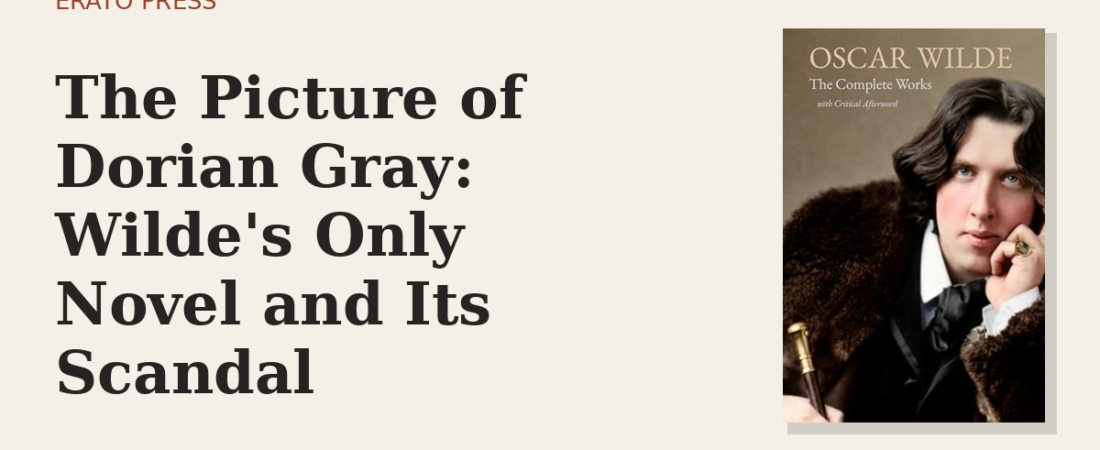
Wilde’s only novel deserves to be read as he wrote it and around the life it cost him — not as a museum piece but as the dangerous, beautiful, self-incriminating book it remains. The Erato Press edition gathers it with the apparatus that situates the 1890 scandal, the 1891 revisions, and the aesthetic theory that animated and undid him: the full text restored to its proper context, so that the most famous portrait in English fiction can be read for what Wilde made of it rather than for what the courts made of him.
Read the Erato Press edition →
Enjoyed this piece?
Get the next one — our essays on the classics and news of each new Erato Press edition — straight to your inbox.