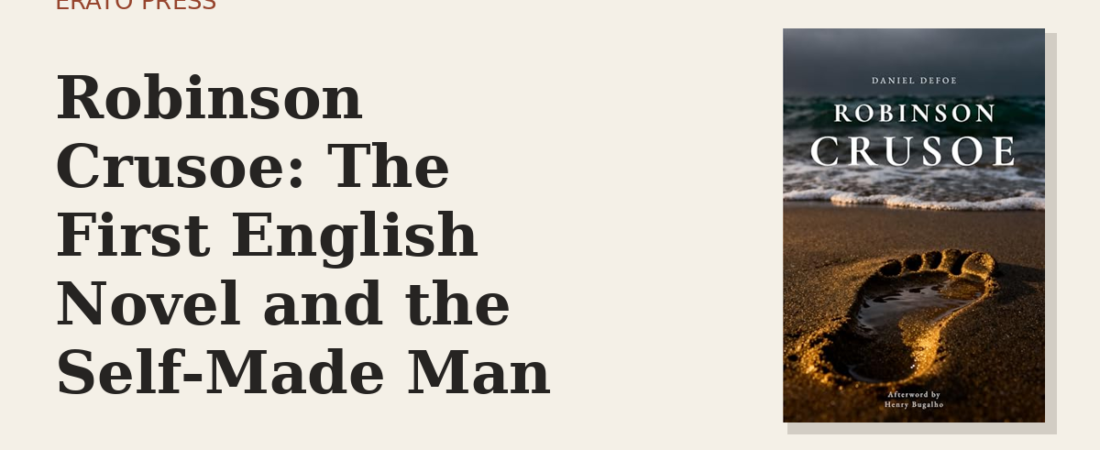
In 1719 a sixty-year-old Londoner with a long career as a merchant, a spy, a pamphleteer, and a bankrupt published a book whose full title ran to a paragraph and whose first edition named no author at all: The Life and Strange Surprizing Adventures of Robinson Crusoe, of York, Mariner, presented to the public as a true history, edited from the castaway’s own papers. The disguise fooled no one for long, but the gesture was telling. Daniel Defoe did not announce that he had written a novel; he claimed to have found a life. And in that pretense — that a single ordinary man’s day-to-day existence, his fears and provisions and account-keeping, was worth several hundred pages of close attention — lies the reason Robinson Crusoe is so often called the first English novel. It was not the first work of English prose fiction, but it was among the first to treat one unremarkable individual’s experience as the whole sufficient subject of a book, rendered with a documentary plainness that asked to be believed.

That formal innovation is bound up with the figure Crusoe became in the cultural imagination: the self-made man, alone on his island, building a civilization from a wrecked ship’s salvage by sheer industry and will. It is one of the most powerful myths the modern West has produced, and like most powerful myths it is partly a misreading. To read Defoe’s book closely is to watch the self-made man assemble himself before our eyes — and to notice everything the legend leaves out: the inherited cargo, the divine providence, the unfree labor, and the empire on whose far edge the whole story takes place.
The novel as inventory
What strikes a modern reader first about Robinson Crusoe is how much of it consists of lists. What Crusoe salvages from the wreck — the guns, the powder, the carpenter’s chest, the bread, the rum, the coins he keeps even though they are useless to him on the island. What he plants, what he builds, how long each task takes. He keeps a journal; he draws up a balance sheet of his condition with “evil” in one column and “good” in the other, like a merchant reckoning profit and loss on his own survival. This is not padding. It is the form making its argument. The newness of Defoe’s method is its insistence that reality consists of particular things in particular quantities, accumulated through time and labor — that a life can be told as an account of what a man does, hour by hour, with his hands and his tools.
The literary scholar Ian Watt famously placed Crusoe at the head of “the rise of the novel” for exactly this reason. The book’s realism is an economic realism: it treats its hero as homo economicus, economic man, whose relationship to the world is one of appropriation, improvement, and gain. Crusoe cannot encounter a thing without measuring it, storing it, or putting it to use. Even his solitude becomes a kind of estate to be managed. The island, in his hands, turns from a prison into a property — fenced, cultivated, defended, surveyed — and his deepest satisfaction is the satisfaction of ownership, of looking over what he has made and finding it his. The novel and the capitalist self were, Watt suggested, born together, and Crusoe is the document where you can watch it happen.
The myth of the self-made man
Out of this came the legend: Crusoe alone, master of his fate, raising order from nothing by personal effort — the patron saint of self-reliance, beloved of economists, who for two centuries used “Robinson Crusoe economies” as a teaching model of value created by individual labor. It is a stirring story, and Defoe half-believed it himself. But the book quietly undercuts it at every turn. Crusoe does not begin from nothing. He begins from a shipwreck stocked with the tools, weapons, seed, and instruments of an entire civilization — the accumulated product of other men’s labor, washed conveniently within his reach. Strip the wreck away and the self-made man starves in a week. His independence is underwritten, from the first page of the island, by a society he never has to thank.
Nor is Crusoe’s industry as self-directed as the myth implies. The novel is shot through with the language of Puritan providence: Crusoe reads his shipwreck as punishment for the “original sin” of disobeying his father and going to sea against his counsel, and his survival as an act of divine mercy. His sprouting barley, which he first takes for a miracle, becomes the occasion of a religious awakening. Defoe, a devout Dissenter, framed the whole adventure as a spiritual autobiography in the tradition of Bunyan — a fall, a wandering, a conversion, a redemption. The self-made man of legend is also, in the text, a man being remade by God, who attributes his success less to his own hands than to grace. The secular myth had to file that part away to function. Read whole, Crusoe is far less the autonomous individual of capitalist fable and far more a soul under correction, kept alive by forces he does not control.
Friday, and the empire offshore
The myth’s largest omission has a name: Friday. For twenty-four years Crusoe is alone; then he rescues a captive from cannibals, and his first act is to make the man his servant — teaching him to say “Master” before teaching him anything else, clothing him, converting him, renaming him for the day of the week on which he was saved. The relationship is presented in the book as gratitude and devotion, and it can be genuinely affecting; but it is, unmistakably, a relationship of dominion, and it discloses the political content the adventure had carried all along. Crusoe’s island is not a neutral wilderness. It sits off the coast of South America, in the orbit of the Atlantic trade; the voyage that wrecked him was a slaving voyage, bound for Africa to buy human beings for the Brazilian plantations he himself had come to own. The fortune he discovers he possesses at the book’s end comes from those plantations, worked by enslaved labor in his absence.
This is the dimension the self-made-man reading must suppress, and the reason the book repays a colonial reading so richly. Crusoe is an emblem not merely of individual enterprise but of European expansion — the man who lands on a shore he does not own, declares himself its “king and lord,” subdues its one inhabitant into service, and converts a world into property. Defoe wrote at the dawn of the British Empire, and his castaway is the empire in miniature, its appetites and its self-justifications rehearsed on a single island. The book does not condemn this; it largely endorses it. But it records it with such concrete fidelity that later readers could see, in the very inventory of Crusoe’s triumphs, the shape of a system. The first English novel is also one of the first and most revealing novels of colonialism.
Why the contradictions are the point
It would be a mistake to read all this as exposing Defoe, as if a clumsy propagandist had let the truth slip. The greatness of Robinson Crusoe is precisely that it holds its contradictions in plain sight, because Defoe’s method — relentless, particular, accumulative — could not help recording them. The same documentary realism that gives us the myth of self-reliance also gives us the salvaged cargo that refutes it; the same piety that frames Crusoe as God’s instrument also frames him as a slaver who feels his bargain blessed; the same loving attention to property that makes the island an achievement also makes Friday a possession. The book is more honest than its legend because it is more complete. To read it well is to refuse to choose between the heroic Crusoe and the troubling one, and to see instead how the two are the same man — and how the myth of the self-made individual was, from its first great telling, entangled with providence, inheritance, and empire.
Frequently asked questions
Is Robinson Crusoe really the first English novel?
It is one of the strongest candidates, and the conventional choice, though the title is always contested. Earlier English prose fictions exist, and a case can be made for several rivals. What earns Crusoe the distinction is its sustained realism — its treatment of one ordinary individual’s day-to-day experience as a sufficient subject, rendered with circumstantial, documentary detail meant to be believed. That combination of the single representative life and the realist method is what later critics identified as the novel’s defining innovation, and Defoe’s book is where it arrives in full.
Is the book racist or pro-colonial?
It reflects and largely endorses the assumptions of early-eighteenth-century English imperialism, and the Crusoe-Friday relationship is one of mastery, however warmly Defoe paints it. Modern readers cannot and should not read past that. But the novel is valuable precisely as evidence — it records the mind of empire with such concrete honesty that we can examine its workings. Reading it critically means neither excusing its politics nor refusing the book, but understanding what it shows us about the world that produced it.
Why is Crusoe always alone in the popular image when the book has other characters?
Because the myth needed him alone. The cultural icon of the solitary self-reliant castaway suppresses the inheritance, the providence, and above all Friday, all of which complicate the story of pure individual achievement. The actual novel spends a great deal of its length in company — with Friday, with rescued sailors, with the long voyages that bracket the island — and its true subject is less solitude than the relations of mastery and dependence that solitude was supposed to erase.
Our edition presents Defoe’s text with the apparatus to read it as both the founding English novel and the founding myth of economic individualism — notes on the Puritan tradition of spiritual autobiography that shapes its structure, on the Atlantic slave economy that frames its plot, and on the long afterlife of the “Robinson Crusoe” figure in economics and colonial thought. The book is richer, stranger, and more troubling than the children’s-adventure version that survives in the culture.
Read the Erato Press edition →
and meet the self-made man as Defoe actually made him.Enjoyed this piece?
Get the next one — our essays on the classics and news of each new Erato Press edition — straight to your inbox.