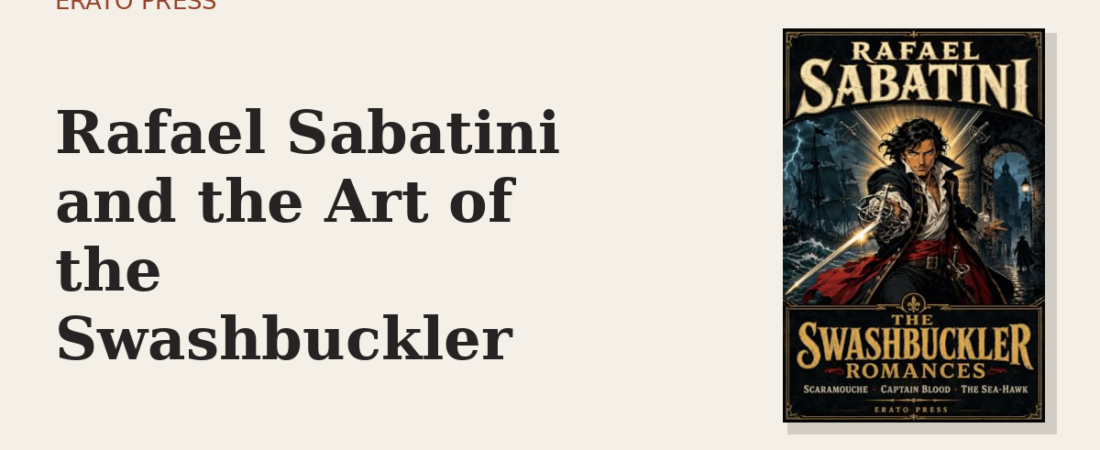
“He was born with a gift of laughter and a sense that the world was mad.” It is one of the great opening sentences in popular fiction, and it tells you almost everything about the writer who wrote it. Rafael Sabatini begins Scaramouche not with a sword or a chase but with a temperament, a man’s angle on existence, and only then does he turn that temperament loose on the French Revolution. This is the secret most people miss about the swashbuckler, the reason it looks easy and is not. The duels are the least of it. What holds the form together is character under pressure, wit as a survival tool, and a moral seriousness hiding inside the entertainment.

The argument of this piece is simple and, I think, undervalued: Sabatini is a far better writer than his genre’s reputation allows, and the adventure novel done at his level is one of the hardest things in fiction to pull off. The swashbuckler must move at speed and still make you care; it must deliver spectacle and still be about something. Sabatini, an Anglo-Italian who wrote in his fourth or fifth language, mastered that balance so completely that three of his books, Scaramouche, Captain Blood, and The Sea-Hawk, remain the standard against which the form is measured.
The form is harder than it looks
Consider what the swashbuckler has to do at once. It must keep a plot galloping forward, because momentum is the genre’s lifeblood, while also building a hero substantial enough that his peril matters. It must stage physical action, swordplay, sea battles, escapes, with enough clarity that the reader can follow the geometry of a fight, while never letting the choreography become an end in itself. And it must do all this in prose brisk enough not to slow the chase yet vivid enough to make a world. Most attempts at the form fail in one direction or the other: they are all incident and no person, a series of stunts performed by a mannequin, or they are so busy with character that the adventure stalls. Sabatini’s gift was to make the action arise from the character, so that the duels are never gratuitous. Andre-Louis Moreau learns to fence in Scaramouche not because the plot needs a swordsman but because a man who has seen his friend murdered by an aristocrat’s blade decides to turn himself into a weapon. The skill and the soul are the same story.
Scaramouche: the revolution as a personal education
Scaramouche is the best demonstration of how Sabatini smuggles seriousness into spectacle. Its hero begins as a detached ironist, a young lawyer of obscure birth who watches the gathering French Revolution with amused skepticism and a conviction that the men making it are mostly hypocrites, wealthy bourgeois talking of equality while the poor starve in the streets. Sabatini is genuinely interested in this, and the novel does not flinch from it: the revolution it portrays is not a pageant of noble idealists but a chaos of mobs, opportunists, and frightened aristocrats, in which a stuttering young firebrand named Desmoulins can set Paris alight with a leaf for a cockade, and the people who die first are always the people who had least to begin with.
What makes the book more than a costume drama is that the hero’s politics are forced to change by what happens to him. Andre-Louis begins by preaching ideas he does not fully believe, and is slowly compelled by grief and experience to believe them. He hides from the law inside a traveling theater company, taking the role of Scaramouche, the scheming clown of the old Italian comedy, and the mask becomes the man: the ironist learns to act, to move a crowd, to fight. Sabatini understood that the most satisfying adventure is also a story of self-transformation, and that the sword fight at the climax means nothing unless the reader has watched a soul change to make it possible. The laughter the famous first line promises is real, but it is laughter that has had to absorb a great deal of darkness to keep going.
Captain Blood and The Sea-Hawk: the wronged man remade
The same structure, the decent man driven by injustice to become something formidable, powers Sabatini’s two other masterpieces. Captain Blood takes a peaceable physician, condemned to slavery in the West Indies for the crime of treating a wounded rebel, and turns him into a buccaneer who is more honorable than the legal authorities who wronged him. The Sea-Hawk takes an English gentleman betrayed by his own brother, sold into the galleys, and remade as a corsair commander on the Barbary coast. In each case the pattern is the same: the law and the gentry are the true villains, and the hero’s outlawry is a higher form of justice. This is the moral engine that distinguishes Sabatini from the mere thriller. His heroes are not adventurers by temperament but by necessity; they are good men whom a corrupt order has forced outside itself, and their competence with a sword or a ship is the measure of what that order has cost them. The reader roots for them not because they win fights but because they are right.
The craft of the sentence at speed
It is worth pausing on the prose, because here is where Sabatini’s reputation has been most unfair to him. The swashbuckler is assumed to be carelessly written, but Sabatini’s sentences are built with real economy. He can sketch the paralyzed France of 1789, trade at a standstill, the proletariat starving while the substantial men talk of liberty, in a paragraph, and then drop you into a single human encounter on a crowded street, two enemies suddenly face to face in a streaming mob, with the focus of a film director. He knew when to pull back to the historical panorama and when to close in on a face, and the alternation is what gives his books their pace and their weight at once. The wit, too, is genuine wit, dry and quick, the verbal equivalent of swordplay, and it is no accident that his most memorable heroes are talkers as much as fighters. To write fast and well at the same time is rarer than it sounds, and Sabatini did it across a long career.
Frequently asked questions
Where should a new reader start with Sabatini?
Scaramouche is the natural entry point: it has the most famous opening, the richest historical backdrop, and the clearest example of Sabatini’s method of fusing adventure with self-transformation. From there, Captain Blood offers the purest pleasures of the pirate romance, and The Sea-Hawk the most sweeping, with its movement from Cornwall to the Mediterranean. The three together show the range of a writer too often reduced to a single mode.
Is Sabatini just a writer of escapism?
He is a writer of escapism in the best sense, but the escapism is built on a real argument about justice and a real eye for history. His heroes are driven outside the law by the law’s own corruption, and his revolutions and empires are observed with skepticism rather than swallowed whole. The pleasure of the adventure is genuine, and so is the seriousness underneath it; the two were never opposed in his hands.
Why has Sabatini’s reputation faded?
Partly the snobbery that dismisses popular fiction by definition, and partly the films, which fixed him in the public mind as a supplier of swordfights and swept the novels themselves out of view. But the books are richer than the movies, more political, wittier, and more interested in character. The fading is a failure of attention, not of the work.
The swashbuckler was perfected by a handful of writers, and it is illuminating to read Sabatini alongside the book that first taught the form how to thrill: Treasure Island: The Map That Invented the Pirate gave the adventure novel its map and its menace, and Sabatini took up that inheritance and added political weight and a grown-up wit. The Erato Press edition gathers the core public-domain Sabatini, the great swashbuckler romances together with his narrative histories, so that a reader can see the full shape of a writer who treated adventure as a serious craft. It is the collection that lets you watch a master at work rather than a movie’s idea of him.
Read the Erato Press edition →
Enjoyed this piece?
Get the next one — our essays on the classics and news of each new Erato Press edition — straight to your inbox.