Philosophy does not begin in the classroom. In Plato’s hands it erupts in a lateral space, between goblets and speeches, between the drunkenness of bodies and the sobriety of ideas — and nowhere more deliberately than in the Symposium, where the most searching thing the Greeks ever wrote about love takes place at a dinner party after a heavy night, among men nursing hangovers and agreeing, for once, to drink in moderation. The choice of setting is the first argument. To open a treatise on Eros not with a definition but with desire, not with sober sages but with guests whose feet are still dirty with the world, is to insist that the longing to understand love is itself a form of love. The Symposium begins not with the answer but with the wanting.

A drinking party that becomes a contest
The frame is almost novelistic. A group of Athenians — the playwright Agathon, celebrating a prize; the comic poet Aristophanes; the doctor Eryximachus; the young Phaedrus; Socrates, late as usual because he stopped to think on a neighbor’s porch — agree to spend the evening not in their usual hard drinking but in giving speeches, each in praise of Eros. What follows is not a chorus but a competition. Love is not celebrated in unison; it is dismembered, disputed, suspected, staged. Each speaker offers a different Eros, and Plato arranges them so that each both adds something true and reveals its own limit, building a ladder of arguments that the reader climbs without quite noticing the ascent.
This dramatic structure is the genius of the dialogue and the reason it never reads like a lecture. Phaedrus praises Love as the oldest of the gods and the spur to honor. Pausanias splits Eros into a common and a heavenly kind. Eryximachus, the physician, inflates love into a cosmic principle of harmony in all things. Each speech is partly persuasive and partly self-betraying — the doctor cannot help medicalizing the universe, the lawyerly Pausanias cannot help drawing distinctions that flatter his own attachments. Plato is showing us that how a person praises love reveals who they are.
Aristophanes and the myth of the divided selves
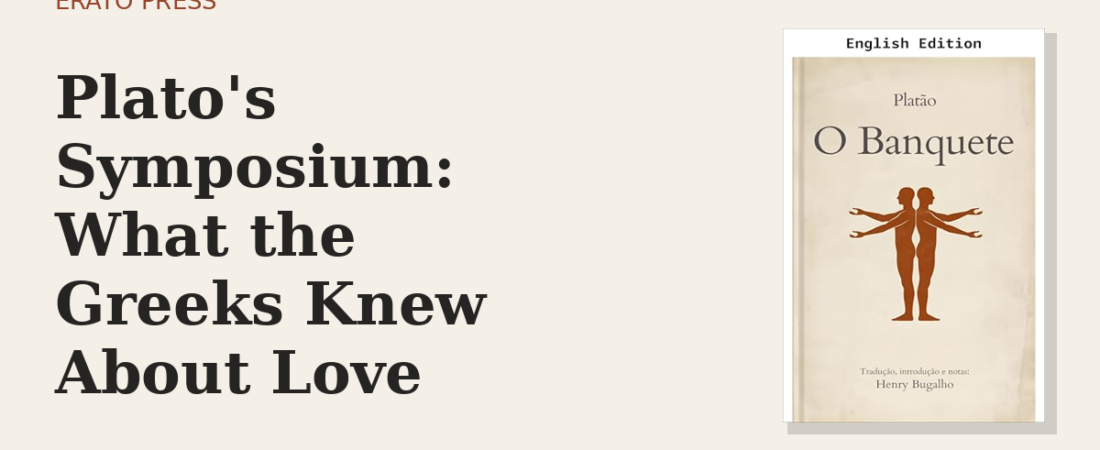
Then the comic poet stands up and delivers the most beloved speech in all of Plato. Aristophanes tells a myth: human beings were once round, doubled creatures with four arms, four legs, and two faces, so powerful that they threatened the gods. Zeus, rather than destroy them, sliced each in half — and ever since, each of us wanders the world as a severed portion of an original whole, aching to find our other half and be made complete again. Love, in this telling, is the name we give to the pursuit of wholeness, the desire to heal a wound we did not inflict and cannot remember receiving.
It is a comic fable and it is heartbreaking, which is exactly the combination Plato wanted from the mouth of a comedian. The myth explains the strange specificity of desire — why we feel that one particular person, and no other, restores something missing — and it explains love’s undertow of grief, the sense that even fulfillment is a recovery of something already lost. Twenty-four centuries later the image of the divided selves remains the most durable thing anyone has said about why we want each other. But Plato is not finished, and the speeches that follow will complicate Aristophanes’ beautiful answer rather than confirm it.
Diotima’s ladder and the redirection of desire
When Socrates’ turn comes, he refuses to praise Eros directly. Instead he reports a conversation with a priestess named Diotima, who taught him — he claims — everything he knows about love. Through her, Plato delivers the dialogue’s deepest and most demanding idea. Love is not a god but a daemon, a spirit between mortal and divine, the child of Resource and Poverty, forever lacking and forever reaching. And what it ultimately reaches for is not a person at all but Beauty itself.
Diotima describes an ascent that later readers named the ladder of love. One begins by loving a single beautiful body, then comes to love beautiful bodies in general, then the beauty of souls, then of laws and institutions, then of knowledge, until at the summit one beholds Beauty itself — eternal, unchanging, the form behind every lovely thing. It is a breathtaking vision and a troubling one, because it asks us to treat the beloved person as a rung, a step toward something higher and impersonal. Set Diotima beside Aristophanes and you have the dialogue’s central tension perfectly poised: the comedian says love seeks one irreplaceable other; the priestess says love uses that other to climb beyond all others. Plato does not resolve it. He leaves us on the ladder, looking up and looking back.
Alcibiades, or what philosophy cannot tidy away
Just when the dialogue threatens to ascend into pure abstraction, the door bursts open. Alcibiades — brilliant, beautiful, drunk, the most dazzling and dangerous figure in Athens — crashes the party and insists on praising not Love but Socrates. His speech drags everything back to earth. He recounts trying to seduce Socrates and being gently, devastatingly refused; he describes the philosopher’s ugliness and his maddening self-control, comparing him to the little carved figures that are plain outside and hold gods within. He is in love with Socrates and cannot have him, and his confession is raw where everyone else’s was polished.
The placement is masterful. After Diotima’s serene ascent toward Beauty itself, Plato gives us a real man wrecked by love for a particular person who will not be a rung on anyone’s ladder. Alcibiades embodies everything the philosophical ascent cannot absorb — jealousy, particularity, the body, the wound. The Symposium ends not with a conclusion but with this magnificent disruption, as if Plato wanted to guard his own highest idea against the suspicion that it has forgotten what love actually feels like. It does not conclude. It opens.
Why the Greeks staged love as an argument
It is worth standing back to notice what kind of object the Symposium is. The Greeks did not write love poetry here, or a moral handbook, or a how-to. They staged love as a debate — a series of incompatible accounts, each defended by a person whose temperament shapes the case he makes, with no narrator stepping in to declare a winner. This is itself a claim about love: that it cannot be captured in a single definition, that it looks different from the angle of the physician, the lawyer, the comedian, the priestess, and the wrecked young lover, and that the truth about it lives in the friction between those views rather than in any one of them. That is why the dialogue has never aged. Every generation finds its own preferred speech — the Romantics took Aristophanes, the mystics took Diotima — and every generation is partly right and partly caught in the same trap Plato set, of mistaking one true thing about love for the whole of it.
Frequently asked questions
Do I need to know philosophy to read the Symposium?
No. It is one of the most accessible doors into Plato precisely because it is built as a party with characters, jokes, drunkenness, and a gate-crasher. The speeches can be read as a sequence of vivid arguments about love, each spoken by a distinct personality, long before you worry about the metaphysics underneath.
What is the “ladder of love”?
It is the ascent Socrates attributes to the priestess Diotima: love begins with one beautiful body and rises, step by step, through beautiful bodies, souls, institutions, and knowledge, to the contemplation of Beauty itself. It is Plato’s most famous account of how erotic desire can become philosophical desire.
Why does Alcibiades show up at the end?
His drunken, jealous, intensely personal praise of Socrates pulls the dialogue back from abstraction to lived experience. He represents the particular, embodied love that the philosophical ascent risks leaving behind, and his intrusion keeps the Symposium honest about what love costs.
The Greeks knew that love is both the most ordinary thing and the strangest, and the Symposium remains the place where that double knowledge was first set down with comedy and rigor at once. The Erato Press edition offers a fresh translation with a preface that situates the banquet, the speeches, and the rivalry between Aristophanes’ myth and Diotima’s ascent. Readers drawn to how the Greeks turned the deepest human passions into stories will also find much in The House of Atreus: The Curse That Became Greek Tragedy, where love and its ruin take a darker, bloodier shape.
Read the Erato Press edition →
Enjoyed this piece?
Get the next one — our essays on the classics and news of each new Erato Press edition — straight to your inbox.