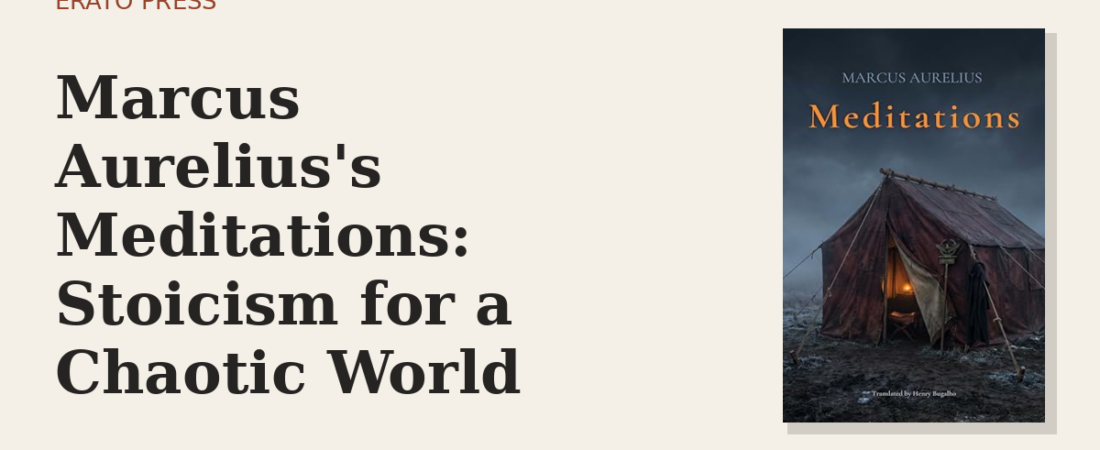
The book we call the Meditations has no title. Marcus Aurelius gave it none, because he never imagined anyone would read it. The Greek heading that has come down to us is Ta eis heauton — “to himself,” or “things to oneself” — and it is the single most important fact about the work. This is not a treatise, not a course of instruction, not a philosopher addressing posterity. It is the private notebook of an exhausted man, written in Greek, often at night, in army tents on the frozen Danube frontier, by an emperor trying to talk himself back into steadiness before the next morning’s duties. We are reading something we were never meant to see. That is why it survives the centuries when so much polished philosophy has gone dead on the page: it has the urgency of a man arguing with himself because the alternative is to come apart.

The circumstances matter. Marcus ruled from 161 to 180, and Cassius Dio, no flatterer, observed that he “did not meet with the good fortune that he deserved” — that his entire reign was a succession of wars, plagues, betrayals, and frontier emergencies. He spent more than a decade away from Rome, defending the empire against Germanic invasion. A plague swept through the legions and very likely killed him at last, at Vindobona, the city we now call Vienna. The Meditations were composed inside that chaos, not in a study with the door shut. When Marcus reminds himself that a man can be unshaken amid disorder, he is not theorizing. He is writing in the disorder, with the campfires outside the tent.
The accidental philosopher-king
The strangeness of the book deepens when you know who wrote it. Marcus Annius Verus was born in 121 into a wealthy provincial family of Spanish origin, the sort the empire was good at absorbing and elevating. His father died when he was three. As a boy he showed an inclination unusual for his class — he preferred books to games, philosophers to the arena — and the aging emperor Hadrian noticed it, nicknaming him half in jest Verissimus, “the most truthful.” Then Hadrian arranged the succession in such a way that the boy who dreamed of philosophy was drafted, at seventeen, into the machinery of absolute power. He would carry both things for the rest of his life: the temperament of a man who wanted to retire into thought, and the obligations of a man who could never lay down the weight of an empire.
This is the productive tension behind every entry. Plato had imagined the philosopher-king as a thought experiment; Marcus is the rare case of the experiment actually run, and the Meditations are the lab notes. They are full of the friction between the ideal and the job — reminders to deal patiently with stupid and ungrateful men because he will meet them every day, reminders not to be “Caesarified,” not to let the purple stain his soul. The historical record bears out that he tried. He sold palace treasures to finance his wars rather than raise taxes on the provinces; he pardoned the family of a general who had risen in revolt against him. The philosophy was not decoration. He was attempting, daily and imperfectly, to govern as the notebook told him to.
What Stoicism actually asks of you
It is worth clearing away the modern caricature. “Stoic,” in everyday English, has come to mean unfeeling, gritted-teeth, the suppression of emotion. That is nearly the opposite of what the school taught. Stoicism is a philosophy of judgment, not numbness. Its central claim is that we are disturbed not by events but by our opinions about events — that between what happens to us and our suffering there is always an act of interpretation, and that this act is the one thing fully within our power. The Stoic does not refuse to feel; he refuses to let his peace be hostage to things he cannot control.
Marcus learned this not chiefly from the famous Greek founders but, by his own account, from Epictetus — and the source is itself instructive. Epictetus had been a slave. The man who taught an emperor how to be free was someone who had been literally owned, who knew from the inside that the body can be in chains while the mind that judges remains its own master. That lineage runs straight through the Meditations. When Marcus tells himself that no one can harm his ruling faculty without his consent, he is repeating a lesson he received from a former slave, and the irony is the whole point: inner freedom is available to the powerless and the all-powerful alike, because it depends on nothing external at all.
The dichotomy of control, and why it endures
The engine of the book, the idea readers in trouble keep coming back for, is what the Stoics called the dichotomy of control. Some things are up to us — our judgments, our intentions, our responses, the character we choose to bring to a situation. Most things are not — our reputation, our health, the behavior of other people, the time and manner of our death. Misery, on this view, is the predictable result of investing our happiness in the second category. Serenity comes from withdrawing our demands from what we cannot govern and concentrating our entire effort on what we can.
Marcus applies this relentlessly to himself, and the applications are bracing because they are aimed inward, never preached at an audience. He rehearses, again and again, the brevity of life and the smallness of fame: the people whose praise you crave will soon be dead, and so will the people who remember them, and so will you, and the whole transaction will vanish like smoke. He practices the deliberate stripping of grandeur from impressive things — rich food is the corpse of a fish, the purple robe is wool dyed with shellfish blood — not out of cynicism but to break the spell that external goods cast over the judging mind. And he returns, each morning, to the day’s first task: get up and do the work of a human being, because that is what you were made for, and the discomfort of the cold bed is not a reason. This is the discipline of a man who has every excuse for self-pity and refuses it.
A handbook for a chaotic world, with an honest caveat
The reason the Meditations have surged back into popularity in our anxious century is not hard to see. Here is a practical, non-dogmatic, intensely usable method for staying upright when the world is unstable — a philosophy that asks for no belief in any particular god, demands no ritual, and offers instead a set of mental exercises you can run at three in the morning. The advice is portable and durable precisely because it was forged for a man whose external life was a continuous emergency. If it held him together on a war frontier during a plague, it can do something for the rest of us.
But honesty requires a caveat, and the best editions make it. There is a risk in turning Marcus into a productivity guru, a dispenser of detachable maxims for the office and the gym. The book resists that flattening. It is repetitive because he needed the repetition; it is sometimes bleak; it circles obsessively around death because death was always near. Read whole, in sequence, it is less a collection of slogans than the record of a real human being failing and trying again, night after night, to be the person his philosophy described. The maxims are not marble. They are the visible scars of an interior struggle, and that struggle, not the polish, is what makes them worth keeping.
Frequently asked questions
Were the Meditations written for publication?
No, and this is the key to reading them well. Marcus wrote them as private self-counsel, addressed “to himself,” with no expectation of any reader. The Greek title means roughly “things to oneself.” Their survival was a matter of chance. The absence of an audience is exactly what gives the entries their raw, unguarded force.
Do I need to know Stoic philosophy to read it?
No. The Meditations assume the doctrines rather than expound them, which can be disorienting at first, but the core ideas — the dichotomy of control, the priority of judgment over circumstance, the practice of accepting what cannot be changed — come through clearly in the entries themselves. A good edition supplies the background, but Marcus’s own voice does most of the work.
Why does Marcus keep repeating himself?
Because the book is a spiritual exercise, not an argument. Marcus returns to the same themes — mortality, patience with difficult people, indifference to fame — because he was using writing as a discipline, re-grooving the same habits of mind that daily life kept eroding. The repetition is the method. He was not composing a treatise; he was keeping himself in training.
The right edition treats the Meditations as what they are — not embalmed wisdom but the living notebook of an exhausted man trying not to lose himself — and renders the Greek into language you can actually hear rather than reverential archaism. The Erato Press text, translated directly from the Greek and framed with the full story of the man behind the book, restores that immediacy.
Read the Erato Press edition →
and sit with the emperor in his tent, where the philosophy was first written down for an audience of one.Enjoyed this piece?
Get the next one — our essays on the classics and news of each new Erato Press edition — straight to your inbox.