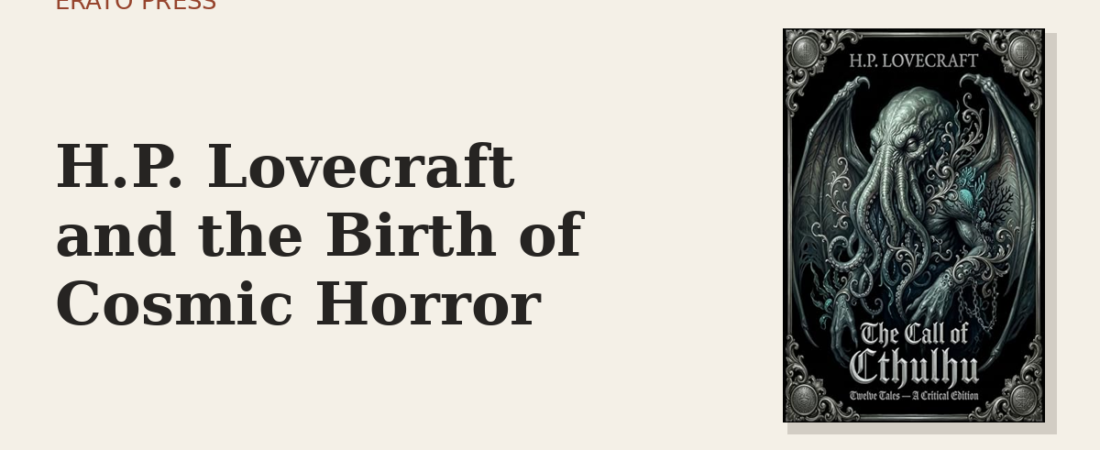
Most horror flatters us. It assumes that human beings matter enough to be worth tormenting — that there is a vengeful ghost who cares about us, a devil who wants our soul, a killer who has chosen this house. H.P. Lovecraft did something no one had quite done before: he removed the human from the center of the cosmos and let the horror follow from that single subtraction. His monsters do not hate us. They do not notice us. The terror in his best stories is not that something monstrous wants to destroy you but that the universe is vast, ancient, and utterly indifferent, governed by forces beside which the whole human story is an accident too brief and too small to register. He called the feeling “cosmic fear,” and in inventing a fiction to carry it he founded a genre that has outlived almost everything else the pulp magazines produced.

What cosmic horror actually is
The conventional ghost story works by intrusion: the supernatural breaks into the ordinary world and threatens a person who matters to it. Lovecraft inverted the proportions. In his fiction the “ordinary world” is the intrusion — a thin, recent crust of human civilization spread over a planet and a cosmos that were here long before us and will be here long after, populated by entities so old and so large that to them we are less than insects. The dread does not come from being hunted. It comes from learning the truth about your own scale. His narrators are typically scholars, antiquarians, scientists — rational men who pride themselves on knowledge — and what destroys them is precisely knowledge: a forbidden book, a buried city, a star-spawned thing glimpsed at the bottom of the sea. To understand the universe correctly, in Lovecraft, is to go mad, because a sane mind cannot hold the fact of its own insignificance and survive intact.
This is why his method depends so heavily on what it withholds. The famous monsters — Cthulhu sleeping in drowned R’lyeh, the shoggoths, the Colour that falls from the sky — are most effective when half-described, glimpsed at the edge of comprehension, named but never fully shown. Lovecraft understood, as the best weird writers always have, that the unseen and the barely-grasped frighten more than the explicit. He inherited that lesson from the strain of weird fiction whose roots run back through The King in Yellow, and he pushed it further than anyone before him: not the merely uncanny, but the cosmically annihilating, the suggestion that reality itself is a trap door over an abyss.
Providence, and the wound that made the work
It is impossible to understand Lovecraft’s fiction without understanding the displacement at the root of his life. He was born in 1890 in Providence, Rhode Island, into a family that traced itself back to colonial New England and lived in a grand house on Angell Street, surrounded by an inherited library and the weight of ancestral expectation. That world fell apart in stages, each one a descent. His father was committed to an asylum when the boy was three and died there of what was almost certainly tertiary syphilis — a fact that would haunt Lovecraft’s lifelong horror of the diseased and decaying body. His grandfather, the source of the family’s resources and the keeper of that beloved library, died when Lovecraft was fourteen, and the family was forced out of the ancestral mansion into smaller quarters. He experienced this as an expulsion from paradise, a literal fall from the house of his imagination.
Then his mother, too, was committed to the same asylum that had taken his father, and died there. Both parents lost to the same institution: the symmetry is too cruel to be anything but formative. Lovecraft spent years as a near-recluse, failed to graduate from high school after a breakdown, and built, in his enforced solitude, the intellectual machinery that would later support his stories — a deep reading in astronomy, ancient history, and science, and a worldview already tilted toward pessimism and the conviction that the present was a degraded version of a lost past. The decaying mansions, the buried colonial history, the sense of a grand inheritance corrupted and intruded upon — all of it is Providence, transmuted. His fiction is a form of excavation: digging beneath the New England he had lost to find out what horror lay underneath.
The racism problem, faced directly
There is no honest way to write about Lovecraft without confronting his racism, and any edition that tries to look past it does the reader a disservice. He was not merely a man of his time absorbing common prejudices. His private letters express a virulent, obsessive xenophobia and anti-Semitism that exceeded even the casual bigotry of his era, and this hatred is not confined to the correspondence. It surfaces in the fiction. Stories written during his miserable years in New York — “He” and “The Horror at Red Hook” — turn the immigrant neighborhoods of the city into landscapes of cosmic revulsion, where racial and cultural mixing is rendered as a kind of contamination. The fear of the alien that powers his greatest work is, at its root, entangled with a literal fear of other human beings.
The paradoxes are real and worth sitting with rather than resolving. The same man married Sonia Greene, a Ukrainian-Jewish immigrant woman who embodied two of the categories his letters despised — evidence of a human capacity for connection that ran ahead of his ideology and never reconciled with it. In 2015 the World Fantasy Award retired its trophy, a bust modeled on his face, in acknowledgment of all this. The right response for a serious reader is neither to excuse the bigotry nor to refuse the books. It is to read with both eyes open: to recognize that the very engine of Lovecraft’s genius — his terror of the foreign, the contaminating, the boundary-crossing — is inseparable from the prejudice that disfigures him, and that understanding the fiction means understanding that entanglement, not pretending it away.
The mature work, and why it lasts
The remarkable thing is that Lovecraft wrote his masterpieces in poverty and obscurity, in the last decade of a life that ended in 1937 with intestinal cancer at forty-six. Returning to Providence alone after his marriage collapsed, he produced the stories that made him: “The Call of Cthulhu,” “The Colour Out of Space,” “The Dunwich Horror,” “At the Mountains of Madness,” “The Shadow over Innsmouth.” These are the works in which his conceptual innovations reached maturity — the architecture of cosmic dread, the slow layered discovery of a hidden reality beneath the visible one, the deliberate withholding of full knowledge so that the reader’s own imagination supplies the worst. “The Colour Out of Space,” which Lovecraft considered his best, is the purest example: a thing from space that is not a creature at all but a wrongness in the spectrum of light, a contamination that drains the color and life from everything it touches, explicable by no science and stoppable by no human act.
He died near-penniless, his work scattered across pulp magazines, his reputation held by a small circle of correspondents — he wrote an estimated hundred thousand letters, many of them long essays on craft and philosophy, and through them he became the intellectual center of a movement he had helped invent. After his death, two of those younger admirers founded a press specifically to collect his work, and the long labor of canonization began. The line of his influence runs straight through Stephen King, Guillermo del Toro, Thomas Ligotti, and Jeff VanderMeer; the word “Lovecraftian” now names an entire mode of dread that needs no further explanation. A failed, frightened, bigoted recluse who could not hold an ordinary job invented the horror of the modern, scientific universe — the fear appropriate to a species that has learned how small and how recent it really is.
Frequently asked questions
Where should a new reader start?
Begin with “The Call of Cthulhu,” which assembles the core of his method in a single story — the fragmentary documents, the scholar piecing together a truth he would rather not know, the monstrous entity glimpsed and survived but never escaped. Then “The Colour Out of Space” for the purest distillation of cosmic dread, and “The Shadow over Innsmouth” for the slow horror of tainted inheritance. Save the longer works, “At the Mountains of Madness” and “The Case of Charles Dexter Ward,” until the method has its hooks in you.
Is Lovecraft’s prose actually good?
It is uneven, and honest admirers admit it. He overuses words like “eldritch,” “cyclopean,” and “unnamable,” and his sentences can pile adjectives where restraint would serve better. But the architecture beneath the style is masterly — the pacing of revelation, the management of what is shown and withheld, the building of dread through accumulating documentary detail. Read him for the structure and the ideas, and the purple patches become a tic you forgive rather than a flaw that ruins.
Do I need to read his stories in order?
No. Lovecraft built a loosely shared mythology — recurring names, books, and places — but each major story stands on its own, and he never imposed strict continuity. The recurrences reward the returning reader with a sense of a coherent buried world, but no single story depends on having read another. Start anywhere among the central works and let the connections accumulate.
Lovecraft demands a reader who can hold the achievement and the bigotry in the same hand, and that is exactly the reader a thoughtful edition should serve. Our Erato Press volume gathers the essential stories in reliable texts and frames them with a candid account of the man — the Providence that shaped him, the displacement that fed the fiction, and the racism that no serious reading can set aside. and stand, with his doomed scholars, at the edge of an indifferent universe.
Enjoyed this piece?
Get the next one — our essays on the classics and news of each new Erato Press edition — straight to your inbox.