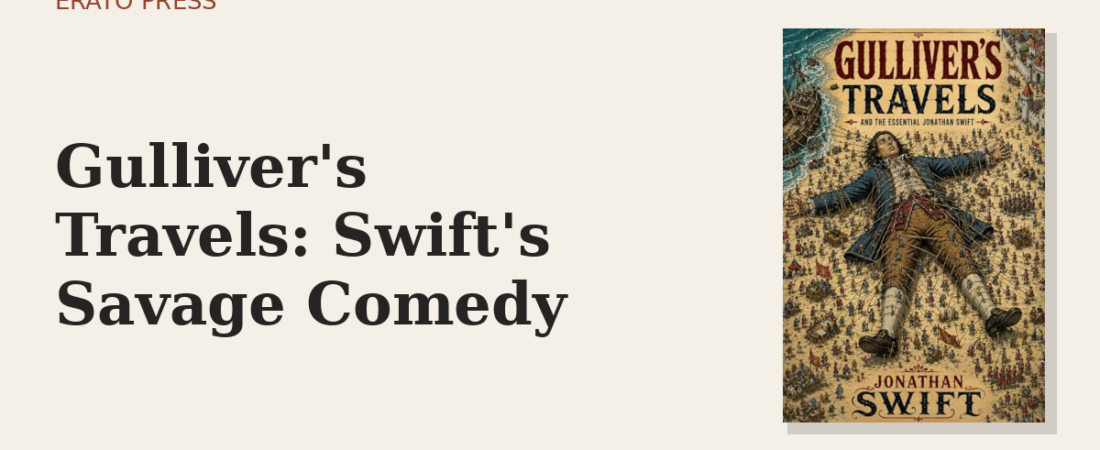
There is a particular cruelty in what publishing did to Gulliver’s Travels. We handed it to children. We made it a wall decoration, a nursery frieze of a giant pinned down by tiny men, and in doing so we performed the exact operation Swift spent his life warning against: we took something designed to wound and sanded it into something soothing. The book that survives in the popular imagination is a charming travelogue of size. The book Jonathan Swift actually wrote in 1726 is one of the angriest documents in the English language, a sustained assault on the proposition that the human animal deserves the dignity it claims for itself.

That is the thesis worth holding onto as you read: Gulliver’s Travels is not a fantasy with a satirical seasoning. It is satire all the way down, and its true subject is not Lilliput or Brobdingnag but you. The genius of the structure is that it lets you laugh comfortably for three voyages before it turns the knife in the fourth, and by then you have already agreed to its terms.
The miniature and the magnified are the same argument
The first two voyages work as a matched pair, and reading them together reveals how methodical Swift is beneath the apparent whimsy. In Lilliput, Gulliver is enormous, and from that height the politics of the little people look absurd: the empire convulsed by a war over which end of an egg to crack, the high offices distributed by competitive rope-dancing, the deadly factional hatred between those who wear high heels and those who wear low. We laugh because the stakes are so visibly trivial relative to the passion expended on them. Then Swift performs the reversal. In Brobdingnag, Gulliver is the tiny one, and now it is his civilization being held up to a magnifying lens. He boasts to the king of giants about England’s gunpowder, its parliamentary maneuvering, its wars and its law courts, expecting admiration, and the king delivers the verdict that is the moral center of the whole book: that the bulk of Gulliver’s countrymen are “the most pernicious race of little odious vermin that nature ever suffered to crawl upon the surface of the earth.”
The trick is that nothing has changed except the scale. Lilliputian politics looked ridiculous because we saw them from above; English politics looks ridiculous because the giant sees it the same way. Swift is teaching the reader to perform the act of estrangement on himself, to recognize that our own egg-wars only seem important because we are standing too close to them.
The third voyage and the comedy of useless intellect
The voyage to Laputa is the one readers skip, and that is a mistake, because it is where Swift turns his contempt on a target he understood from the inside: the modern intellectual. The floating island of abstracted philosophers, so lost in mathematics and music that servants must rouse them with bladders to remind them to speak or listen, is a portrait of reason divorced from use. Down on the ground, the Academy of Lagado houses projectors extracting sunbeams from cucumbers and trying to build houses from the roof down. Swift, who watched the Royal Society and its enthusiasms with a jaundiced eye, is not against knowledge. He is against the particular vanity of intellect that has lost contact with the ordinary work of keeping people fed and housed. The Struldbrugs, the immortals who do not stay young but simply age forever into miserable senility, deliver the same lesson in another key: the thing we think we want, eternal life, is a horror once you actually inspect it. The third voyage is where Swift establishes that his pessimism is not casual misanthropy but a worked-out skepticism about human improvement schemes.
The Houyhnhnms, the Yahoos, and the trap Swift sets
Then comes the fourth voyage, and here the comedy goes savage. Gulliver lands in a country governed by the Houyhnhnms, rational horses who live by reason so completely that they have no word for lying, only for “the thing which is not.” Sharing their land are the Yahoos: filthy, greedy, lustful, brawling creatures who hoard shiny stones and fling their own excrement. Gulliver slowly, sickeningly, realizes that the Yahoos are human beings. They are us, seen without flattery, stripped of the clothing and manners that let us pretend to be something nobler.
What makes the fourth voyage one of the great unresolved problems of English literature is that Swift refuses to let the reader off in either direction. Gulliver becomes a convert to the Houyhnhnm view, comes to loathe humanity so totally that on his return he cannot bear the smell of his own wife and prefers the company of his horses in the stable. He goes mad with disgust. And here the reader must decide: is Gulliver right, or has Swift made him a fool? The Houyhnhnms’ cold, passionless reason is itself a kind of inhumanity; their utopia has no love in it, no art, no forgiveness. Swift will not tell you whether to side with the rational horses or the filthy Yahoos, and that withholding is the point. The misanthropy on the page belongs to Gulliver. What belongs to Swift is the harder thing: a refusal to grant that we are as reasonable as we flatter ourselves, paired with a refusal to pretend that pure reason would save us.
The Modest Proposal logic running underneath
To understand the engine of Swift’s satire, set Gulliver beside the essay he published a few years later, A Modest Proposal, in which a reasonable-sounding economist suggests that the Irish poor sell their infants as food for the tables of the rich. The horror of that piece comes not from savagery but from its flawless courtesy. Every sentence is calm, statistical, humane in tone. Swift’s method is to adopt the voice of perfect rationality and follow it, without flinching, to a monstrous conclusion, so that the reader recoils and in recoiling locates the monstrousness already present in the “reasonable” attitudes the satire only extends. That same logic runs all through Gulliver. Gulliver narrates atrocities, gunpowder and disembowelment and judicial murder, in the bland, helpful tone of a man explaining his country’s customs to a foreigner. The flatness is the weapon. Swift makes you supply the outrage yourself, which means you cannot disown it.
Why the craft matters as much as the rage
It would be easy to leave Swift as a great hater, but that would miss what makes the book endure rather than merely sting. The misanthropy is held inside an almost unbelievable control of voice. Gulliver is a perfectly calibrated narrator: credulous, literal, vain about his accuracy, the kind of man who gives you exact measurements of everything and notices nothing about himself. Swift sustains that voice across four voyages without ever winking, which is why the satire keeps ambushing readers three centuries on. The book never tells you it is angry. It simply arranges the evidence and lets the reasonable little man recite it, and the result is funnier, and crueler, than any direct denunciation could be. Comedy is the delivery system; the payload is despair about the species, administered in a tone of perfect helpfulness.
Frequently asked questions
Is Gulliver’s Travels a children’s book?
Only by accident of marketing. The first two voyages can be enjoyed by children as adventures of scale, which is why they were extracted and abridged into a nursery favorite. But the complete book is a work of adult political and philosophical satire, and the fourth voyage in particular is a meditation on human degradation that has unsettled grown readers for three hundred years. Reading only the Lilliput section is like knowing a symphony from its opening bars.
Did Swift actually hate humanity?
His famous line to Alexander Pope is the best gloss: he loved individuals, John and Peter and Thomas, but hated “that animal called man” in the abstract. The misanthropy in the book is real but precise. It is aimed at human pride, at our conviction that we are reasonable creatures, rather than at the warm particulars of actual people. Swift was a working clergyman and a fierce defender of the Irish poor; the rage and the conscience were the same faculty.
Why is the fourth voyage so controversial?
Because Swift refuses to resolve it. Gulliver ends up preferring horses to people, mad with disgust at his own kind, and the reader cannot be sure whether to admire his clarity or pity his madness. Critics have argued for centuries about whether the Houyhnhnms represent Swift’s ideal or a sterile parody of one. The ambiguity is deliberate, and it is what keeps the voyage alive as a question rather than a lesson.
This is a book that punishes the abridged edition and rewards the complete one, where the four voyages can do their cumulative work and the reader can feel the floor tilt in the fourth. The Erato Press edition restores Gulliver whole, with the savage logic intact and an apparatus that situates Swift’s anger in its political moment without explaining it away. It is the version that lets the fourth voyage do its work, the version that treats the reader as the adult Swift was writing for.
Read the Erato Press edition →
Enjoyed this piece?
Get the next one — our essays on the classics and news of each new Erato Press edition — straight to your inbox.