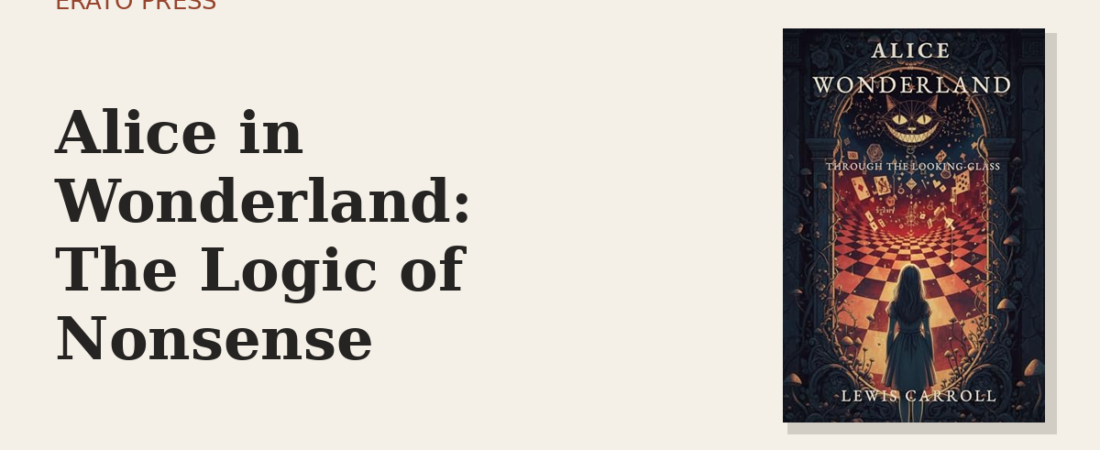
On a golden afternoon in July 1862, a shy Oxford mathematics don named Charles Lutwidge Dodgson took the three young daughters of the college dean rowing on the Thames and, to pass the time, improvised a story about a girl who falls down a rabbit-hole. One of the girls, Alice Liddell, asked him to write it down. Three years later, under the pseudonym Lewis Carroll, the story reached the public as Alice’s Adventures in Wonderland, and English literature acquired a book that has never sat comfortably in any category we have for it. It is read as a children’s classic and as a coded autobiography, as light verse and as a treatise on logic, as a Victorian curio and as a proto-Surrealist masterpiece. The one reading the book actively resists is the one most often imposed on it — that it is mere whimsy, charming chaos, delightful nonsense in the sense of nothing in particular. Alice is nonsense, but nonsense of a peculiarly rigorous kind. Its absurdities are not the absence of logic. They are logic taken at its word and pushed until it breaks.

That is the thesis worth holding onto: Carroll was a working mathematician and logician, and Wonderland is a place where the rules of sense are not suspended but obeyed too literally, too faithfully, with a precision that produces the uncanny. The book is funny the way a flawless syllogism with an insane premise is funny. To read it as a dream of disorder is to miss that almost every joke is a joke about order — about language, number, and rule turning on the user who trusted them.
The mathematician at play
Dodgson lectured in mathematics at Christ Church for twenty-six years and published, under his own name, works on geometry, algebraic determinants, and symbolic logic. This is not a biographical footnote; it is the key to the book’s machinery. Consider Alice’s anxious arithmetic as she falls: “four times five is twelve, and four times six is thirteen, and four times seven is — oh dear! I shall never get to twenty at that rate!” The line reads as childish confusion, but it is a genuine mathematical curiosity — the multiplication works if you carry it through progressively higher number bases (4×5 in base 18, 4×6 in base 21, and so on), and the sequence indeed never reaches twenty. Carroll has hidden a real numerical pattern inside a girl’s panic. Wonderland is full of such buried structures: the Caucus-race with no rules and no finish, in which everyone wins and all must have prizes, is a small comic essay on the arbitrariness of competition; the Mad Hatter’s stopped watch and endless tea-time stage a puzzle about time and periodicity.
The deepest of these games concern logic itself. The Cheshire Cat’s casual proof that everyone in Wonderland is mad proceeds by impeccable steps from a daft definition. The Caterpillar’s interrogation — “Who are you?” — is a problem in identity and reference that would not be out of place in a seminar on the philosophy of language. Carroll, who would later write the celebrated logical paradox “What the Tortoise Said to Achilles,” was fascinated by the points where formal reasoning eats its own tail, and Wonderland is a landscape assembled out of those points. The nonsense is the residue of logic run without the governor of common sense to stop it.
The trouble with words
If number is one of the book’s obsessions, language is the other, and here the comedy is sharpest. Wonderland is a country where words refuse to behave — where metaphors are taken literally, where puns acquire the force of physical law, where a name is mistaken for the thing it names. When the Mouse offers to tell its “tale,” Alice pictures the creature’s actual tail and the text obligingly prints the story in the shape of one. When the March Hare advises Alice to “say what she means,” she protests that she means what she says, and is briskly informed that the two are not at all the same thing — “you might just as well say that ‘I see what I eat’ is the same thing as ‘I eat what I see’!” The exchange is a lesson in the non-commutativity of meaning, delivered as table talk.
This reaches its peak across the looking-glass, in Humpty Dumpty’s notorious doctrine that a word means “just what I choose it to mean — neither more nor less,” and that the only question is “which is to be master.” It is one of the most quoted passages in the philosophy of language for good reason: it dramatizes the problem of whether meaning is a private decision or a public convention, the very problem that would occupy professional philosophers a century later. Carroll’s children’s books keep stumbling onto the foundational questions of twentieth-century thought because Carroll was, in his day job, circling the same questions. Wonderland is what happens when you let a logician’s worries loose in a nursery.
The architecture of the dream
And yet the book is not a textbook, and its strangeness is more than a series of clever puzzles. The reason the logic-games land as enchantment rather than exercise is that Carroll wrapped them in the structure of a dream — and got the structure exactly right, decades before Freud made dream-logic a subject of study. Wonderland obeys the rules of sleep: scenes dissolve into one another without transition, characters transform and recur, the dreamer’s own body swells and shrinks beyond her control, urgency and meaning are everywhere and nothing can be pinned down. Alice spends the book trying to impose order on a world that keeps changing the rules, which is precisely the experience of dreaming, and precisely the experience of being a small child among baffling adults. The two great anxieties of childhood — that the body is unreliable and that grown-up rules are arbitrary — are rendered with a fidelity no realistic children’s book of the period came near.
The frame seals it. Both books end by waking Alice and gently dispelling the marvels, and the second closes on a question — “Life, what is it but a dream?” — that lets the whole edifice resonate beyond the nursery. The dream-structure is what saves the logic from dryness: it gives the puzzles emotional weight, the genuine vertigo of a self that cannot find stable ground. This is why Alice reads as profound to adults and as thrilling to children. The same machinery serves both.
Resisting the drug reading
No account of Alice‘s afterlife can avoid the cloud that drifted over it in the 1960s, when the shrinking and growing, the mushroom, the hookah-smoking Caterpillar, and a certain rock song persuaded a generation that the book was a coded psychedelic trip. It is worth saying plainly: there is no evidence for it, and the reading misunderstands both the man and the era. Dodgson was a fastidious, conventional Victorian clergyman and don; the “eat me, drink me” transformations belong to the long tradition of fairy-tale enchantment and to the documented physical sensations of childhood, not to a pharmacology that the 1860s reader would not have recognized in those terms. The mushroom comes from a real interest in mycology, the hookah from the period’s fashion for the Oriental and exotic. To file Alice under drug literature is to swap the book’s actual, harder achievement — a logician’s dream rendered with mathematical care — for a lazier and more flattering anachronism. The wonder of Wonderland needs no chemistry. It is made of grammar and number, which are stranger.
Frequently asked questions
Is Alice in Wonderland really a children’s book, or is it for adults?
It was written for a specific child and works completely as a children’s story — fast, funny, full of memorable creatures. But Carroll built it on logical and linguistic puzzles that reward an adult’s attention, and the dream-structure carries an emotional charge that grows richer with age. It is one of the rare books that does not condescend to its young readers and does not exhaust its older ones. The two audiences are reading different layers of the same text.
Do I need to understand the mathematics to enjoy it?
Not at all. The jokes work as comedy whether or not you spot the number-base puzzle inside Alice’s multiplication or the logic inside the Cheshire Cat’s proof. But knowing that the nonsense is engineered — that Carroll the mathematician built these absurdities on real structures — changes the book from a charming muddle into something far more deliberate and strange, and makes a re-read genuinely different from a first read.
Should I read Through the Looking-Glass too?
Yes, and ideally together. The second book (1871) is in some ways the more cunningly built of the two: where Wonderland runs on the logic of a pack of cards, the sequel is structured as a chess game, with Alice advancing across the board to become a queen, and it contains Carroll’s sharpest writing on language, including the Humpty Dumpty exchange and the magnificent nonsense poem “Jabberwocky.” The two books are companion experiments in the same project.
Our edition brings the Alice books together with the apparatus a modern reader needs to catch what a clever Victorian child would have caught and what only a logician’s afternoon could have planted — the parodied poems restored to their originals, the mathematical jokes unpacked, the dream-architecture traced. The illustrations, the wordplay, and the buried structures all come into focus at once.
Read the Erato Press edition →
and discover how much rigor it takes to write convincing nonsense.Enjoyed this piece?
Get the next one — our essays on the classics and news of each new Erato Press edition — straight to your inbox.