For a century and a half the verdict on Anne Brontë held firm: she was the quiet one, the lesser sister, the third Brontë who never quite reached the heat of Charlotte or the visionary strangeness of Emily. It is one of the most durable misjudgments in English literary history, and it is exactly backwards. The thesis of this essay is that Anne, in The Tenant of Wildfell Hall (1848), wrote the most radical novel any of the three sisters produced — more radical than Jane Eyre, more radical even than Wuthering Heights — because she insisted, plainly and without flinching, on something Victorian fiction had been built to deny: that a woman has the right to leave her husband, even a man she chose and married, when that marriage is destroying her and her child.

The novel that frightened its own century
The Tenant of Wildfell Hall opens with a mystery. A young widow, Helen Graham, arrives with her small son to take up residence in the half-ruined Wildfell Hall, an old house set apart from the local society, and her refusal to explain herself sets the neighborhood gossiping. The house itself is the novel’s first statement of intent — isolated, austere, governed by its own rules, it is the physical manifestation of Helen’s moral independence, a place where she has withdrawn precisely because she will no longer live by the world’s terms. When the truth emerges, it is not what scandal supposes. Helen is no fallen woman. She is a wife in hiding, who has fled a marriage with her child rather than let the boy be raised in his father’s image.
That premise was incendiary in 1848. A married woman in England had, at that date, almost no legal existence separate from her husband; she could not easily divorce him, could not reliably keep her own earnings, and had no automatic right to her own children, who belonged in law to the father. For Helen to take her son and run was, by the standards of the day, not heroism but a crime against the natural order. Charlotte Brontë herself was uneasy about the book and later suppressed its republication, calling the choice of subject “an entire mistake.” It was not a mistake. It was the boldest thing a Brontë ever did.
Arthur Huntingdon and the anatomy of ruin
What gives the novel its terrible authority is the portrait of the husband Helen flees. Arthur Huntingdon is not a Gothic villain in the mode of a Heathcliff or a Rochester; he is something far more recognizable and harder to bear — a charming, weak, self-indulgent man who drinks himself into degradation and drags his household down with him. Anne knew this material intimately. Her brother Branwell, the family’s bright hope, had collapsed into alcoholism and opium, and Anne had watched at close range what addiction does to a household: the broken promises, the maudlin self-pity, the cruelty alternating with remorse, the slow corruption of everyone forced to live in proximity to it. She put what she saw on the page with a clinical honesty that no other novelist of the period attempted. The dinner parties that curdle into drunkenness, the corruption of the young son as his father teaches him to swear and to swallow wine, the steady erosion of Helen’s hope — these are not melodrama. They are reportage, and they sting.
This is Anne’s signature method: she refuses easy moral judgment while refusing equally to look away. She lets us understand Huntingdon — his weakness, his charm, the boredom and vanity that drive him — without ever asking us to excuse him. Where Charlotte’s novels set up a clear moral framework that tells the reader how to feel, Anne withholds that comfort. She insists on seeing her people whole, in all their contradiction, and trusts the reader to draw the conclusion that understanding does not require approval. To understand Arthur is not to forgive him; it is to grasp, precisely, why a woman would be right to leave him.
The diary, the letters, and the right to one’s own story
The novel’s structure is not decorative; it is the argument made into form. The Tenant of Wildfell Hall is a narrative within a narrative. The outer frame belongs to Gilbert Markham, the young farmer who falls for the mysterious widow, but at the novel’s heart Anne hands the telling directly to Helen, in the form of the diary she keeps through the years of her marriage. This matters enormously. By giving Helen her own diary, Anne lets a woman narrate the interior of a bad marriage from the inside, in her own voice, unmediated by a man’s interpretation. The reader does not hear about Helen’s suffering secondhand; the reader lives it day by day, as Helen recorded it, watching her illusions fall away one at a time. The form guarantees that Helen owns her story. A Victorian woman might be denied her property, her children, and her legal personhood, but Anne gives her, at least, the absolute authority over her own account of what happened to her.
The boldest sister, reconsidered
Why, then, the long demotion? Partly the suppression by Charlotte; partly the sheer discomfort of the subject, which fit no comfortable Victorian category. But mostly, I think, because Anne’s radicalism is quiet. She does not rage on the moor or burn down the house. She observes, with a cool moral clarity that can read as coldness until you notice how much steel is in it. Her restraint is not timidity; it is a deliberate artistic choice that let her see and say things her more obviously passionate sisters could not quite reach. Where Emily pushed the family’s materials toward myth and Charlotte toward the architecture of desire, Anne pushed them toward the law — toward the actual conditions of a woman’s life and the actual question of what she may do when those conditions become unbearable. Read against her sisters, as she ought to be read, Anne completes the family argument; we make exactly that case in The Brontë Sisters: One Family, Seven Novels, and a Myth. The three of them were writing at once, in the same rooms, against the same horizon, and Anne’s answer to the family’s shared questions is the most practical and the most dangerous of the three.
Frequently asked questions
Why is The Tenant of Wildfell Hall considered so radical?
Because it defends a married woman’s right to leave a destructive husband and to take her child with her — a position with almost no legal standing in 1848, when a wife had little separate existence in law and no automatic claim to her own children. The novel treats that flight not as sin but as moral necessity, which was genuinely shocking to its first readers.
Is the book autobiographical?
Not in plot, but deeply in its raw material. Anne drew the portrait of Arthur Huntingdon’s alcoholic decline from watching her brother Branwell’s collapse into drink and opium. The unsparing accuracy of those scenes comes from direct observation, which is part of what unsettled contemporary readers.
Where does it rank among the Brontë novels?
Higher than its long neglect suggests. While Jane Eyre and Wuthering Heights remain more famous, many readers now regard The Tenant of Wildfell Hall as the most socially courageous of all the Brontë novels and a foundational work of feminist fiction.
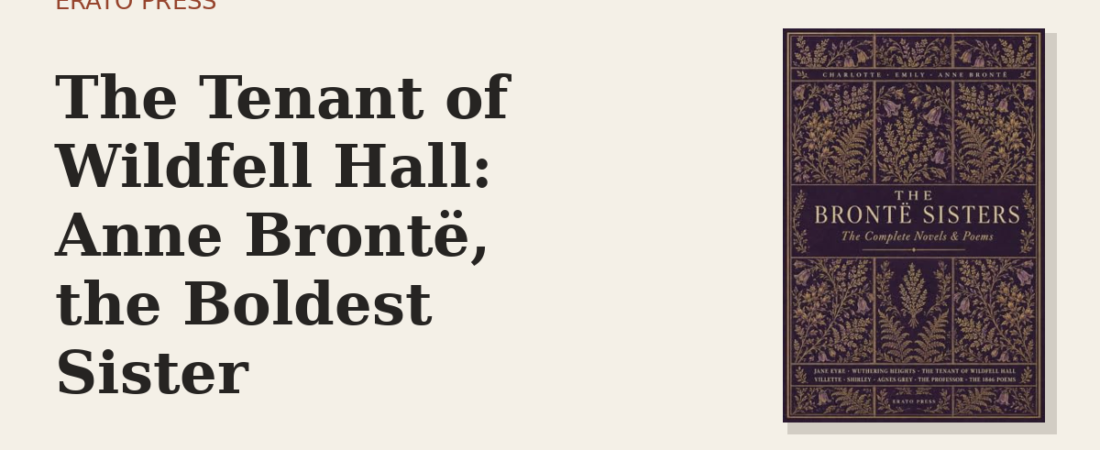
To read Anne Brontë properly is to watch a reputation correct itself in real time — to discover that the “quiet” sister was the one who looked hardest at the things the others approached obliquely. The Erato Press edition restores The Tenant of Wildfell Hall to its full stature, with the critical apparatus to read it as the deliberate, daring book it is rather than the minor work convention long made of it. Read the Erato Press edition and meet the boldest Brontë of them all.
Read the Erato Press edition →
Enjoyed this piece?
Get the next one — our essays on the classics and news of each new Erato Press edition — straight to your inbox.