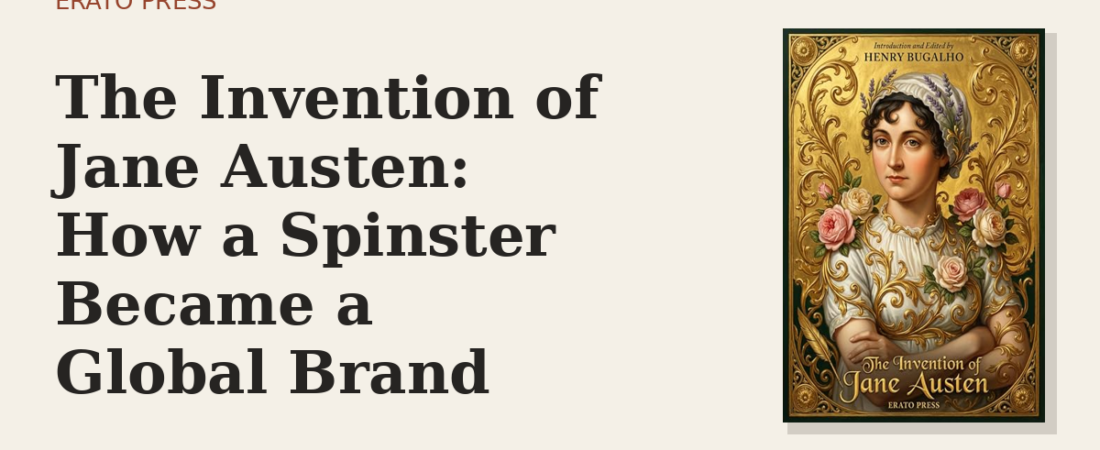
When Jane Austen died at Winchester in July 1817, at the age of forty-one, she was an unmarried woman of small means whose novels had been published anonymously, attributed on their title pages only to “A Lady.” Her last completed book, Persuasion, finished from a couch improvised out of chairs because she would not deprive her aged mother of the one sofa, had not yet appeared in print. She left an unfinished manuscript, the satire we now call Sanditon, its later pages first traced in pencil because her fingers had grown too weak to manage ink. She was buried in the cathedral under a stone that did not so much as mention that she had written anything. Two hundred years later she is a global industry: pilgrimage sites, film franchises, dating manuals, an effigy on the Bank of England’s ten-pound note. How a sickly, private spinster became “Jane” to millions is one of the strangest afterlives in literary history, and it is worth understanding how the legend was made.

The argument of this essay is simple and slightly uncomfortable: the Austen the world adores is in large part an invention, assembled after her death by relatives, editors, and an industry of admirers, and the real woman, sharper and stranger than the brand, has been steadily sanded down to fit it. To read her well, we have to recover the writer from the franchise.
The making of “dear Aunt Jane”
The legend begins with her family, and with love. In 1870, more than half a century after her death, Austen’s nephew James Edward Austen-Leigh published A Memoir of Jane Austen, the book that effectively launched the cult. It is a tender, evasive portrait of a sweet maiden aunt who wrote in the family sitting-room, hid her manuscript when visitors called, and harbored no literary ambition unbecoming to a gentlewoman. The Memoir gave the Victorians exactly the Jane they wanted: domestic, modest, faintly saintly, an ornament of the hearth who happened to produce immortal comedies in her spare moments.
The portrait was not false so much as selective. The nephew, writing of her final months, records the heartbreaking devotion of her sister Cassandra, who took over the household duties one by one as Jane weakened, and whom Jane called “such an excellent nurse, so assiduous and unwearied.” He preserves the touching detail of the donkey-carriage bought so the invalid could still take the air. These things are true and moving. But Cassandra had also, after Jane’s death, burned or censored the bulk of her sister’s letters, and what survived was curated to protect the family’s idea of her. The acid wit, the bawdy jokes, the impatience with fools, the cool appraisal of marriage as an economic transaction, all of it was quietly trimmed to fashion the gentle aunt of the Memoir.
Two inches of ivory, and the trap of modesty
The single most quoted sentence Austen ever wrote about her own art has done more than any other to miniaturize her. Writing to that same nephew in December 1816, gently mocking his suggestion that she might borrow his “strong, manly sketches, full of variety and glow,” she asked how she could possibly join them to “the little bit (two inches wide) of ivory on which I work with so fine a brush as produces little effect after much labor.” It is a brilliant line, and it has been read for two centuries as a humble confession of limited scope, the perfect motto for the maker of small domestic comedies.
Read in context, it is something closer to the opposite. It is a private joke between an aunt and a teenager, a piece of arch self-deprecation from a woman entirely confident of what her fine brush could do. Austen knew precisely what she was accomplishing within her chosen frame, even if, as one early biographer shrewdly noted, she may not have fully credited how much. The “two inches of ivory” was not an apology for narrowness; it was a description of a method, the deliberate concentration of enormous psychological intelligence onto a small, sharply lit surface. The phrase has been weaponized against her ever since by critics who mistake the size of her canvas for the scale of her achievement, as if irony, moral judgment, and the whole free indirect machinery of the modern novel were somehow lesser for being deployed at three or four country families gathered in a village.
The writer the brand leaves out
What the global brand mostly markets is the romance: bonnets, balls, Mr. Darcy emerging from a lake, the reassuring guarantee that the heroine will marry well. What it tends to suppress is how unsentimental Austen actually was about the thing it sells. She never married. She accepted a proposal from a wealthy man named Harris Bigg-Wither one evening and withdrew it by morning, choosing genteel poverty and her writing over security without love. She understood marriage as the only career open to women of her class and watched, with merciless clarity, the calculations it forced upon them. The famous opening of Pride and Prejudice, with its “truth universally acknowledged” about single men and fortunes, is not a romantic premise. It is a satirical thesis about a marriage market, delivered in the driest possible voice.
The Austen of the late work is darker and more searching than the franchise admits. Persuasion, written as illness closed in, is autumnal, regretful, almost elegiac, the story of a woman who let prudence talk her out of love and must live with the second chance she barely dares to hope for. Sanditon, the unfinished fragment of her last weeks, turns its satire on speculation, hypochondria, and the new commercial England of seaside resorts and investment schemes. A writer dying by inches chose, for her final subject, sharp social comedy about money and self-delusion. That is not the maiden aunt of the Memoir. That is one of the most ruthless ironists in the language, working at full strength until the pen dropped from her hand.
Why the invention matters
None of this is to scold the millions who love her, or to pretend the affection is unearned. The point is that the brand and the writer have come apart, and that the brand, by domesticating her, makes her smaller and easier than she is. Recovering the real Jane Austen, the unmarried woman of acute intelligence and limited options who turned the confined material of her life into an instrument for dissecting an entire society, does not diminish the pleasure of the novels. It deepens it. The comedy is funnier and the romance more precarious once you see how clearly she saw what was at stake for her women, and how little she was inclined to console them with easy endings.
Frequently asked questions
Was Jane Austen really unknown in her lifetime?
Not entirely. Her novels sold respectably and were admired by readers including the Prince Regent, who kept a set in each of his residences and to whom Emma was dedicated. But she published anonymously, earned modest sums, and enjoyed nothing like fame. The cult, the pilgrimages, the global recognition, all came after her death.
Why did Cassandra burn the letters?
Out of love and a sense of propriety. Cassandra wanted to protect her sister’s privacy and the family’s image, destroying letters that were too candid, too sharp, or too revealing of private feeling. The result is that we possess only a fraction of Austen’s correspondence, and the gaps have been filled, ever since, by legend.
Did she finish Sanditon?
No. She began it in January 1817 and worked at it for about seven weeks before illness forced her to stop in mid-March; she died in July. The twelve completed chapters, some of their pages first drafted in pencil, are among the most poignant documents in English literature: a dying woman’s last, vigorous comedy, left unfinished like the window in Aladdin’s tower.
To meet Austen on her own terms, set aside the brand for a while and read her closely, attentive to the irony that lives in the gap between what her characters say and what they mean. The Erato Press edition restores that sharper writer, pairing the novels with the biographical record, the surviving letters, and the family memoir that first built the legend, so that you can watch the invention happen and judge the original for yourself. For more on the difference between the woman and the myth, see The Real Jane Austen: Life Behind the Novels.
Read the Erato Press edition →
Enjoyed this piece?
Get the next one — our essays on the classics and news of each new Erato Press edition — straight to your inbox.