“The wrong-doing of one generation lives into the successive ones, and, divesting itself of every temporary advantage, becomes a pure and uncontrollable mischief.” Nathaniel Hawthorne wrote that sentence in the preface to The House of the Seven Gables in 1851, and it is as close as he ever came to stating his lifelong subject outright. The novel is a ghost story in which the ghost is history itself. No specter walks the corridors of the Pyncheon mansion in Salem; what haunts the house is a deed of property, a stolen acre of land, a judicial murder dressed as law. Hawthorne’s great insight, and the source of the book’s strange, mossy power, is that a curse and an inheritance are the same thing seen from different angles.

This is the argument the novel patiently develops: that America, a nation that imagined itself born new and free of the past, was in fact built on dispossessions it had not paid for, and that the past does not stay buried simply because the living would prefer it to. The seven-gabled house is the most concentrated symbol Hawthorne ever devised for the weight of that unpaid debt.
The crime at the foundation
The house stands on stolen ground. Two centuries before the action of the novel, the stern Puritan Colonel Pyncheon coveted the modest plot owned by a humble man named Matthew Maule. When Maule would not sell, Pyncheon used the witchcraft hysteria of the 1690s to have him hanged, a transparent abuse of the courts that put the land into Pyncheon hands. From the scaffold, Maule pronounced his curse: “God will give him blood to drink.” On the very day the Colonel held his housewarming in the new mansion built over Maule’s grave, he was found dead in his great chair, blood staining his ruff and beard.
Hawthorne, whose own great-great-grandfather John Hathorne had been a judge in the Salem witch trials and never repented of it, knew exactly what he was writing about. The added w in his name was a deliberate distancing from that ancestral guilt, and the novel is in part his reckoning with it. The Pyncheon curse is not supernatural in any simple sense. The recurring deaths by apoplexy, blood in the throat, run in the family as both a hereditary affliction and a moral verdict, and Hawthorne keeps the two readings deliberately fused. Is it a hanging man’s hex or a congenital condition? The genius of the book is its refusal to choose. Guilt is passed down like a disease, and the bloodline carries the crime in its very veins.
The past as a sealed room
When the story proper opens, the once-grand Pyncheons have dwindled to the spinster Hepzibah, scowling not from ill temper but from near-sightedness, and her gentle, broken brother Clifford, just released after thirty years’ wrongful imprisonment. They live like fossils in the decaying house, and the great house decays with them. Hawthorne’s prose grows thick with rust, dust, and the smell of old wood; the chickens in the garden are degenerate descendants of a once-noble breed, a small grotesque emblem of the whole family’s decline. The Pyncheons are imprisoned not by walls but by their own pedigree, by a pride in ancestry that has become a tomb.
The presiding villain, Judge Jaffrey Pyncheon, is the most chilling figure in the book precisely because he is so respectable. Smiling, prosperous, a pillar of the community, he is the Colonel reborn, the same rapacity now wearing the mask of philanthropy and public service. Hawthorne stages his death as a set piece of black comedy and moral horror at once: the Judge sits dead in the ancestral chair through a long night while his watch ticks on, and the narrator, in one of the boldest passages in American fiction, taunts the corpse, mockingly urging it to keep its appointments, attend its dinner, run for governor. The dead Judge fulfills the curse exactly as the Colonel did. The wrong-doing of one generation has lived into the next, and into the next.
The American gothic and the burden of history
Hawthorne called the book a “romance” rather than a novel, claiming for it the latitude to mingle the marvelous with the actual. That permission produced something distinctly American. The European gothic had its crumbling abbeys and aristocratic curses; Hawthorne transplanted the form to a democracy that officially had no aristocrats and no past worth dreading, and discovered that the New World had its own buried crimes, its dispossessed Maules and its hanging judges. The Salem of the witch trials sits beneath the genteel surface of the Republic the way Maule’s grave sits beneath the Pyncheon parlor. This is the lineage that runs forward to Poe’s collapsing House of Usher and outward to William Faulkner’s Mississippi, where the sins of slavery and theft refuse to stay in the past. The American gothic, Hawthorne understood first, is not about foreign castles. It is about the home ground and what was done to acquire it.
The escape that almost convinces
Hawthorne does grant his characters a way out, and readers have argued ever since about whether it is earned. The young, sunlit Phoebe Pyncheon, a country cousin untouched by the family gloom, and the daguerreotypist Holgrave, who turns out to be the last descendant of the wronged Maules, fall in love and marry. Their union is meant to dissolve the ancient feud, to reconcile the families of the wronged and the wrongdoer, and the survivors leave the cursed house for a fresh start in the country. The blood-debt, two centuries old, is at last cancelled by love.
It is the most hopeful ending Hawthorne ever wrote, and the least convincing, which may be the point. Holgrave, the radical who once declared that no generation should inherit the dead hand of the past, ends by happily moving into the Judge’s fine country estate. The reformer becomes a property owner; the cycle of inheritance starts again. Whether Hawthorne meant this as genuine redemption or as a sly admission that escape from history is a comforting fiction, the ambiguity is itself the deepest thing in the book. America wants to believe it can love its way out of its origins. Hawthorne lets it hope so while quietly noting how the new heir settles into the old chair.
Frequently asked questions
Is The House of the Seven Gables a horror novel?
Not in the modern sense of jump-scares and gore. It is gothic and atmospheric, steeped in dread and decay, but its horrors are moral and psychological. The most frightening passage in the book is a description of a respectable man sitting dead in a chair. Hawthorne wants you unsettled by history, not by monsters.
How does it relate to The Scarlet Letter?
Both are obsessed with hidden guilt and its long aftermath, and both grow out of Hawthorne’s Puritan ancestry. The Scarlet Letter studies the guilt of an individual conscience; The House of the Seven Gables studies guilt as it descends through a family across two hundred years. Together they form Hawthorne’s anatomy of the American conscience.
Is the house a real place?
A seven-gabled house in Salem, associated with Hawthorne’s cousin, still stands and draws visitors. But Hawthorne insisted in his preface that he was building a moral structure, not a literal one, and asked readers not to map his romance too closely onto any actual street.
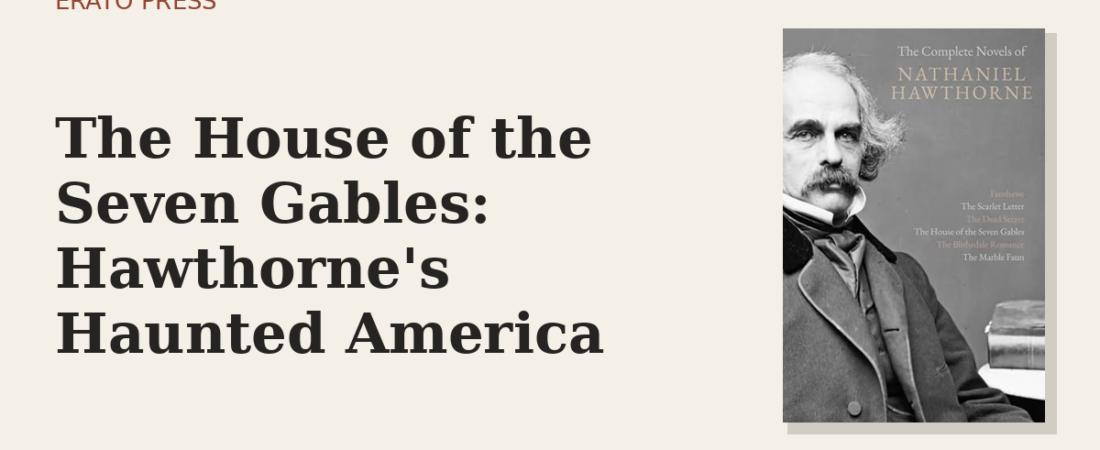
Read slowly, the novel rewards attention to its symbols, the chickens, the mirror, the daguerreotype that exposes the true face beneath the public smile. The Erato Press edition frames the romance with the Salem history Hawthorne drew on and the family guilt he was working through, so that the curse on the Pyncheons reads not as quaint superstition but as Hawthorne’s enduring question to his country: what do we owe for the ground we stand on?
Read the Erato Press edition →
Enjoyed this piece?
Get the next one — our essays on the classics and news of each new Erato Press edition — straight to your inbox.