Halfway through the Odyssey, the most resourceful man in Greek poetry does the one thing no living man is supposed to do: he sails to the edge of the world, digs a trench, fills it with blood, and summons the dead to come and drink. Book 11 — the nekuia, the rite of the dead — is the strangest and in some ways the most revealing episode in all of Homer. It is the chapter where the poem stops being an adventure story and becomes a meditation on what it means to be alive, told entirely through the mouths of people who no longer are. The argument I want to make is that everything the Greeks believed about life is encoded, by negation, in what their dead are made to say.

Circe sends Odysseus there, and she is precise about the method. He must reach the grove of Persephone at the cold limit of Ocean, perform the sacrifice with his back to the river, and then — this is the unbearable part — hold off the thronging shades with his drawn sword until the one he came for has drunk. The dead crowd toward the blood because blood is what they lack. Without it they are eidola, shadows of the people they were, drained of voice and memory and the power to recognize. Only the dark blood restores them, briefly, to speech. Homer has built the scene so that consciousness itself is the thing the underworld has taken away, and the living visitor must lend it back, one ghost at a time.
Tiresias, and the only knowledge worth the journey
Odysseus has not come for comfort. He has come for navigation. The blind seer Tiresias — alone among the dead in keeping his wits intact, a privilege Persephone granted him — is the one shade Circe insisted he consult, because Tiresias can tell him how to get home. And what the prophet delivers is not a magic shortcut but a set of conditions and a warning: the cattle of the Sun must not be touched; the suitors must be dealt with; and, most hauntingly, Odysseus’s own death will come “from the sea,” gently, in a sleek old age, far in the future. The hero who crossed into the land of the dead to learn how to live receives, as his reward, the shape of his own end.
This is characteristically Greek. The underworld is consulted not for salvation but for information — and the deepest information it has to give is mortality itself, named and dated and made bearable only by being made certain. There is no promise of paradise here, no judgment that sorts the good from the wicked into reward and punishment. (That theology comes later, and from elsewhere.) Tiresias offers knowledge, the Greek good above all others, and the knowledge is that the journey ends.
Anticleia: the discovery that the dead cannot be embraced
Then comes the passage that has broken readers for three thousand years. Among the shades pressing toward the blood, Odysseus sees his own mother, Anticleia — and learns, only now, that she has died in his absence, of grief for him. He had left her living. Three times he reaches to take her in his arms, and three times she slips through his hands “like a shadow or a dream,” and he cries out in bewilderment, and she explains: this is simply what the dead are. The sinews no longer bind flesh and bone; the fierce fire of the pyre has undone them; the soul flutters off “like a dream.” It is not that she will not hold him. She cannot. There is no body left to hold.
Homer puts the whole Greek metaphysics of death into that failed embrace. The person survives, after a fashion — she knows him, she speaks, she grieves — but the survival is a subtraction. What death removes is exactly what made love and presence possible: the warm, weighty, graspable fact of the body. The Greeks did not, in the Homeric world, fear annihilation so much as they mourned this thinning, this reduction of a full human being to a knowing shadow. Anticleia teaches Odysseus — and us — that to be dead is to be unembraceable.
Achilles, and the verdict on glory
And then the most famous line. Odysseus finds Achilles among the dead and tries to console him with the language of heroic poetry: surely you, who were honored like a god in life, are a great prince here among the shades? Achilles cuts him off with the bitterest sentence in Greek literature. Do not gloss over death to me, he says. I would rather be a hired laborer, bound to the field of some landless, portionless man — the lowest condition a free Greek could imagine — and be alive, than rule as king over all the perished dead.
This is staggering coming from Achilles, because Achilles is the hero who, in the Iliad, chose precisely the opposite: a short life crowned with imperishable glory over a long, obscure, comfortable one. The man who staked everything on fame now, from the far side of death, repudiates the bargain. The poem is doing something deliberate and severe here. It lets its greatest warrior measure the whole heroic value system — honor, glory, the deathless name — against the bare fact of being alive, and find it wanting. The Odyssey, a poem about a man who wants nothing more than to get home and grow old, uses the ghost of the Iliad‘s hero to vote for survival over splendor. Whatever else Book 11 is, it is the moment Greek poetry weighs glory against life and lets life win. (Achilles’ fierce choice, and the world that produced it, are the subject of the war epic that stands beside the Odyssey; readers who want the other half of the imagination — the public, tragic, civic vision that the Greeks set against Homer’s domestic one — will find it in Greek Tragedy: The Other Pillar of the Greek Imagination.)
What the dead are for
Why does the Odyssey need this episode at all? Structurally, Odysseus could be sent home without a trip to the underworld; Tiresias’s sailing instructions could be delivered by any oracle. The nekuia is there for a deeper reason. It is the still center of a poem otherwise full of motion — the place where the hurtling story of monsters and shipwrecks pauses so that the poem can take the measure of its own stakes. Odysseus is a man fighting, against every obstacle, to live: to reach home, reclaim his wife, sleep in his own bed, die in his own time. Book 11 shows him, with terrible clarity, the alternative. It lets him stand among the people who lost that fight — his mother, his comrades, the great names of the heroic age — and hear from them, in their own diminished voices, exactly what is at stake in the rest of his journey.
The Greek dead, in short, are a mirror held up to Greek life. They have no reward and no torment, no heaven and no hell in the later sense; they have only the loss of everything the living take for granted. And that is precisely why they are eloquent. By telling Odysseus what he no longer has, they tell him — and Homer tells us — what is worth having: the body, the daylight, the embrace that holds, the years that have not yet run out. The Greek view of death is a backhanded hymn to the world above ground.
Frequently asked questions
What does “nekuia” actually mean?
It is the ancient term for the rite Odysseus performs — a summoning of the dead by sacrifice and offering, so that the living may question them. Book 11 of the Odyssey is the foundational example in Western literature, and it gave the later tradition, from Virgil to Dante, its template for the descent to the underworld.
Does Odysseus actually go down into the underworld?
In Homer’s account he stays at the threshold, at the edge of Ocean, and the dead come up to him through the trench of blood. Later poets, above all Virgil with Aeneas and Dante with his own pilgrim, turn the summoning into a full descent and tour. Homer’s version is starker: the hero waits at the border, sword drawn, and the dead come to him.
Why is Achilles’ speech so important?
Because it reverses the choice that defines him in the Iliad. There he chooses glory over long life; here, dead, he says he would trade all the honor of the underworld to be the poorest living man. It is the Greek tradition criticizing its own heroic ideal from the inside, and it crystallizes the Odyssey‘s preference for life and home over death and fame.
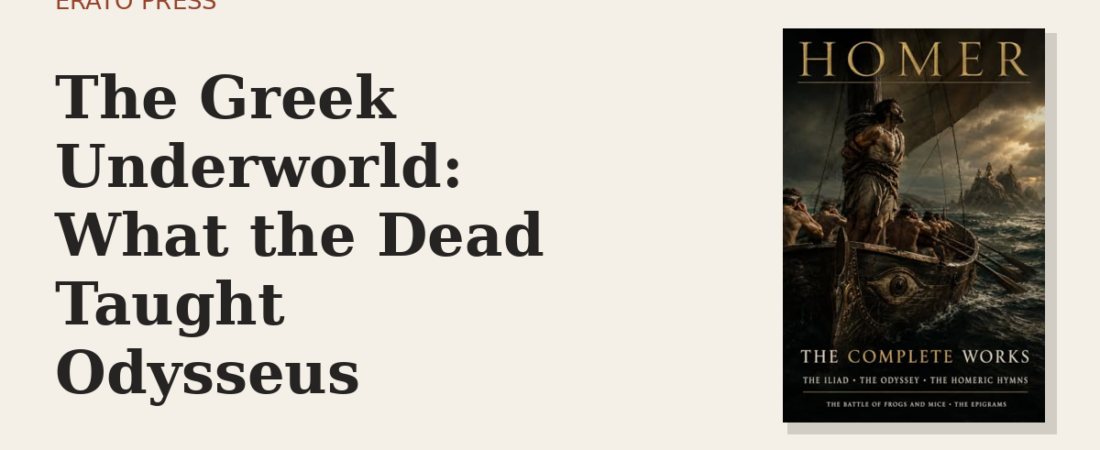
Erato Press presents Homer’s complete works in a single annotated volume, with the nekuia set in the full arc of the journey and a critical apparatus that follows its long afterlife through Virgil and Dante. For readers who want to meet the Greek dead with a guide, it is the edition to keep.
Read the Erato Press edition →
Enjoyed this piece?
Get the next one — our essays on the classics and news of each new Erato Press edition — straight to your inbox.