Most people meet the Norse gods sideways — through a Marvel film, a video game, a heavy-metal album cover, a Tuesday (Tyr’s day) and a Wednesday (Woden’s) they never thought to question. What few people do is read the actual sources, and there is a reason for that: the sources are strange, fragmentary, and divided against themselves. There is no Norse Bible, no single authoritative scripture handed down whole. What survives is a small, battered, miraculous library of medieval Icelandic manuscripts, compiled centuries after the conversion to Christianity, by men who half-believed and half-doubted what they were writing down. To start with Norse mythology properly is to start with those books — and to understand why they cannot be read the way we read a novel.
Here is the orientation I would give anyone who wants the real thing rather than the merchandise. There are essentially three doors: the Poetic Edda, the Prose Edda, and the sagas. They are not interchangeable, and the order in which you open them changes everything.

The Prose Edda: start with Snorri, the man who organised the chaos
Begin, counterintuitively, with the later book. The Prose Edda was written around 1220 by Snorri Sturluson, an Icelandic chieftain, lawyer, historian, and political schemer who was eventually murdered in his own cellar. He composed it as a handbook for poets — a guide to the old mythological knowledge that the new Christian generation was forgetting, so that the intricate art of skaldic verse, dense with mythological allusion, would not become unreadable. This makes Snorri our single most coherent narrator of the myths, and the Prose Edda the most welcoming entry point.
It is here, in the section called Gylfaginning (“The Deluding of Gylfi”), that you get the great set-pieces in continuous, confident prose: the creation of the world from the body of the slain giant Ymir; Odin trading an eye at Mímir’s well for a draught of wisdom; Thor’s humiliating journey to the hall of the giant Útgarða-Loki, where he fails to drain a drinking horn whose other end is the sea, and fails to lift a cat that is secretly the world-serpent. And it is here that Snorri lays out Ragnarök, the doom of the gods, with its terrible specificity — the wolf Fenrir swallowing Odin, Thor and the serpent killing each other, the sun devoured, the world drowned and then, astonishingly, reborn. Snorri tells it cleanly. He is also, crucially, a Christian writing about a religion he no longer practices, and his framing — the gods as deceivers, as cleverly euhemerised ancient kings — should put you on guard. Start here for the shape of the story; just remember the shape has an author with an agenda.
The Poetic Edda: the older, wilder, more dangerous voice
Then go back in time to the Poetic Edda — a collection of anonymous mythological and heroic poems, most of them preserved in a single late-thirteenth-century Icelandic manuscript called the Codex Regius, which sat unread in obscurity until it was rediscovered in 1643. This is the raw ore Snorri was refining, and it is far less tidy and far more powerful.
The opening poem alone, the Völuspá (“The Prophecy of the Seeress”), is one of the great visionary poems of medieval Europe: a dead prophetess, summoned by Odin, recites the history of the cosmos from before creation to after the end, in a voice that is gnomic, accusatory, and unforgettable. Then comes the Hávamál, “The Sayings of the High One,” a sprawling collection of Odin’s advice that veers from peasant prudence (“Cattle die, kinsmen die, you yourself die; I know one thing that never dies: the reputation of each dead man”) to the god’s own account of hanging nine nights on the world-tree, wounded with a spear, sacrificed to himself, to win the runes. The Poetic Edda does not explain. It assumes you already know the gods and plunges you into their quarrels, their flytings, their doom. It is harder than the Prose Edda and incomparably richer. Read it second, when Snorri has given you the map and you are ready to leave it.
The sagas: when the gods step back and the people come forward
The third door opens onto something different in kind. The Icelandic family sagas — Njáls saga, Egils saga, Laxdæla saga, Grettis saga and their fellows — are not myth at all but a body of prose narrative, composed mostly in the thirteenth century, about the settlement of Iceland and the lives of its early inhabitants in the ninth and tenth. They are among the earliest realistic prose fiction in any European language: spare, ironic, devastatingly understated, concerned with feud, honour, law, and the slow logic of revenge.
The gods are mostly offstage here, glimpsed at the edges — a sacrifice, an oath sworn on a sacred ring, the precise moment Iceland voted to accept Christianity at the Althing in the year 1000 (a scene Njáls saga renders with extraordinary political subtlety). What the sagas give you is the human world that produced the myths: a society of farmers and poets and killers who lived by reputation and died by feud, for whom Odin and Thor were not allegories but presences recently departed. Read a saga or two after the Eddas, and the mythology stops being a cabinet of curiosities and becomes the imaginative life of a real, hard, articulate people. Njáls saga is the masterpiece; Egils saga, possibly written by Snorri himself, gives you a poet-warrior who is half a troll and wholly unforgettable.
Why the sources resist us — and why that is the point
It is worth saying plainly what makes Norse mythology so different to approach from Greek. We have no Norse Homer, no Hesiod systematising the genealogies of the gods while the religion was still alive. Everything we have was written down by Christians, in Iceland, two or three centuries after the old faith had officially ended. The result is a mythology preserved by people who no longer worshipped its gods — which means it reaches us already shadowed by loss, by nostalgia, by the knowledge of its own ending. Perhaps that is why Ragnarök, the foretold death of the gods, sits at the centre of the whole structure in a way that has no real Greek equivalent. This is a mythology that knows it is doomed and tells you so on the first page.
That fatalism is the great Norse contribution to the imagination: not the serene immortals of Olympus but gods who will die, who fight on anyway, who value the courage of the doomed above all things. You do not read these books for consolation. You read them for the bleak, magnificent dignity of beings who face the end with open eyes.
Frequently asked questions
Do I need to read the Poetic and Prose Eddas in Old Norse?
Absolutely not. Excellent prose translations exist, and the poetry survives translation better than you might fear, because so much of its power lies in compression and image rather than in metre. What matters far more than the original language is reading a thoughtful edition that explains who the gods are, what the kennings mean, and how the poems relate to one another — apparatus the original Icelandic reader carried in his head and the modern reader needs supplied.
Is the mythology in popular culture accurate?
Selectively, and usually flattened. The broad cast survives — Odin, Thor, Loki, Freyja, the rainbow bridge, Ragnarök — but the tone is almost always lost. The real Loki is far stranger and more disturbing than any screen version: a shapeshifter who gives birth to a horse, whose children include the wolf that will kill Odin, and whose final crime is bound up with grief and cruelty in ways no film dares. The sources reward the reader precisely where the adaptations simplify.
Which single book should I buy first?
A good combined edition that gives you the mythological core — the creation, the gods, Ragnarök — drawn from both Eddas, with the apparatus to guide you. That gives you the whole architecture in one volume, after which you can pursue the sagas as a separate, deeper expedition.
The edition to begin with
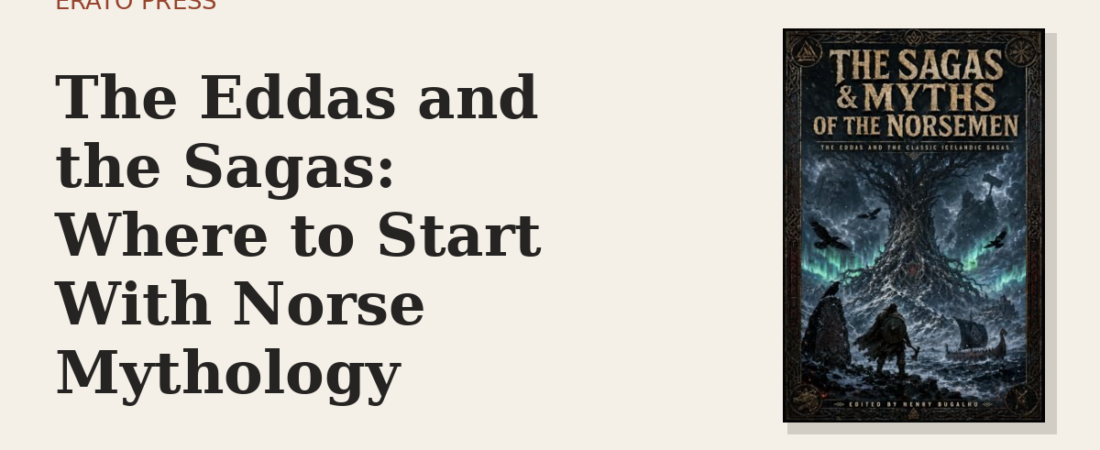
Norse mythology punishes the unguided reader and rewards the well-equipped one; the difference is almost entirely in the edition. The Erato Press volume gathers the essential mythological material into a single coherent narrative arc — from the creation out of Ymir’s body to the rebirth after Ragnarök — with introductions and notes that clarify the names, the kennings, and the strange Christian-pagan double vision of the sources, so that a first-time reader can follow the doom of the gods without drowning in genealogy. It is the map and the territory together, which is exactly what this mythology, more than any other, requires.
Read the Erato Press edition →
Enjoyed this piece?
Get the next one — our essays on the classics and news of each new Erato Press edition — straight to your inbox.