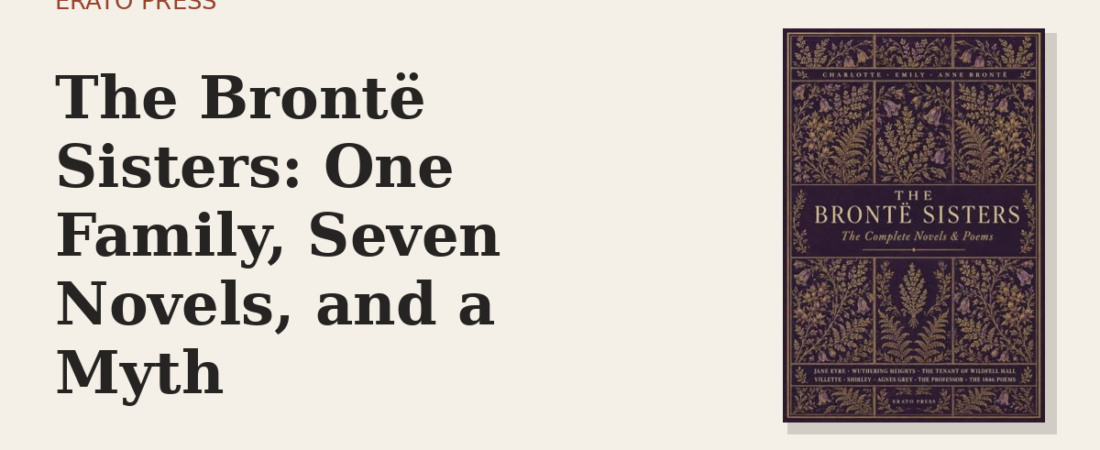
Read on its own, Wuthering Heights looks like a book that fell out of the sky — a work of such concentrated strangeness that it seems to have no parents and no siblings. It has both. Set it beside Agnes Grey and The Tenant of Wildfell Hall, beside Jane Eyre and Villette, with the 1846 Poems behind it and the shadow of the childhood kingdoms behind those, and the meteor turns out to be the most extreme product of a shared imaginative culture. That is the argument worth holding onto about the Brontës: they are one of the rare cases in literature where reading the writers together teaches you more about each of them than reading any one alone ever could. Three sisters, seven novels, one book of poems — and a myth that has nearly swallowed the working reality.

The myth is the parsonage on the edge of the moor, the doomed and dreaming children, the graveyard and the early deaths — and none of it is false. But it tends to space the sisters out, to make Charlotte the senior figure with the others as her satellites, or to isolate Emily as a solitary genius. The truth is harder and more interesting. They wrote not in succession but at once, in the same few rooms, often at the same table on the same evenings, reading one another’s pages. The Brontë achievement was not a relay of individual triumphs but a single concerted act of a family of writers.
Haworth: a house between the dead and the wild
Begin with the place, because the place is improbable. Haworth was a steep village of soot-darkened stone in the West Riding of Yorkshire, a working settlement of weavers and wool-combers more industrial than pastoral, sitting at the threshold of the great moors. The parsonage stood at the very top, beyond the church, beyond the last houses, with the crowded graveyard pressing almost to its windows on one side and the open moorland beginning on the other. A house balanced between the dead and the wild — and the children who grew up in it were shaped, permanently, by both.
The Reverend Patrick Brontë brought his family there in 1820. Born poor in County Down, he had climbed by sheer force of intellect to St John’s College, Cambridge, refashioning the old Irish name “Brunty” into the dignified “Brontë,” diaeresis and all; he would outlive his wife and all six children, dying in 1861 the last survivor of a family he had watched predecease him. The losses began at once. The children’s mother died in 1821; then, in 1825, the two eldest girls, Maria and Elizabeth, were carried off by tuberculosis contracted at the harsh charity school of Cowan Bridge — the school Charlotte would never forgive and would set down, decades later, as Lowood in Jane Eyre. Four children remained: Charlotte, the only brother Branwell, Emily and Anne. Bereaved and isolated, with a learned but remote father and few companions across the gulf of class that separated them from the village, they turned inward and invented entire worlds.
This is the most remarkable fact of their childhood, and the true workshop of their art. From a box of toy soldiers grew elaborate, ever-expanding imaginary kingdoms, recorded in a torrent of miniature manuscripts in a tiny hand: Charlotte and Branwell built the glittering African empire of Angria; Emily and Anne broke off to create Gondal, a northern island of moors and prisons and doomed queens, which fed Emily’s poetry for the rest of her life. These were not idle games but a two-decade collaborative apprenticeship in narrative, character and verse. The seven novels grew out of that nursery.
Three sisters, three incommensurable gifts
What the single volume restores is the irreducible difference among them. Out of the same inherited materials — the moor, the grief, the constraint, the master theme of the self against the world that would master it — three unlike artists made three unlike answers.
Charlotte (1816–1855) was the eldest survivor and the engineer of the family’s career. By her own fierce estimate plain and small in a world that prized beauty in women above almost everything, she made out of that wound the most radical fiction of the century: novels narrated by women who are not beautiful, not rich, not powerful, and who nonetheless demand in the plainest terms to be treated as the moral and intellectual equals of the men who would master them. The plain heroine who insists upon her own worth is Charlotte’s great invention, and it changed the English novel. The grinding indignities of the governess’s life — neither family nor servant, dependent on households that despised her — bred in her an anger at a social order that wasted the gifts of women, and that anger is one of the engines of her art. Her year in Brussels, and her unreciprocated attachment to the exacting teacher Constantin Heger, gave English literature two novels of a woman in love against hope: the apprentice Professor and, near the end of her life, the dark, unflinching Villette, whose lonely Lucy Snowe many readers count her finest achievement.
Emily (1818–1848) is the metaphysical extremist, the one who pushed the family’s common materials furthest toward myth. Wuthering Heights takes the moor, the passion and the constraint of the shared culture and concentrates them into something that still has no rival for sheer elemental force — a novel that asks whether love is a union that annihilates the self or a bond between selves that remain distinct, and answers in a key no one else has ever managed to strike. Its violence and dissolution, its dual narrators and its refusal of every comfort, make it the place where the Brontë imagination reached its most concentrated form. Readers who want to take the full measure of that achievement will find it traced in Wuthering Heights: Love, Violence, and Dissolution.
Anne (1820–1849) was long patronized as the quiet, minor sister, and the judgment is an injustice that the collected reading corrects at once. Her cool moral clarity is the exact counterweight to Charlotte’s heated interiority and Emily’s metaphysical fire. Agnes Grey is the most unillusioned account of the governess’s life any of them wrote; and The Tenant of Wildfell Hall, with its unsparing portrait of a marriage destroyed by drink and dissipation and its heroine who flees rather than endure, is in some ways the boldest book the family produced — a frontal assault on the law and convention that bound a wife to a ruinous husband. Where Emily mythologizes and Charlotte burns, Anne reports, with a steady ethical nerve that the twentieth century took far too long to honor.
The Bells: why they hid, and what they risked
In 1846 the three published a joint volume of verse, Poems by Currer, Ellis, and Acton Bell, behind pseudonyms ambiguous as to sex but preserving their own initials — a shield against the condescension that met women writers. It sold a notorious handful of copies. But it had broken the seal, and each sister had a novel ready. Emily’s Wuthering Heights and Anne’s Agnes Grey found a publisher; Charlotte’s Professor was refused again and again — and that rejection produced her triumph, because the encouragement of one declining publisher spurred her to finish Jane Eyre, which appeared in 1847 and made “Currer Bell” famous overnight. Readers were gripped by the voice: the small, plain, orphaned governess telling her own story with an emotional directness and a refusal of self-pity no English novel had quite achieved. Jane will not stay with Rochester on dishonorable terms; she leaves rather than compromise her integrity, and returns only as a free woman and an equal. The book has never been out of print.
The masks nearly undid them. A rumor spread that all three Bells were one author, and to scotch it the intensely private Charlotte and Anne traveled to London and presented themselves to the publishers as two separate persons, and women — to the astonishment of men who had had no idea they were dealing with a small countrywoman from a remote Yorkshire parsonage. Within two years of that disclosure, Branwell, Emily and Anne were all dead. Only death divided the sisters, and it divided them with a cruelty that the later separation of their reputations has, in its way, prolonged.
Why read the phenomenon whole
To gather the seven novels and the poems between two covers is to recover the conversation among them. The books are in dialogue — not by design, but by the deeper fact of common origin and divergent answers to the same inherited questions. What does a self owe to its passions, and what to the world that would constrain them? Is love a union that annihilates the self or a bond between distinct selves? Is the right response to a ruined marriage endurance or flight? Charlotte answers in one key, Emily in another, Anne in a third, and the reader who holds all three together hears not a single Brontë position but a debate — the most intimate debate in English literature, carried on among three sisters who learned to think by thinking against one another in a nursery and never stopped. The separate editions honor the writers. A collected one honors the phenomenon — which remains, after every explanation, improbable: that one household, in one generation, produced three of the permanent novelists of the language.
Frequently asked questions
How many novels did the Brontë sisters actually write?
Seven completed novels in all: Charlotte’s four (The Professor, Jane Eyre, Shirley, Villette), Emily’s single Wuthering Heights, and Anne’s two (Agnes Grey and The Tenant of Wildfell Hall) — plus the 1846 joint book of poems.
Were the sisters really writing at the same time?
Yes — this is the fact the staggered order of their fame tends to obscure. They wrote their major novels in the same years, in the same rooms, often at the same table, reading one another’s pages. They had agreed each would produce a novel, and produced them side by side.
Why did they publish as Currer, Ellis, and Acton Bell?
To evade the prejudice that met women writers and to protect their privacy in a small village. The pseudonyms were deliberately ambiguous as to sex while keeping the sisters’ own initials — Charlotte, Emily, Anne becoming Currer, Ellis, Acton Bell.
Erato Press has collected all seven novels and the complete poems in a single annotated volume, with a critical apparatus that lets the three voices answer one another across the page and an essay on the family and Haworth that separates the working reality from the myth. It is the edition for readers who want the whole phenomenon.
Read the Erato Press edition →
Enjoyed this piece?
Get the next one — our essays on the classics and news of each new Erato Press edition — straight to your inbox.