In 1850 the United States was seventy-four years old and had, by the lights of European critics, produced almost no literature worth the name. Sydney Smith’s sneer of 1820 still echoed — “In the four quarters of the globe, who reads an American book?” — and the answer was, embarrassingly, almost no one. Then, in the span of about five years, a handful of writers working largely in obscurity and partly in failure produced The Scarlet Letter, Moby-Dick, Walden, the first Leaves of Grass, the great essays of Emerson’s maturity, and the poems Emily Dickinson was beginning to write in a Massachusetts bedroom. The thesis of this essay is that the American Renaissance was not a gradual ripening but something closer to an explosion — a nation finding its literature, almost all at once, in one extraordinary decade — and that the term itself, and the books it names, repay close attention precisely because they emerged not from confidence but from struggle.

Matthiessen’s term and what it captured
The phrase “American Renaissance” was given currency by the critic F. O. Matthiessen, whose 1941 book of that title fixed the canon we still argue about. His subtitle is the key: Art and Expression in the Age of Emerson and Whitman. Matthiessen’s claim was bold and, in retrospect, decisive — that in the years around 1850 five writers (he concentrated on Emerson, Thoreau, Hawthorne, Melville, and Whitman) achieved a body of work that could stand beside anything in English, and that they did so by forging a distinctively American idiom out of the materials at hand: Puritan conscience, frontier vastness, democratic faith, and the unresolved horror of slavery. “Renaissance” is slightly a misnomer, since nothing was being reborn — there was no prior American golden age to revive. What Matthiessen really described was a naissance, a birth: the moment a colonial literature became a national one.
The Concord faith: Emerson and Thoreau
At the philosophical headwaters stood Ralph Waldo Emerson, whose essays and addresses — Nature (1836), “Self-Reliance,” “The American Scholar” — supplied the new literature with its operating principles. Emerson’s demand was for intellectual independence: an American thinker should stop apprenticing himself to Europe and trust the evidence of his own soul and his own continent. “We have listened too long to the courtly muses of Europe,” he told the Harvard Phi Beta Kappa society in 1837, in an address Oliver Wendell Holmes called America’s “intellectual Declaration of Independence.” Emerson was less a system-builder than a liberator of energies, and almost every other figure of the period was, in some sense, responding to him.
His neighbor and sometime protégé Henry David Thoreau turned the doctrine into practice. Walden (1854) — the record of the two years Thoreau spent in a cabin he built himself on Emerson’s land at Walden Pond — is the great American experiment in deliberate living, a book that asks what a life would look like if stripped to essentials and lived on principle. Thoreau’s “Civil Disobedience,” written after a night in jail for refusing to pay a tax that funded slavery and the Mexican War, would later arm Gandhi and King. The Concord writers gave the new literature its conscience.
The dark side: Hawthorne and Melville
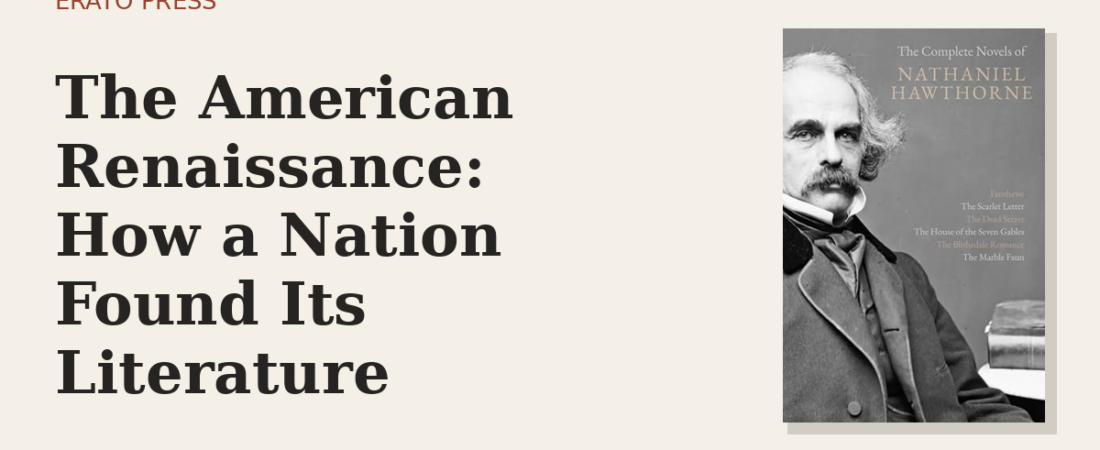
If Emerson supplied the optimism, Hawthorne and Melville supplied the shadow that makes the period whole. Nathaniel Hawthorne, descended from a judge of the Salem witch trials and unable to shake the inheritance, wrote in The Scarlet Letter (1850) the first indispensable American novel — a study of sin, concealment, and public shame set in the Puritan Boston his ancestors helped govern. Hawthorne understood, as Emerson would not, that the American past was not a clean slate but a haunted house, and that guilt was as native to the national character as self-reliance. His tales and romances opened a vein of psychological and moral darkness that ran straight into the heart of the country’s literature.
It was Hawthorne to whom Herman Melville dedicated Moby-Dick (1851), the strange, encyclopedic, half-mad masterpiece that is now the leading candidate for the Great American Novel and was, in its own day, a commercial and critical disaster that effectively ended Melville’s career as a popular author. Where exactly such a book sits in the larger story of American fiction is a question worth a map of its own. Melville took Emersonian self-reliance and pushed it to the edge of monomania in Captain Ahab, and took the democratic faith and tested it against the indifferent malice of the white whale. The book failed in 1851 and was resurrected in the twentieth century precisely because it had seen further than its moment could bear.
The new voice and the hidden poet: Whitman and Dickinson
In poetry the break was even sharper. In 1855 Walt Whitman printed, at his own expense, a thin volume of twelve untitled poems called Leaves of Grass, written in long unrhymed lines that no American had used before — a barbaric yawp that threw out English meter and English decorum to make a verse as sprawling, various, and democratic as the country itself. Emerson, reading it, wrote to the unknown author: “I greet you at the beginning of a great career.” Whitman had answered Emerson’s call for an American poet almost to the letter, and in doing so invented the line that runs through all of modern American verse.
And entirely unknown to any of them, in Amherst, Emily Dickinson was filling her drawers with hundreds of compressed, dash-riddled, metaphysically daring lyrics that would not be properly published until the twentieth century. She is the secret member of the Renaissance — its inward, private counterpart to Whitman’s public expansiveness, proof that the great awakening of American literature was happening even in rooms where no one was watching.
How a nation found its literature
What unites these wildly different writers is a single underlying fact: each was trying to make an art adequate to a new kind of country, one with no aristocracy, no settled tradition, an open continent, a democratic creed, and a monstrous contradiction at its center in the form of slavery. They disagreed about almost everything — Emerson’s optimism against Melville’s darkness, Whitman’s expansiveness against Dickinson’s compression — but they shared the conviction that American experience demanded American forms. The decade around 1850 is when that conviction produced its first masterpieces, and when the line of American literature that would later run through Twain and on to the modern voice we trace in Huckleberry Finn and the American Voice properly begins.
Frequently asked questions
Why is it called a “renaissance” if nothing was reborn?
The term, popularized by F. O. Matthiessen in 1941, is more honorific than literal. There was no earlier golden age of American letters to revive; what the period actually represents is a birth rather than a rebirth — the first flowering of a genuinely national literature. The word stuck because it captures the sense of sudden, concentrated achievement.
Who belongs to the American Renaissance?
Matthiessen’s core five are Emerson, Thoreau, Hawthorne, Melville, and Whitman. Most readers now add Emily Dickinson, whose work was written in the same years though published much later, and many would include Edgar Allan Poe and Frederick Douglass as essential voices of the moment.
Were these books successful when they appeared?
Mostly not. Moby-Dick failed badly and ruined Melville’s career; the first Leaves of Grass sold almost nothing; Dickinson published a mere handful of poems in her lifetime. The American Renaissance is a case where the verdict of posterity reversed the verdict of the marketplace almost completely.
To read these writers together is to watch a literature come into being — to see a nation that had been told it could produce no books of its own answer, within a single decade, with several of the permanent books of the language. The Erato Press edition gathers the foundational work of this moment with the critical apparatus to read it as the connected event it was, rather than as a scatter of isolated classics. Read the Erato Press edition and witness the decade in which America found its voice.
Read the Erato Press edition →
Enjoyed this piece?
Get the next one — our essays on the classics and news of each new Erato Press edition — straight to your inbox.