On the morning of July 11, 1804, the sitting Vice President of the United States rowed across the Hudson to a ledge in Weehawken, New Jersey, and shot the former Secretary of the Treasury through the abdomen. Aaron Burr and Alexander Hamilton were not fringe agitators or hooded night-riders; they were two of the most consequential architects of the republic, men who had helped write and ratify its founding documents. That the second-highest officer in the land could kill one of the Founders in a premeditated encounter, then flee south and later be tried for an entirely separate plot of treason, ought to disturb the comfortable story Americans tell themselves about their political origins. The duel is usually filed under personal honor, a relic of an older code. But it is more honestly read as the first famous entry in a ledger that has never closed.
The thesis of this study is plain and, to many readers, unwelcome: political violence in the United States is not an aberration that periodically interrupts an otherwise placid civic order. It is a recurring structural feature of American life, woven into the founding, the expansion, the wars over slavery and labor and race, and into the present. To call each new episode “unprecedented” or “un-American” is to flatter the country with an amnesia it cannot afford. The honest task is not to rank one era’s bloodshed against another’s, nor to assign the whole burden to a single party or ideology. It is to trace the thread, observe its persistence, and ask what conditions make it flare.
The founding was armed, and stayed armed
The romance of 1776 obscures how violent the early republic remained once the redcoats sailed home. Shays’s Rebellion in 1786 sent indebted Massachusetts farmers, many of them veterans of the Revolution, marching on courthouses and the Springfield arsenal; the fright it caused among the propertied class did as much to summon the Constitutional Convention as any high theory of federalism. Five years later the Whiskey Rebellion drew George Washington himself, in uniform, at the head of a militia larger than any army he had commanded against the British. The new government’s first great demonstration of its own legitimacy was a show of force against its own citizens.
What these early convulsions establish is a pattern visible ever after: violence in America tends to erupt at the seam between competing claims of legitimacy. The Shaysites believed the courts had become instruments of creditor tyranny; the federal government believed the law was the law. Both invoked the Revolution. Neither was simply a criminal. This is the uncomfortable quality of political violence as distinct from ordinary crime: its perpetrators almost always understand themselves as defenders of something, a constitution, a way of life, a people betrayed. The dueling code that killed Hamilton ran on the same logic of legitimacy and honor, scaled down to the individual. The country was born believing that, in extremity, force was an acceptable continuation of argument.
Slavery, secession, and the long aftermath
If the early republic merely hinted at the pattern, the slavery crisis made it national policy. The decades before the Civil War were not a debate that regrettably ended in war; they were a slow-burning war that occasionally paused for debate. “Bleeding Kansas” turned a territorial question into a rehearsal for the conflict to come, with John Brown’s massacre at Pottawatomie and the sack of Lawrence trading like blows. In 1856, in the chamber of the United States Senate itself, Representative Preston Brooks beat Senator Charles Sumner nearly to death with a cane over an antislavery speech, and was celebrated across the South for it. The seat of deliberation had become a scene of assault, applauded.
The war that followed killed three-quarters of a million people, but the more instructive story for the recurrence thesis is what came after Appomattox. Reconstruction was strangled not in open battle but through sustained terror: the Colfax massacre of 1873, the rise of the Klan and the rifle clubs, the systematic murder and intimidation that hollowed out Black political participation across the South for the better part of a century. This was political violence operating as a governing technology, deliberate, organized, and largely unpunished. The lynching regime that persisted into the twentieth century was its grim continuation, a campaign of public terror designed to enforce a racial order that the Constitution, on paper, had abolished. To understand how an enemy population comes to be marked for such treatment, it helps to study the machinery of dehumanization that precedes the violence, the way a group is first rendered less than fully human in the public mind. The companion essay Manufacturing an Enemy: How Propaganda Dehumanizes follows exactly that machinery from the page to the street.
The twentieth century: labor, assassination, and the long sixties
The thread does not thin in the modern era; it changes costume. The struggles between capital and labor between the 1870s and the 1930s produced pitched battles that read like small wars: the Haymarket affair, the Homestead strike with its barge full of Pinkertons, the Ludlow massacre of 1914 in which the Colorado National Guard fired on a tent colony of striking miners and their families. These were not riots in the dismissive sense; they were contests over the basic terms of industrial life, fought with rifles and machine guns because the parties believed nothing less was at stake.
Then there is the American peculiarity of the assassinated leader. Four presidents have been murdered in office, Lincoln, Garfield, McKinley, Kennedy, and the list of those merely shot at or narrowly missed is far longer. The 1960s compressed the pattern into a single traumatic decade: John Kennedy, Malcolm X, Martin Luther King Jr., Robert Kennedy, each killing tearing at the assumption that grievances would be settled at the ballot and the lectern rather than the rifle scope. What unites a Confederate sympathizer, an anarchist, and a segregationist gunman is not ideology but the conviction that removing one body could redirect the course of a nation. That belief is the recurring American virus, indifferent to party.
Why it recurs, and why naming it matters
The reasons for the recurrence are not mysterious, though they resist a single explanation. A heavily armed populace, a frontier myth that romanticizes the man who takes the law into his own hands, a constitutional order that decentralizes power and so multiplies the seams where legitimacy is contested, a tradition of righteous violence baked into the founding scripture itself. Above all, there is the habit of seeing political opponents not as fellow citizens who are wrong but as enemies who are illegitimate. Once an adversary is reclassified as an existential threat, violence ceases to feel like a crime and begins to feel like self-defense. That reclassification is the hinge on which every episode in this ledger turns.
To insist on the recurrence is not counsel of despair, and it is emphatically not an endorsement. Naming a pattern is the precondition for refusing it. The danger of the “this is not who we are” reflex is that it makes each new outbreak a shock with no precedent and therefore no lesson, leaving the country perpetually surprised by its own history. The more useful posture is sober memory: to hold the duel at Weehawken, the cane in the Senate, the burning of Colfax, the rifle in Dallas, and the present in a single field of vision, and to recognize the continuity without collapsing the moral distinctions among them. The historian’s restraint here is not coldness; it is the only honest ground from which to say that this thread can, in fact, be cut, but only by those who first admit it is there.
Frequently asked questions
Does emphasizing the recurrence of political violence excuse it?
No. To say that violence recurs is a descriptive claim about American history, not a normative one about its acceptability. The argument runs the other way: only by acknowledging the pattern honestly can a society interrupt it. Treating each episode as an inexplicable shock guarantees that the next one arrives just as unexpectedly, and just as unaddressed.
Is this study partisan? Does it blame one side?
The thread it traces runs through duelists and abolitionists, anarchists and segregationists, Klansmen and lone gunmen of no fixed creed. The recurring element is structural and psychological, the reclassification of opponents into enemies, not the property of any single party or era. The study’s restraint is deliberate: it withholds the easy satisfaction of assigning the whole burden to one’s political adversaries.
Where should a reader begin to understand the deeper mechanics?
Begin with the seams of legitimacy: moments when two groups each believed the law, the founding, or the people were on their side. From there, study how populations are prepared for violence before any blow is struck, the propaganda and dehumanization that make a neighbor into a target. That preparatory machinery is the subject worth understanding first.
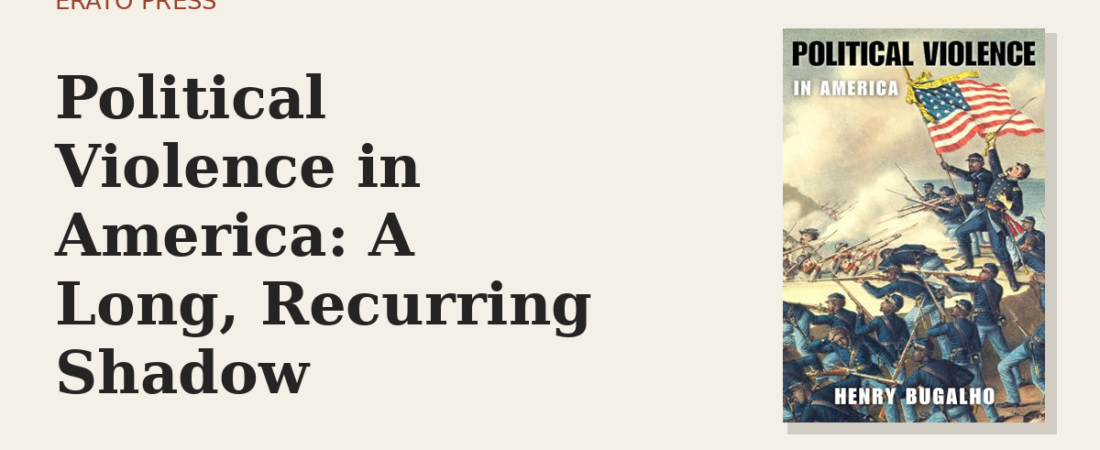
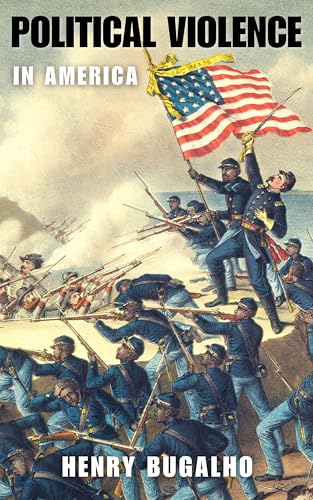
Henry Bugalho’s study refuses both the comfort of amnesia and the cheap thrill of partisan accusation. It reads the American record as a single long document, from Hamilton’s last morning to the present, with the patience of a historian and the unease of a citizen. The Erato Press edition presents that argument with its full apparatus, sources, and chronology intact, so the reader can follow the thread for themselves rather than take its existence on faith.
Enjoyed this piece?
Get the next one — our essays on the classics and news of each new Erato Press edition — straight to your inbox.