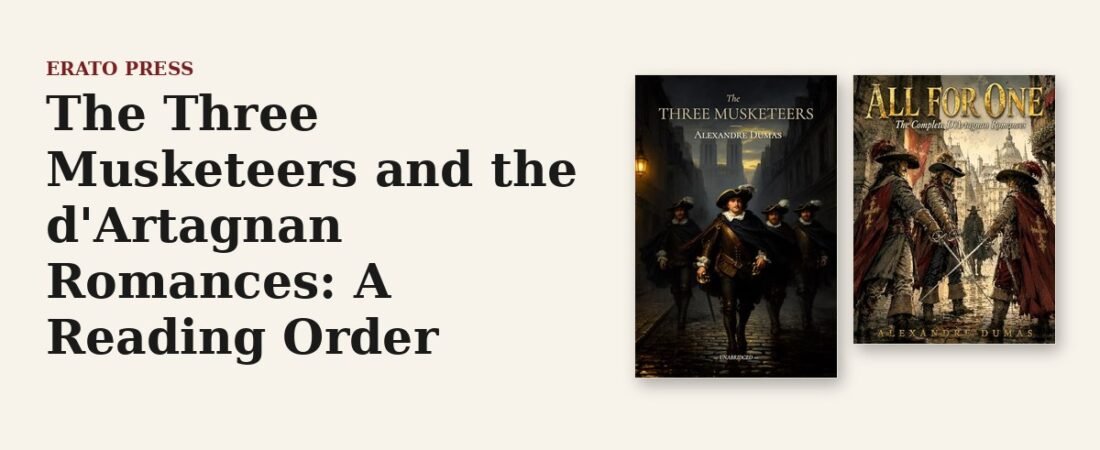
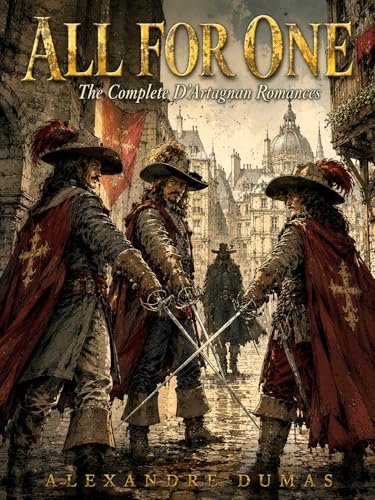
Short answer: Read them in order — The Three Musketeers, then Twenty Years After, then The Vicomte de Bragelonne (which ends with the Man in the Iron Mask). But know what you’re starting: not three adventure novels, but one thirty-year story that grows from comedy to elegy. The complete d’Artagnan Romances collect the whole arc in a single volume.
A novel that opens, not begins
There’s a useful distinction between novels that begin and novels that open. A novel that begins asks you to start patiently at the start; it’s a contract with deferred rewards. A novel that opens is already in motion when you arrive — the world has been running without you and will keep running whether you keep up or not. The Three Musketeers opens. A young Gascon on a comically ugly yellow horse rides into Meung, collects an insult and three duels for the same hour, and you have already surrendered. Where Balzac begins with sociology and Flaubert with style, Dumas begins with momentum, and never wastes a step. It is among the most assured openings in all of popular fiction, and everything that makes the saga great is already coiled inside it.
The reading order — and what each book becomes
1. The Three Musketeers (1844). Comedy and intrigue: the queen’s diamonds, the duels, the unforgettable Milady — one of the great villains in the language. D’Artagnan starts as a figure of slight absurdity and ends, by the final chapter, magnificent; the distance between the ridiculous and the heroic is exactly the length of the book.
2. Twenty Years After (1845). The longest and strangest of the three, and the most tonally uncertain — it moves between the swagger of its predecessor and an unmistakable elegiac chill. This is the novel in which Dumas first turns his attention to what time does to people, and what it does is not kind. When d’Artagnan finds his old companions, he finds them diminished — not in their essential qualities, which remain, but in their circumstances. Athos has retreated to the country to raise a son; Porthos has bought a barony and discovered that money cannot purchase the social ease birth would have given him for nothing; Aramis has become an ecclesiastical politician, fluent in the drawing rooms of Paris; and d’Artagnan is still a lieutenant, still as brave as ever, still passed over by men with better connections and no better skills. Darker, wiser, and many readers’ favorite.
3. The Vicomte de Bragelonne (1847–50). The vast finale — which appears in English in three volumes, the last titled The Man in the Iron Mask — is Dumas’s most ambitious work and, in many ways, his finest. Its great subject is time. The political setting is Louis XIV’s assumption of personal rule after Mazarin’s death in 1661, the moment the Sun King became the Sun King and France reorganized itself entirely around his person. Dumas understands the meaning of that reorganization with precision: the new France being built at Versailles has no place for the old France of individual honor and personal loyalty that the musketeers represent. Louis needs functionaries like Colbert — cold, precise, tireless — not heroes. The bright noise of musketeers clattering through Paris gives way to the silence of a chapel and the last of the four laid in the earth.
All for one: what the motto actually costs
Tous pour un, un pour tous is the most famous phrase Dumas ever wrote, and it has been worn smooth into a cheerful slogan. The novels mean something harder by it. The brotherhood of Athos, Porthos, Aramis, and d’Artagnan is not a condition of their existence; it is chosen, renewed, and earned across fifty years of a shared life that includes long separations, conflicting political loyalties, and at least one act of near-unforgivable betrayal. Twenty years pass between the first novel and the second, and the men who reconvene are not the men who swore the oath. What elevates the saga from adventure fiction to something with genuine philosophical weight is that the friendship survives anyway — not as nostalgia, but as a thing the four of them keep deciding to honor even when their interests pull them apart.
A curiosity: Dumas didn’t invent d’Artagnan
He found him. The raw material came from a semi-fictional memoir published in Amsterdam in 1700, the Mémoires de M. d’Artagnan, attributed to Gatien de Courtilz de Sandras. Dumas encountered it in 1843 and recognized in its blend of real history and invention the scaffolding for something far larger — a habit of his, turning a forgotten source into an immortal. The work of expanding that scaffolding into a saga was shared with his collaborator Auguste Maquet, who supplied much of the historical research.
Why read the whole arc
Because the saga’s real subject is time, and you cannot feel it from the first novel alone. Read only The Three Musketeers and you get a great adventure. Read all three and you get one of fiction’s great long elegies for youth — four young men becoming old, a friendship outlasting kingdoms, an entire age ending. To meet the men individually at their best, the standalone Three Musketeers is the perfect door; to live the whole story, the complete Romances are the volume to own.
Get the complete d’Artagnan Romances in one volume →
Or start with the standalone Three Musketeers →
Related reading: Where to Start With Alexandre Dumas · The Count of Monte Cristo Isn’t Who You Think · Dumas and the Ghostwriter Question
This article contains affiliate links; as an Amazon Associate, Erato Press earns from qualifying purchases.
Enjoyed this piece?
Get the next one — our essays on the classics and news of each new Erato Press edition — straight to your inbox.