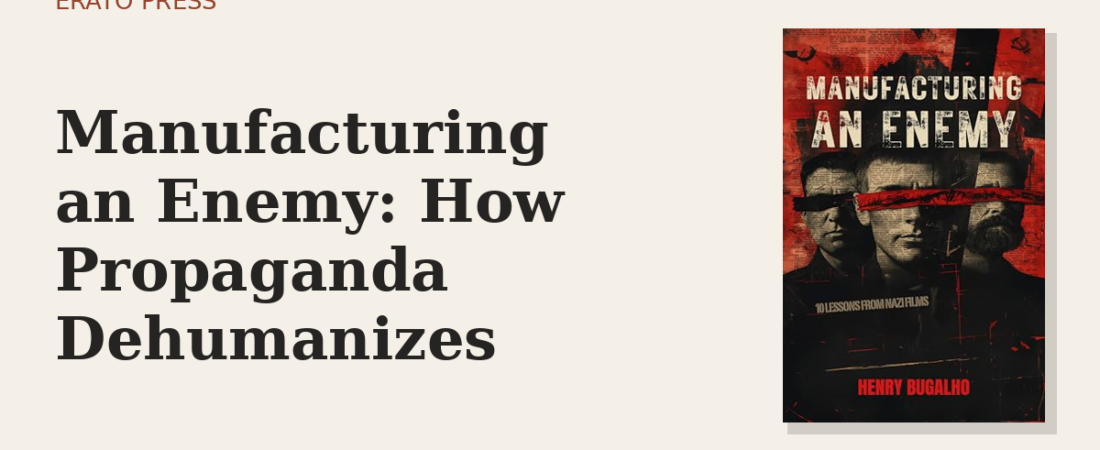
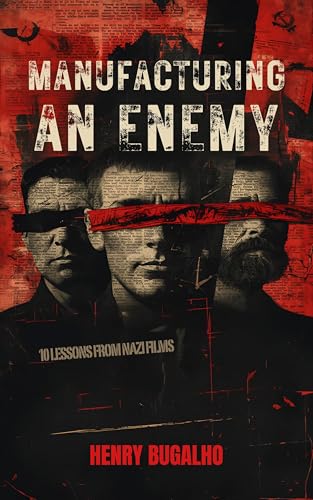
Propaganda did not kill six million people. Police killed them, and soldiers, and bureaucrats who stamped the forms, and the railwaymen who drove the trains, and the guards who opened the doors. But propaganda created the conditions in which the killing became possible — and that is the harder, more disquieting fact that Henry Bugalho’s study of how an enemy is manufactured sets out to make legible. The book’s central insight is that the production of an enemy has two inseparable dimensions, the discursive and the material, and that the first is what licenses the second. Language builds the category — “the parasite,” “the invader,” “the enemy of the people” — and only once the category exists can the doors begin to close: first the small doors of a lost job or a forbidden school, and at last the large ones of revoked citizenship and suspended right to life. To understand the mechanics of othering is not an academic exercise. It is, as the book insists, a condition of resisting it.
The discourse before the deed
The argument turns on a deceptively simple observation: the same physical act changes its moral meaning according to the discourse that surrounds it. To arrest, to deport, to kill — these are constants. What varies is the story told around them. A Jewish citizen described as a religious minority is a person whose persecution is plainly a crime; the same citizen described as “a parasite draining the nation’s blood” becomes a thing whose elimination can be presented as self-defense. A migrant described as a person seeking a better life makes mass deportation read as cruelty; the same migrant recast as an “invader threatening to destroy civilization” makes the deportation read as survival. Propaganda, in this reading, does not supply hatred so much as supply justification — the moral cover without which violence remains illegitimate even to those who commit it. This is why Hannah Arendt, reporting from Eichmann’s 1961 trial, found that the perpetrators of the Holocaust so rarely saw themselves as criminals. They saw themselves as soldiers in a defensive war, as doctors fighting a disease, as officials carrying out necessary orders. The inversion was not hypocrisy. It was genuine belief, manufactured over years by a discourse that had quietly redefined the terms of moral debate.
The staircase
The most useful image in the book is the staircase. Genocide, Bugalho insists, is not a lightning bolt from a blue sky; it is a process, an escalation in which each measure is a single step, and each step, viewed in isolation, can always be minimized. The German Jews of the 1930s lived this descent in slow motion. The Law for the Restoration of the Professional Civil Service, in April 1933, dismissed Jewish state employees — but one could still work in the private sector. The Doctors’ Law and the Lawyers’ Law of the same year closed off the professions — but other livelihoods remained. The Nuremberg Laws of 1935 stripped Jews of citizenship and forbade their marriages to non-Jews — and still it was possible to believe the worst had passed. In November 1938, the pogrom of Kristallnacht turned scattered violence into coordinated state violence, synagogues burning and shops shattered across Germany — and the regime presented it as a spontaneous popular reaction, maintaining the fiction that the state was merely channeling the people’s indignation rather than orchestrating it. Then came the ghettos, the deportations, the camps. Whoever stood on a single step could call it an administrative measure, a security question, a temporary necessity, a justifiable exception. Only whoever looked at the whole staircase could see where it led. This is the work that euphemism performs: it allows those who wish not to see, not to see.
Turning the other into a beast
At the foundation of the staircase lies the oldest technique of all — the conversion of a human being into an animal, a contagion, a thing. The vermin metaphor recurs across the history of atrocity because it does a precise piece of work: it severs the target from the moral community, so that what would be murder among humans becomes mere extermination of pests. Disgust, the psychologists who study prejudice have shown, is the affect most easily recruited to this end, and propaganda has long known it instinctively — the language of rats and lice and infestation, of blood and parasitism, attaching itself to the chosen enemy until the figure of speech hardens into a premise. And crucially, dehumanizing speech does not work by argument. It works by feeling. It bypasses the slow, contestable machinery of reason and lodges itself in the faster, cruder channels of fear and revulsion — which is why it is so resistant to correction and why repetition, not evidence, is its method. A claim repeated often enough acquires the texture of truth regardless of its content.
The indifference that makes it possible
The book’s most original contribution is its refusal to treat indifference as a single thing. The direct perpetrators of genocide — the men who fire the rifles, who operate the machinery of death — are always a small fraction, tens of thousands in a nation of tens of millions. What converts their localized cruelty into industrial murder is the vast surrounding network of those who do not pull a trigger but make the trigger usable: the clerk who processes the documents, the engineer who supplies the materials, the neighbor who does not hide the fugitive, the citizen who does not protest. The system needs perpetrators to function, but it needs bystanders to persist. And bystanding, Bugalho argues, is not one posture but a spectrum: genuine ignorance shades into cultivated ignorance, the preference not to know — “I didn’t know,” the postwar refrain, so often meaning “I didn’t want to know”; fear shades into opportunism, the colleague who quietly buys the vacated business for a fraction of its worth; and at the far end, collaboration disguises itself as neutrality, the informer who insists he merely did his job. The right question, the book proposes, is not “Am I as guilty as the murderer?” — plainly one is not — but “What did my omission make possible?”
Why it recurs
It would be comforting to consign all of this to history. The book denies us the comfort. Its warning is careful and earns its restraint: we do not live in a repetition of Nazism, and the direct comparison, given the immense differences of context and scale, more often obscures than illuminates. But the techniques are the same, and the psychological mechanisms they exploit are the same, and applied without sufficient resistance they point in the same direction. The conspiracy theory of a hidden elite secretly directing the world is the old forgery — the Protocols — in new clothing, and it surfaces, almost verbatim, in the manifestos of the men who have walked into mosques and synagogues to kill. The leaders who speak of invasion and infestation, the laws that revoke rights that had seemed permanently settled, the camps in which children are separated from their parents — these are not Auschwitz, and saying so would be both false and lazy. But they are the lower steps of a staircase whose shape we have seen before. Recognition, the book concludes, is a necessary condition and not a sufficient one: you cannot resist what you cannot see, nor oppose an escalation whose steps you cannot name. Recognize in order to resist. There is no other formula, and no guarantee that it works — only the fact that it is what we have.
Frequently asked questions
Isn’t comparing anything to Nazi Germany a cheap rhetorical move?
Often it is, and the book is unusually scrupulous on exactly this point. It refuses the lazy equation, insisting that the differences of context, scale, and intensity between the Third Reich and any contemporary situation are immense, and that a flat comparison usually obscures more than it reveals. The argument is narrower and harder to dismiss: not that history repeats, but that a set of techniques — the vermin metaphor, the appeal to feeling over argument, the euphemism that hides the staircase — recurs, and can be studied as technique independent of any single regime.
Why focus on bystanders rather than the perpetrators themselves?
Because the perpetrators, the book shows, are too few to accomplish mass murder alone. Drawing on Raul Hilberg’s scheme of perpetrators, victims, and bystanders, and on the conformity experiments that demonstrate how a single dissenter can break a group’s silence, Bugalho argues that atrocity depends on the immense passive majority that supplies its infrastructure and its cover. Responsibility is graded, not equal — the guard who fires is more culpable than the neighbor who looks away — but the neighbor’s omission is not therefore innocent. It is part of what made the firing possible.
Is this a history book or a warning about the present?
Both, and deliberately so. It uses the documented machinery of the Nazi descent — the 1933 professional laws, the 1935 Nuremberg Laws, the 1938 pogrom — as its case study precisely because that machinery is so thoroughly recorded, then turns the analysis toward the techniques as they operate in newer media. The historical specificity is what gives the contemporary warning its weight; without the dates and the documents, the warning would be mere alarm.
Bugalho’s study reads the primer of dehumanization in order to disarm it — a work of historical analysis written as an act of civic resistance, lucid about the past and unsentimental about the present. The Erato Press edition gives you the full argument, its sources, and its critical apparatus.
Enjoyed this piece?
Get the next one — our essays on the classics and news of each new Erato Press edition — straight to your inbox.