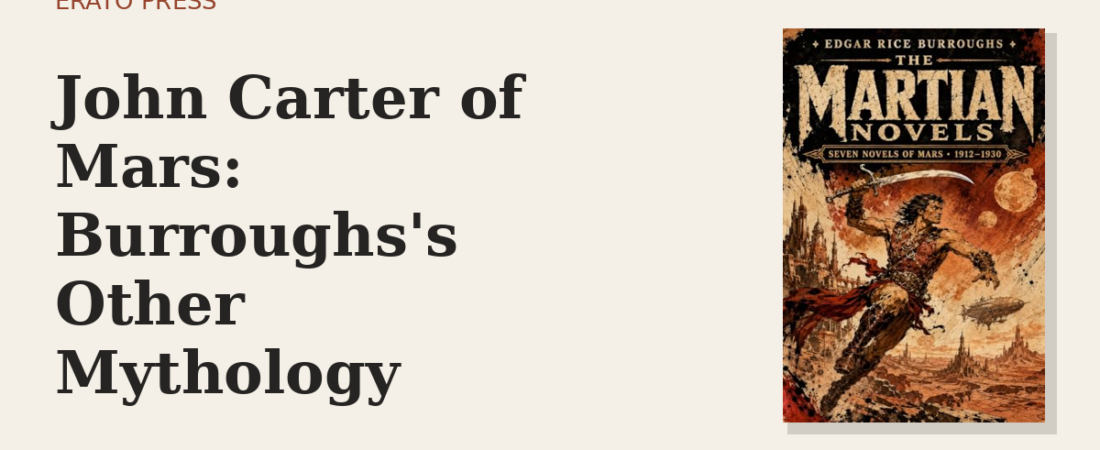
In 1911, a failed pencil-sharpener salesman in Chicago, deep in debt and convinced he could write garbage at least as well as the garbage filling the pulp magazines he read, began a story he was too embarrassed to sign with his own name. He called himself “Normal Bean” — a man of sound mind — and the editor, assuming a typo, printed it as “Norman.” The story was Under the Moons of Mars, later titled A Princess of Mars, and the man was Edgar Rice Burroughs. A year before he sent Tarzan swinging into the canopy, he had already invented something stranger and, in the long run, more consequential: a whole planet. His name for Mars was Barsoom, and the genre he was inventing without quite knowing it would eventually be called planetary romance.

The thesis here is simple and a little subversive: Burroughs is routinely patronized as a hack, and the Mars books are routinely shelved with the disposable pulp they outsold — but the dream-architecture he built on Barsoom became one of the load-bearing structures of twentieth-century popular imagination. Half the marvels we now take for granted in superhero films and science-fiction blockbusters were prototyped, crudely and gloriously, in a dying Martian world he conjured before the First World War. He was not a good prose stylist. He was something rarer: a great inventor of worlds.
How to fall up into the sky
The premise is delivered with a straight face that is half the charm. John Carter, a Confederate cavalry officer prospecting in Arizona after the Civil War, is cornered by Apaches in a cave, undergoes a kind of astral death, and wakes — naked, inexplicably — on Mars. Because Barsoom’s gravity is weaker than Earth’s, his Virginia-bred muscles make him a superman there: he can leap enormous distances and fight with unnatural strength. Hold that detail in your mind, because it is the seed of an entire mythology. A man from one world whose ordinary body becomes extraordinary on another, who can leap great distances in a single bound — this is, two decades early, the original origin of Superman, whose creators borrowed the gravity-gives-strength logic almost wholesale before they ever sent him flying.
What Burroughs understood, and what made him a phenomenon, was the engineering of momentum. A chapter of a Barsoom novel rarely closes without a sword at someone’s throat or a chasm opening underfoot. The plots are machines for forward motion: Carter loves the princess Dejah Thoris of Helium, loses her, crosses a continent of monsters and warring city-states to find her, loses her again. The dead sea bottoms, the crumbling cities of a planet drying to its death, the great atmosphere factory that keeps Barsoom breathing — these are sketched with an economy that leaves room for the reader’s own imagination to furnish them. Burroughs gives you the floor plan; you build the house.
A taxonomy of wonders
The richness of Barsoom is in its cataloguing. Burroughs populated his Mars with the four-armed, green-skinned, fifteen-foot Tharks, a warrior race raised without family or tenderness; the red Martians, humanlike and civilized; the white apes; the calots and thoats, the Martian war-beasts; later the plant men, the spider-thing Kaldanes, the cannibal cult of Issus. He gave the planet its own geography, its own measures of time, even fragments of its own language — the green Martians’ word for the unit of distance, the names of their cities. It is a thinner world-building than Tolkien’s, who came a generation later and had a philologist’s patience, but it is the same impulse, and Burroughs got there first in the popular field.
And he understood that wonder needs a guide. Carter is the displaced Earthman who must learn Barsoom’s rules alongside us, the human lens through which an alien world becomes legible. That structural choice — the outsider who arrives, learns the ways of a strange people, falls in love across the species line, and finally goes native — is the exact armature of James Cameron’s Avatar, a debt the film’s own designers have acknowledged. The blue Na’vi, the floating mountains, the human who becomes more at home among the aliens than among his own kind: it is Barsoom in 3-D, ninety-odd years on.
The reach of a dying planet
The line of influence is long and well documented, and the names on it did not hide their debts. Carl Sagan kept a map of Barsoom on his wall and credited the Mars novels with first turning his boyhood eyes toward the real planet. Ray Bradbury, whose Martian Chronicles is a melancholy reply to Burroughs, said he wrote his own Mars because he had loved Burroughs’s first. Arthur C. Clarke and Robert Heinlein read the books as boys; so did Jack Vance, whose Dying Earth inherits Barsoom’s mood of beautiful exhaustion. The lineage runs straight through the genre and out the other side into film: the leaping superhero, the sword-and-rocket exoticism that George Lucas distilled, the white-savior-among-aliens romance that Hollywood keeps re-staging. Whole shelves of twentieth-century fantasy and science fiction begin in this one feverish, half-ashamed Chicago manuscript.
It is worth being honest about the flaws that come bundled with the wonders. Carter is a Confederate hero, and the books carry the racial assumptions of 1912 in their bones — the hierarchies of skin color among the Martian races are not incidental, and a modern reader has to read them with open eyes rather than nostalgia. Burroughs’s women, Dejah Thoris above all, are brave and capable and then, with maddening regularity, reduced to prizes to be rescued. None of this is hidden, and none of it should be excused. But none of it cancels the achievement either. The reader who wants the full measure of the man who built both this red planet and the African jungle of Tarzan will find it traced in Edgar Rice Burroughs: Tarzan, Mars, and Pulp Adventure.
Why the pulp endures
Critics have always struggled to explain why books this crudely written refuse to die. The answer is that Burroughs operated below the level where prose style matters, at the level of dream. His Mars is a child’s idea of adventure given just enough adult architecture to be inhabitable: a place where a tired man from a defeated army can wake up strong, brave, and loved, in a world that needs exactly his particular courage. That fantasy is not sophisticated, but it is durable, because it answers a hunger that sophistication does not reach. Burroughs gave the twentieth century a place to escape to, and then taught a hundred better writers how to build escapes of their own.
Frequently asked questions
Where should I start with the Barsoom books?
At the beginning: A Princess of Mars (1912). It establishes Carter, Dejah Thoris, the Tharks, and the whole logic of the world, and it ends on a cliffhanger that pulls you straight into The Gods of Mars and The Warlord of Mars, which together form the founding trilogy. Read those three before deciding how deep to go — the later volumes are more uneven.
Is it the same author as Tarzan?
Yes. Edgar Rice Burroughs created John Carter first, in 1911–12, then Tarzan immediately after, and wrote both series for decades. The Mars books are the more inventive in their world-building; the Tarzan books were the bigger commercial juggernaut. Together they made Burroughs one of the best-selling authors on earth.
How dated is it for a modern reader?
Quite dated in its racial and gender assumptions, and worth reading with that awareness. But the pace, the invention, and the sheer momentum hold up remarkably well — this is fast, vivid, unembarrassed adventure, and it reads quicker than its age suggests.
The Erato Press edition collects the foundational Barsoom novels with the context that turns a guilty pleasure into a genuine landmark — how Burroughs built his planet, who he influenced, and where to place him in the history of imaginative fiction.
Read the Erato Press edition →
Enjoyed this piece?
Get the next one — our essays on the classics and news of each new Erato Press edition — straight to your inbox.