When Charles Dickens wanted a writer who could make the cotton mills of the north feel like a moral emergency rather than a statistical abstraction, he turned to a Unitarian minister’s wife in Manchester. Elizabeth Gaskell published her first novel, Mary Barton, anonymously in 1848, the year revolutions burned across Europe and the year after she had buried her infant son. The grief and the politics were not separate things. Gaskell understood, more clearly than almost any English novelist of her century, that suffering is suffering whether it visits a parlour or a cellar, and that the great failure of the industrial age was the refusal of one class to credit the pain of another with the same reality it granted its own.

That conviction is the engine of her best work, and it makes her the indispensable novelist of what Thomas Carlyle called the “Condition of England.” Where Dickens caricatures and Disraeli theorises, Gaskell listens. Her thesis, never stated but everywhere enacted, is that the masters-and-men conflict is not finally a problem of economics but of imagination: people cannot extend sympathy to those they have never been forced to see.
The Manchester she could not unsee
Gaskell wrote from inside the disaster. As the wife of William Gaskell, minister at Cross Street Chapel, she visited the homes of the Manchester poor through the Hungry Forties, the decade of failed harvests, Chartist agitation, and trade depression. Mary Barton carries that firsthand knowledge in its very fabric. The Davenport family, found by John Barton and Wilson in a flooded cellar, the father dying of typhus on damp straw while the children cry from hunger, is not a set piece designed to wring tears. It is reportage transposed into fiction, and Gaskell’s refusal to soften it scandalised Manchester’s manufacturers, who felt, accurately, that the book held them accountable.
What gives the novel its unusual moral nerve is that Gaskell does not flinch from where desperation leads. John Barton, a decent man broken by the death of his son and the contempt of his employers, becomes the murderer of young Henry Carson, the mill-owner’s son. Gaskell could have written a melodrama of innocent workers and villainous masters. Instead she wrote a tragedy in which a good man is deformed into a killer by conditions, and in which the bereaved father of the victim, the elder Carson, must learn to forgive. The novel’s climax is not the murder but the scene of reconciliation, when old Carson kneels with the dying Barton and the two grieving fathers recognise each other’s loss. Sympathy, for Gaskell, is the only thing that can interrupt the logic of class war.
North and South: the argument made human
If Mary Barton is told from below, North and South (1855) is Gaskell’s attempt to hold both sides of the divide in a single frame. Margaret Hale, transplanted from the soft green south of England to the smoky manufacturing town of Milton, arrives with all the genteel prejudices of her class intact. She finds the masters coarse and the workers brutish. The novel is the slow, often painful correction of that first impression, and Gaskell is honest enough to make the correction run in both directions.
The mill-owner John Thornton begins as the embodiment of the cash nexus, the man who sees labour as a commodity and strikes as insubordination. But Gaskell will not let him stay a type. Through his arguments with Margaret, and through his own hard intelligence, Thornton comes to understand that his workers are not instruments but people whose consent he needs and whose grievances are real. The strike that erupts at Marlborough Mills, with Margaret thrown into the violence of the crowd, is one of the great set pieces of Victorian fiction precisely because Gaskell refuses to assign all the right to one side. The masters’ need for profit and the workers’ need for bread are both legitimate, and both, left to themselves, are murderous. What Thornton finally proposes, a shared dining-room, conversation across the divide, is modest almost to the point of anticlimax. That is the point. Gaskell did not believe in revolutions. She believed in the slow, unglamorous work of one person being forced to see another whole.
The novelist as moral witness
It would be a mistake to file Gaskell only under industrial fiction. She wrote the wry, affectionate comedy of Cranford, the dark social protest of Ruth, which dared to make a fallen woman its sympathetic heroine, and the great unfinished Wives and Daughters, a novel of provincial life that some readers rank with George Eliot. But the industrial novels remain her distinctive achievement, because in them she found a subject worthy of her particular gift: the capacity to make the suffering of strangers feel as urgent as one’s own.
This is harder than it sounds, and most reformist fiction fails at it, collapsing into either sentiment or statistics. Gaskell succeeds because she had a novelist’s ear before she had a reformer’s argument. Her workers speak in the Lancashire dialect she transcribed with care, not as comic relief but because their speech carries their dignity. Her mill-owners are permitted real intelligence and real pain. She grants everyone an interior life, and that grant of interiority is itself a political act. To read Bessy Higgins, the dying mill-girl in North and South, describing the cotton fluff that has destroyed her lungs is to be made unable, ever again, to think of the textile trade as a clean abstraction.
Why she still reads as urgent
We live in our own age of vast inequality and of arguments conducted between people who never meet. Gaskell’s central insight, that moral progress depends on the imaginative effort of crossing into another’s experience, has lost none of its force. She is the novelist who took the Victorian conscience and refused to let it stay comfortable, who insisted that the prosperous south and the suffering north belonged to one country and one moral community. Friedrich Engels documented the condition of the English working class in the same Manchester at the same time; Gaskell made it impossible to forget that the condition belonged to human beings with names.
Frequently asked questions
Where should a new reader start with Gaskell?
For the full force of her industrial vision, begin with North and South, which balances love story, social argument, and a heroine of genuine intellectual growth. If you want the rawer, angrier early Gaskell, read Mary Barton first. Readers who prefer comedy to crisis should start with Cranford and work outward.
Was Gaskell a radical?
Not in any party sense. She distrusted both the laissez-faire dogma of the manufacturers and the violence she feared in Chartism. Her radicalism was moral rather than political: she believed the rich had an absolute obligation to know how the poor lived, and she used the novel to enforce that knowledge. Her manufacturer critics found her dangerous enough.
Did she really write a biography of Charlotte Brontë?
Yes, and it is a landmark. Gaskell’s The Life of Charlotte Brontë (1857) helped fix the myth of the isolated genius on the moors, and it remains a model of sympathetic, sometimes controversial, literary biography written by one great novelist about another.
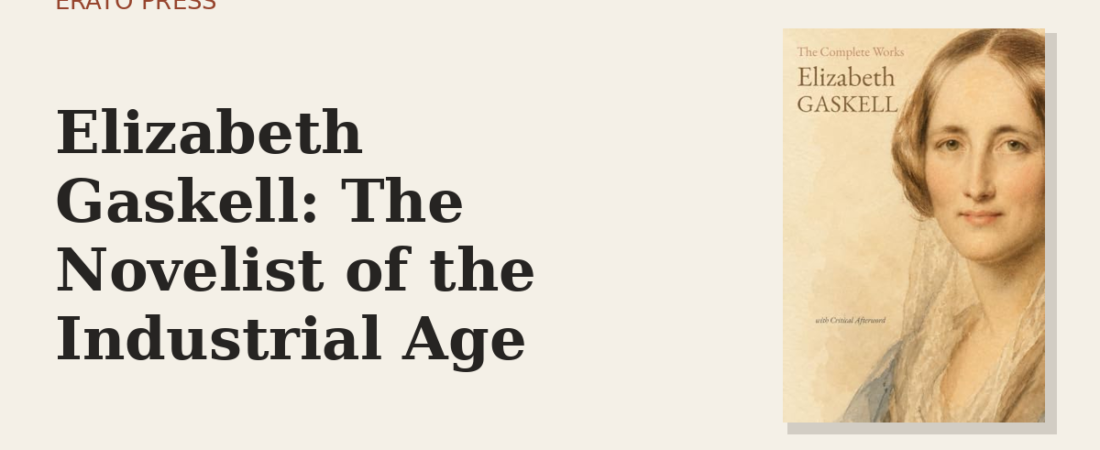
To read Gaskell well is to read her slowly, attentive to the dialect, the moral pressure, the refusal of easy answers. The Erato Press edition gathers her industrial vision with an introduction and apparatus that situate the novels in the Manchester she walked through and the debates she helped to shape, so that the cellars and the counting-houses come back into focus as the connected world she always insisted they were.
Read the Erato Press edition →
Enjoyed this piece?
Get the next one — our essays on the classics and news of each new Erato Press edition — straight to your inbox.