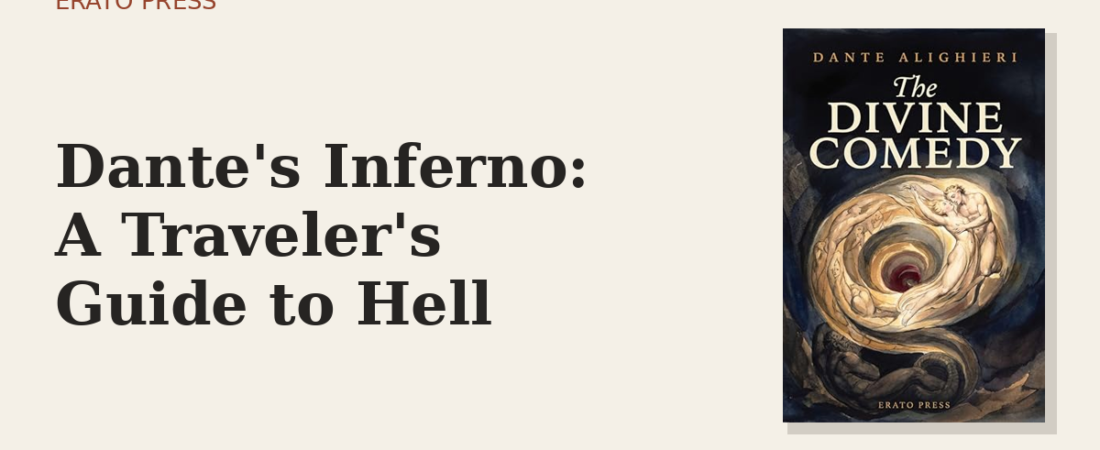
“Midway upon the journey of our life I found myself within a forest dark, for the straightforward pathway had been lost.” So begins the most famous descent in literature. Dante Alighieri, exiled from Florence in 1302 and writing his great poem in the bitter decades that followed, did something no theologian had quite dared: he mapped Hell. Not as a vague region of torment but as an actual place, with a geography, an architecture, a downward-spiraling funnel of nine concentric circles bored into the earth, each with its own population, its own punishment, its own logic. Inferno is the first canticle of the Divine Comedy, and it remains the most vivid imaginative space ever constructed in verse precisely because Dante built it like an engineer, not a preacher.

The thesis worth holding onto as you descend is this: Dante’s Hell is not arbitrary cruelty but a system of perfect moral justice, in which every punishment is the sin itself made visible, eternal, and inescapable. To read the Inferno is to take a guided tour through a place where the soul gets, with terrible precision, exactly what it chose. Understanding that principle turns the poem from a museum of medieval horrors into a coherent and unforgettable journey.
The guide, and why you need one
No one descends into Hell alone. Dante the pilgrim, lost and terrified at the poem’s opening, is rescued by the shade of Virgil, the great Roman poet of the Aeneid, sent to lead him down through the abyss. The choice is deliberate and rich. Virgil represents human reason at its highest, the best that unaided intellect and classical virtue can achieve, and that is exactly why he can guide Dante through Hell but cannot, later, enter Paradise. A pagan who lived before Christ, Virgil is himself a resident of Limbo, the first circle, where the noble souls who lacked baptism dwell in a sorrow without torment, sighing for a heaven they will never see.
For the reader, Virgil is the indispensable companion: the one who explains the rules, names the damned, and steadies the pilgrim when he faints from pity or horror. Their relationship, the anxious student and the patient master, gives the cosmic journey a human warmth that keeps it from becoming a mere catalogue. When Virgil is proud of Dante, the reader feels it. When even Virgil is baffled, at the gates of the lower city of Dis, where the demons bar the way, the danger becomes real.
The law of contrapasso
The governing principle of Dante’s Hell has a name: contrapasso, the counter-suffering, the punishment that fits and mirrors the crime. Once you grasp it, the whole structure clicks into place, because every circle becomes legible as a kind of poetic justice. The lustful, who in life let passion sweep them away, are blown forever on a black wind that gives them no rest, their wills as powerless now as they made them then. The gluttons wallow in cold, filthy mud under endless rain, the appetite that consumed them turned to the squalor it always was. The wrathful tear at each other in the muddy river Styx, while the sullen lie gurgling beneath its surface, choking on the resentment they nursed in the sweet air above.
The deeper you go, the more ingenious and ghastly the symmetry. The flatterers are sunk in excrement, the filth they spoke made literal. The fortune-tellers and diviners, who tried to see too far ahead, have their heads twisted backward on their necks so they can only look behind, weeping down their own spines. The thieves are fused and transformed into reptiles, endlessly stealing one another’s very shapes, because they could not respect the boundary between what was theirs and what was another’s. The sowers of discord, who split communities and families, are themselves split open by a sword-wielding demon, their wounds healing only so they can be cleaved again. Nothing is random. Hell is the sin, frozen into eternity and shown for what it is.
The architecture of the descent
Dante organizes his nine circles by an explicit moral hierarchy, and the order tells you what he thought was worst. The upper circles punish the sins of incontinence, the failures of self-control: lust, gluttony, greed, anger. These are sins of appetite, weaknesses of the flesh and temper, and Dante treats them with a certain pity. Lower down, past the walls of the city of Dis, lie the sins of violence, against others, against oneself in suicide, against God and nature. The suicides have become gnarled, bleeding trees, having thrown away the human bodies they will never reclaim even at the Last Judgment.
But the deepest circles, the ones Dante reserved for the truly damned, punish not appetite or violence but fraud and treachery, the sins of the corrupted intellect, the betrayal of trust. This is the moral heart of the poem’s design: Dante believed that to abuse reason, the faculty that makes us human and most resembles God, was worse than any sin of mere passion. In the eighth circle, the Malebolge, the fraudulent are tormented in ten stone ditches. And at the very bottom, in the ninth circle, the traitors are not burned but frozen, locked in a lake of ice called Cocytus, because betrayal is a coldness, the absolute absence of the warmth that binds human beings to one another.
Why the damned are unforgettable
What raises the Inferno above any other vision of the afterlife is that its sinners are not abstractions. They are characters, fully alive in their damnation, and Dante lets them tell their own stories. Francesca da Rimini, in the circle of the lustful, recounts how she and her brother-in-law Paolo fell in love while reading together of Lancelot, and how “that day we read no more.” She is so eloquent, so sympathetic, that Dante the pilgrim faints from pity, and the reader is meant to feel the pull of that pity too, even while knowing she is justly condemned. The poem is a constant tension between compassion for the human being and acceptance of the divine judgment.
Then there is Ulysses, wreathed in flame among the false counselors, who tells of his last fatal voyage past the limits of the known world, urging his crew onward with the cry that they were not made “to live like brutes, but to follow virtue and knowledge.” It is a magnificent speech, and it damns him, because his hunger to transgress every boundary was itself the sin. And at the absolute pit of the universe, Dante and Virgil reach Satan himself, frozen waist-deep in ice, his three mouths forever chewing the three arch-traitors, Judas, Brutus, and Cassius, the betrayers of Christ and of Caesar. From there the only way out is to climb down the giant’s own frozen body and emerge, at last, to “see again the stars.” Hell, in Dante, is not the end of the journey. It is the place you must pass through to begin climbing back toward the light.
Frequently asked questions
Do I need to read the whole Divine Comedy?
The Inferno stands powerfully on its own and is by far the most read of the three canticles; many readers stop there. But it is the first movement of a single great structure that rises from Hell through Purgatorio to Paradiso, and the descent gains its full meaning as the beginning of an ascent. Read Inferno first, by all means, but know that the journey was designed to go upward.
Who are all these people Dante meets?
Many are figures from classical myth and the Bible, but a great many are Dante’s own contemporaries, Florentine politicians, popes, neighbors, and personal enemies, whom he placed in Hell as an act of judgment and sometimes revenge. A good edition with notes is genuinely necessary here, since half the poem’s force comes from knowing who is being punished and why.
Is Dante’s Hell official Catholic doctrine?
No. It is a poet’s imaginative construction, drawing on theology, Aristotle, and scripture, but invented in its specifics. The nine circles, the contrapasso, the frozen Satan, are Dante’s art, not Church teaching, which is part of why the poem feels so personal and so daring.
The Inferno repays a reader who descends with a map in hand, attentive to the logic of each circle and the voices that rise from it. The Erato Press edition provides exactly that: a translation that keeps the poem’s momentum alongside the historical and theological apparatus needed to know who Dante is condemning and what each punishment means. For the larger architecture into which this descent fits, see Dante’s Divine Comedy: A Map of the Afterlife.
Read the Erato Press edition →
Enjoyed this piece?
Get the next one — our essays on the classics and news of each new Erato Press edition — straight to your inbox.