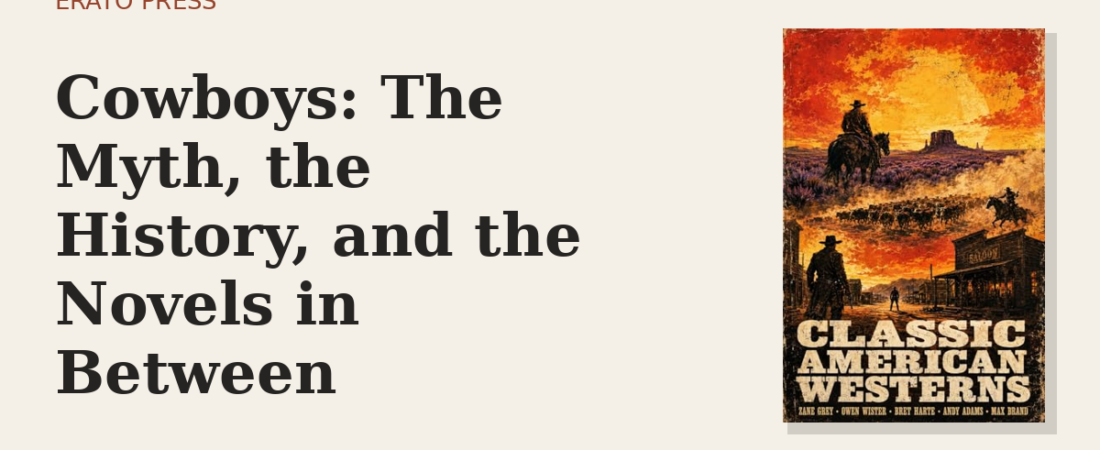
The cowboy is the most successful fiction the United States ever produced — so successful that most people cannot tell where the history ends and the invention begins. He stands in the imagination tall, white, laconic, free, a horseman riding the open range answerable to no one. The reality was almost the opposite at nearly every point. The argument of this essay is that the gap between the real cowboy and the mythic one is not a flaw in the Western but its actual subject: the genre is the machine that converted a brief, badly paid, multiracial labor history into a national fantasy of freedom, and the most interesting Westerns are the ones that show, deliberately or by accident, the seams of that conversion.

Who the cowboy really was
The historical cowboy existed for roughly two decades. The great cattle drives — herding Texas longhorns north to the railheads of Kansas — ran from the late 1860s to the mid-1880s, when railroads, barbed wire, and the catastrophic winter of 1886–87 killed the open range almost overnight. In that brief window, the cowboy was not a romantic loner but a wage laborer, paid roughly a dollar a day to do exhausting, dangerous, monotonous work: long hours in the saddle eating dust at the back of the herd, nights standing guard against stampedes, and at the end of the season a few wild days in town before the money ran out. The work was seasonal and the men were young, often in their teens and early twenties, and many did it for only a year or two before moving on.
And they were, to a degree the films erased, not white. Historians estimate that as many as one in four cowboys was Black — freedmen and former slaves who found on the trail one of the few arenas where their skill, not their color, set their wage — and a very large share were Mexican vaqueros, from whom the entire craft descended. The vocabulary proves it: lariat from la reata, lasso from lazo, chaps from chaparreras, buckaroo a corruption of vaquero itself. The cowboy’s gear, his saddle, his very techniques were Mexican inheritances. The mythic cowboy is an Anglo who speaks a borrowed Spanish trade language and rides equipment invented by the men the myth wrote out.
How the myth was built
The transformation began almost before the real thing had died. Buffalo Bill Cody’s Wild West show, touring from 1883, packaged the frontier as spectacle for audiences in Eastern cities and European capitals while actual cattle drives were still happening. The dime novel made the cowboy a figure of melodrama. But the decisive literary event was Owen Wister’s The Virginian in 1902, which took the cowhand and made him a gentleman — Southern, chivalrous, naturally aristocratic, his violence always justified, his silences always meaningful. Wister’s hero is the template for everything that follows, and it is worth understanding exactly how that template was assembled, which is a story in itself. The Virginian is not a worker; he is an idea about American character dressed in a cowhand’s clothes. The dollar-a-day wage, the Mexican origins, the Black riders — all gone.
Zane Grey industrialized what Wister invented. His Riders of the Purple Sage (1912) and the dozens of novels after it fixed the visual and moral grammar of the genre — the lone gunman, the imperiled woman, the redemptive landscape — and sold in the tens of millions. By the time Hollywood arrived, the myth was complete and self-sustaining, a closed loop of images referring to other images. The historical referent had become irrelevant.
The novels in between
What makes the Western worth taking seriously as literature is that the best practitioners felt the gap and worked it. The genre is more self-aware than its reputation suggests. Wister himself, for all his romanticism, was writing an elegy — The Virginian is shadowed throughout by the knowledge that the world it depicts is already ending, that the open range is closing, that the hero belongs to a vanishing order. Grey’s landscapes are so overwhelming, so much larger than his human figures, that the novels keep tipping over into something stranger than adventure: a quasi-religious encounter with the indifferent grandeur of the West itself.
And there were dissenters from inside the form. The dime-novel West was vast and various, and it included voices the canonical history forgets — women writing under male or ambiguous initials, German novelists imagining an American frontier they had never seen, pulp writers who knew the work was formula and made the formula sing. The genre was never a single thing. It was a field of competing fantasies, some of them straining against the official myth even as they sold it.
Why the gap is the point
To read Westerns well is to read them as documents of a wish. The fantasy the cowboy carries — total freedom, self-sufficiency, a man and a horse and an open country with no boss and no fence — is the exact inverse of what the historical cowboy’s life actually was: hired, fenced in by season and circumstance, poor, transient, and soon obsolete. The genre took the most proletarian and precarious figure on the frontier and turned him into the symbol of American liberty. That is an astonishing act of cultural alchemy, and it is still working on us; the cowboy sells trucks and cigarettes and presidential images to this day.
The honest way to read the Western, then, is with both eyes open — alive to the pleasure of the myth and alert to the history it buried. The pleasure is real; the burial is also real; and the friction between them is where the genre becomes interesting rather than merely escapist.
This is also why the Western refuses to die. A genre built on a wish does not exhaust itself the way a genre built on a fact would; the wish is renewable. Each generation rediscovers the open country and the solitary rider because each generation has its own version of the same hunger — for a life unmediated by employers, mortgages, and the thousand small unfreedoms of modern existence. The cattle drives lasted twenty years; the dream of them has lasted a century and a half and shows no sign of stopping. The novels in between, the ones written while the memory was still fresh, are valuable partly because they caught the wish at the moment it was hardening into legend, before the movies sanded away every rough edge.
Frequently asked questions
Were cowboys really mostly Black and Mexican?
“Mostly” overstates it, but the diversity was real and large. Reliable estimates put Black cowboys at around a quarter of the trail workforce, with Mexican vaqueros a comparable share and the originators of the entire craft. The all-white cowboy of the movies is a casting choice, not a historical fact.
Did the era of the cattle drives really last only twenty years?
Roughly, yes. The classic long drives ran from the late 1860s until the mid-1880s, ended by railroad expansion, the spread of barbed wire, and the devastating winter of 1886–87. The open-range cowboy was a brief historical phenomenon that the myth has stretched into an eternal one.
Are old Westerns worth reading if the history is a fantasy?
Very much so, precisely because they are fantasies with a documented relationship to a real past. Read as evidence of what America wished to believe about itself, the classic Western novels are richer and stranger than their reputation as simple entertainment suggests.
The Erato Press edition presents the foundational Western alongside the apparatus to read it clearly — to enjoy the myth while seeing the history it was built on top of. The cowboy is too important an American fiction to be left to nostalgia; he deserves to be read with the full record in view. Read the Erato Press edition and watch a real, brief, multiracial labor history become the most enduring dream the nation ever told about itself.
Read the Erato Press edition →
Enjoyed this piece?
Get the next one — our essays on the classics and news of each new Erato Press edition — straight to your inbox.