Short answer: Shirley (1849) is Charlotte Brontë’s strange, ambitious second novel — the one almost no one reads — and it shows a side of her that Jane Eyre hides: a social novelist engaged with industry, class, and the question of what women are for in a world that has no place for them. It is uneven, and the unevenness is not a flaw. It is the mark of a book written inside catastrophe.
The book she wrote in grief
Charlotte wrote Shirley during the worst period of her life. Between starting the novel and finishing it, her brother Branwell died, and then both her sisters — Emily and Anne — died too, in the space of a few months, while she was composing it. She was writing a novel about social upheaval and economic crisis while her entire family collapsed around her. You can feel the catastrophe in the book. Its oscillation between broad social panorama and intimate psychological drama, its passages of brilliance interrupted by stretches of almost unbearable sentimentality, are not failures of craft — they are evidence. The novel bears the mark of having been begun, revised, and completed in grief, and it begins as one kind of novel and darkens into another. Knowing this transforms a sometimes uneven book into a moving document of survival.
A novel of industry and unrest
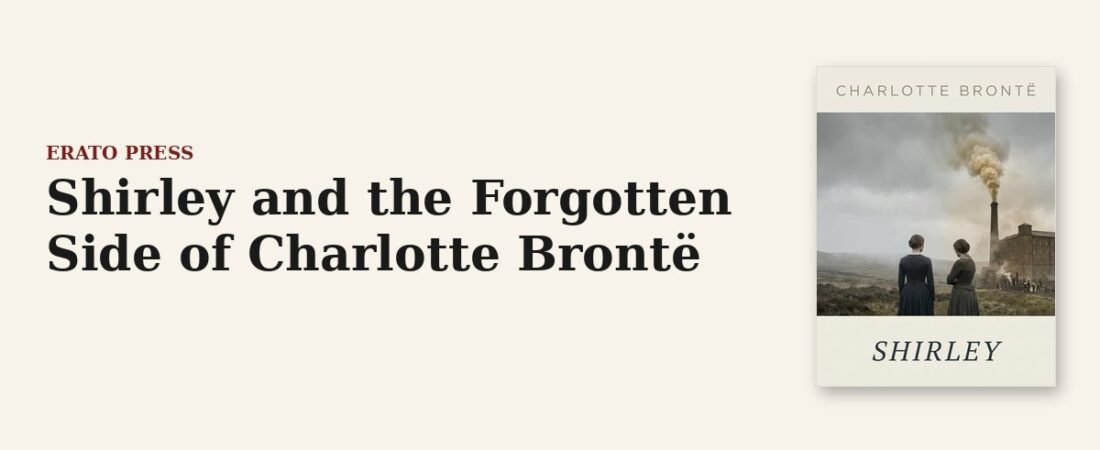
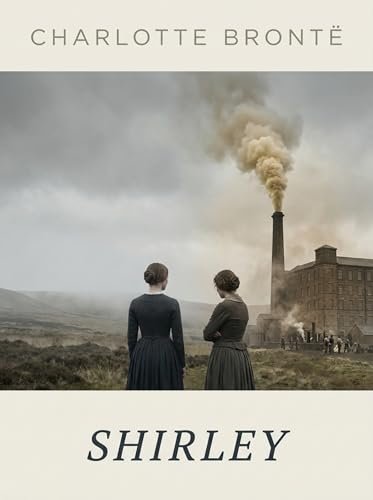
Unlike the intensely personal Jane Eyre, Shirley reaches outward. It is set during the Luddite uprisings of 1811–1816 — the wave of working-class violence against the new textile machinery in the Yorkshire Charlotte knew — and it is her attempt at a “condition of England” novel, engaged with labour, capital, and class conflict. The Luddites were not enemies of technology as such; they were skilled workers trying to preserve their livelihoods against manufacturers installing machines that let them hire cheaper, unskilled hands. Charlotte takes the material seriously, and her honesty has a hard edge: she does not resolve it. The crisis is never settled. The machinery keeps running, the workers’ resistance is crushed, and the social conflict simply goes on, unresolved, beneath the private happy endings. Her manufacturer-hero, Robert Moore, is the first of her male leads who is explicitly a capitalist — a man whose entire consciousness is organized around economic calculation, and who is therefore, the novel quietly suggests, incapable of the full humanity that love requires. This is the closest Charlotte came to writing like Gaskell or Dickens, and the wider canvas gives us a larger view of her intelligence than the governess plot of her famous book.
Two women and the problem of purpose
Its deepest interest, though, is its two heroines — and the relationship between them, which is the real emotional center of the book. Caroline Helstone is the familiar Brontëan figure: poor, orphaned, dependent on a cold uncle, with no resource for survival but marriage. Shirley Keeldar is something new in Charlotte’s work — a woman of wealth and an estate, independent, under no economic compulsion to marry anyone (the name, which Brontë essentially invented as a woman’s name, was a man’s before this novel). Through the contrast Charlotte asks her sharpest social question: what is a woman to do with her life when society offers her nothing but marriage or idleness? Caroline has no choice and is slowly destroyed by the lack of one. Shirley has every choice and discovers there is nothing for her intelligence and courage to be spent on except, in the end, a husband. In her famous declaration that she might have been “Coriolanus,” a warrior or a general, she names the ambitions a woman of her gifts is forbidden — and then channels them, with full and bitter awareness, into love.
A woman dying for lack of work
The most quietly radical thing in the novel — and one of the most radical in all Victorian fiction — is Caroline’s illness. She is not ill in any ordinary sense; her sickness is psychological, the physical manifestation of hopelessness. Forbidden to court the man she loves, forced to wait passively and to swallow the humiliation of his apparent indifference, she begins simply to waste away, to become invisible, to become nothing. Charlotte refuses to romanticize it. There is no spiritual transcendence in Caroline’s decline, no redemptive glow — only the truth that a woman with no future and no permitted outlet for her feeling can be consumed, in her own body, by what her social position forbids her to express. It anticipates twentieth-century psychology by half a century. And the cure, when it comes, does not come from a man. It is Shirley who pulls Caroline back from the brink, through the sheer force of her affection — one of the novel’s profoundest statements: that the remedy for the suffering imposed on women is the recognition and love of other women.
Why read the forgotten one
Because it completes the picture. Shirley ends with two marriages presented as happy and offered with a faint, honest qualification — the acknowledgment that something is being sacrificed even when it is sacrificed willingly, that personal happiness does not dissolve structural injustice. Caroline is still poor; Shirley is still a woman in a world that will not let women wield power. Charlotte understood the problem of women’s confinement with acute clarity, and she understood the economic crises of her age, and the novel’s great unfinished struggle is its attempt to hold both in one frame without letting either collapse into the other. Read it and Charlotte Brontë stops being the author of one famous book and becomes a more capacious, searching novelist — a writer thinking about a whole society, not just one heart. To understand how the loss inside it actually happened, pair it with Elizabeth Gaskell’s Life of Charlotte Brontë; and if you are newer to the family, start with our guide to where to begin with the Brontë sisters. Shirley is the Brontë novel for readers who already love the Brontës.
Read the Erato Press Shirley — with the full critical essay this post draws on →
Related reading: The Brontë Sisters: Where to Start · The Life of Charlotte Brontë: Gaskell’s Classic Biography · Wuthering Heights: Love, Violence, and Dissolution
This article draws on the original critical essay “The Social Novel Broken by Grief,” written for the Erato Press edition. This article contains affiliate links; as an Amazon Associate, Erato Press earns from qualifying purchases.
Enjoyed this piece?
Get the next one — our essays on the classics and news of each new Erato Press edition — straight to your inbox.