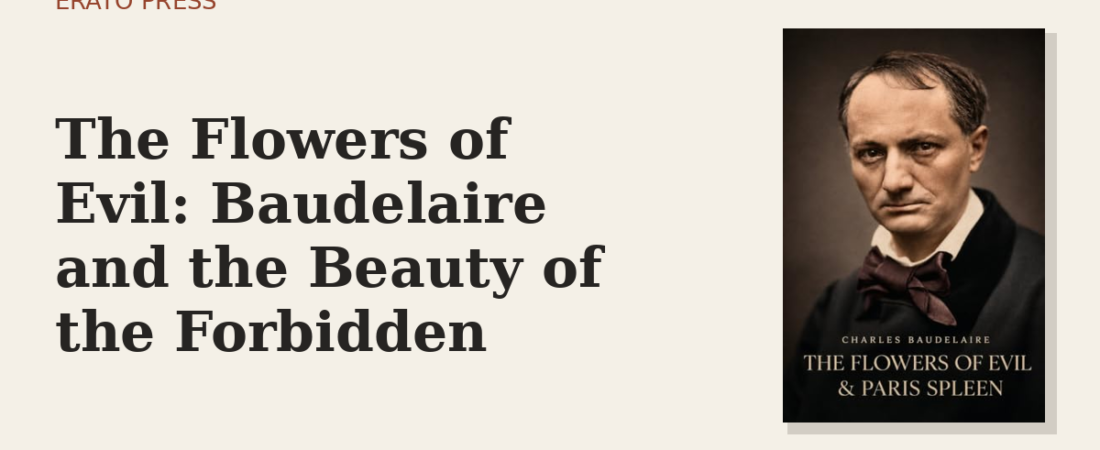

When Les Fleurs du Mal appeared in 1857, French authorities prosecuted Baudelaire for offending public morality, fined him, and banned six poems outright — a ruling France didn’t formally overturn until 1949, nearly a century later. What scandalized the censors was Baudelaire’s central, still-startling proposition: that beauty and corruption aren’t opposites, that decay, lust, and even a rotting corpse by the roadside could be rendered with the same formal precision as a sunset.
This bilingual edition also includes his prose poems, the Petits Poèmes en Prose, in which Baudelaire essentially invents a new form to capture something verse couldn’t: the disorienting, fragmentary experience of walking through a modern city, the flâneur’s eye moving from beauty to squalor within a single city block.
He is, more than any other single poet, the hinge between Romanticism and everything modernist poetry became after him — a debt visible in nearly every twentieth-century poet who followed.
Read The Flowers of Evil & Paris Spleen →
Enjoyed this piece?
Get the next one — our essays on the classics and news of each new Erato Press edition — straight to your inbox.