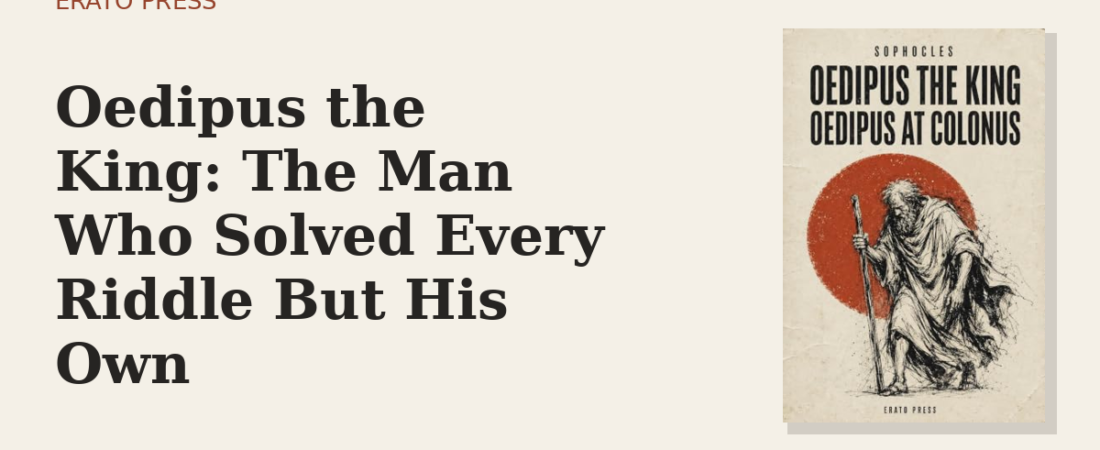

The dramatic irony of Oedipus the King is total and, on rereading, almost unbearable: Oedipus, the man who saved Thebes by solving the Sphinx’s riddle, spends the entire play investigating a murder he himself committed, hunting a curse on the city that he himself embodies, and the audience — who already knows the myth — watches him walk toward the answer with a confidence that is, structurally, the tragedy itself.
Sophocles isn’t interested in whether fate can be escaped; every character already knows it can’t. He’s interested in the terrible dignity of a man who keeps investigating anyway, refusing every offer to stop looking, because not knowing has become worse to him than any truth could be. Oedipus blinds himself not because the gods demand it, but because he can no longer bear to see a world he has finally seen clearly.
Sophocles wrote Oedipus at Colonus, included in this edition, decades later and near his own death — an old man’s coda in which the same broken king finally, quietly, finds a kind of grace.
Read Oedipus the King and Oedipus at Colonus →
Enjoyed this piece?
Get the next one — our essays on the classics and news of each new Erato Press edition — straight to your inbox.