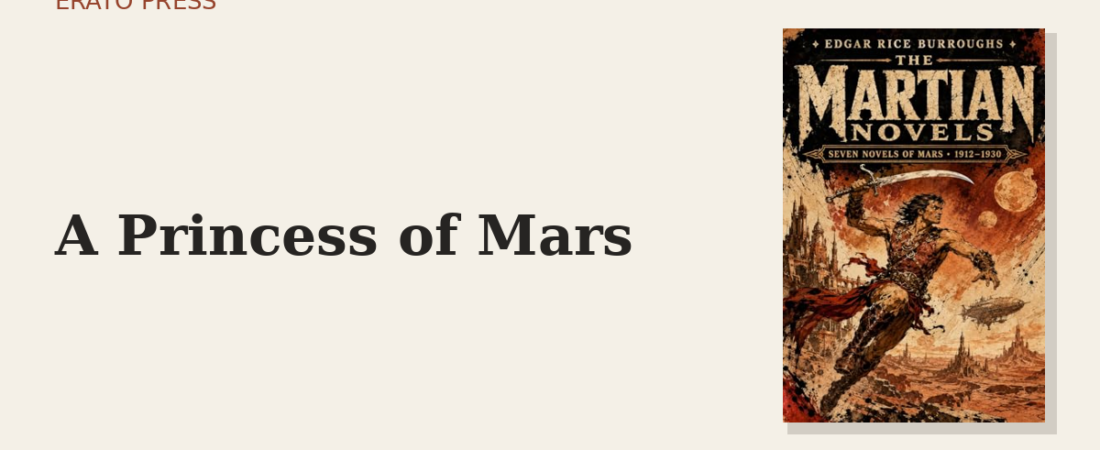

A Confederate soldier lies down in an Arizona cave, and wakes on Mars — lighter, stronger, able to leap enormous distances under the weaker gravity, plunged into a dying world of red deserts, four-armed green warriors, and a princess in need of rescuing. A Princess of Mars (1912) is gloriously silly, and it changed the imagination of the twentieth century.
Edgar Rice Burroughs invented, in John Carter of Mars, the template for nearly all the space adventure that followed. The earthman transported to an alien world, the exotic civilizations, the sword-and-ray-gun romance, the human hero who becomes a legend among aliens — it runs straight from Burroughs to Flash Gordon, to Star Wars, to every planetary romance since. The scientists who built the space age grew up on these books; more than one has said John Carter is why they looked up.
It makes no claim to be literature, and that is part of its charm — pure, propulsive, unembarrassed adventure, written by a man who could make you believe in a dying Mars by sheer conviction. Sometimes the books that shape the future are not the respectable ones.
This edition gathers the Martian novels, beside the myth Burroughs built.
Read The Martian Novels of Edgar Rice Burroughs →
Enjoyed this piece?
Get the next one — our essays on the classics and news of each new Erato Press edition — straight to your inbox.