
In 1774 a twenty-four-year-old German lawyer published a short novel about a sensitive young man’s hopeless love and his suicide, and set off the first true literary sensation in history. The Sorrows of Young Werther made Johann Wolfgang von Goethe famous across Europe overnight — and, according to legend, so moved its readers that some young men dressed in Werther’s blue coat and yellow waistcoat took their own lives in imitation. It may be the first book ever accused of being dangerous to its audience.
Told in feverish letters, Werther gave a generation permission to feel everything at maximum intensity — to worship nature, to adore hopelessly, to find the ordinary world unbearable. It was the founding text of Romanticism, the moment European literature turned inward and made the storms of a single heart the whole subject of art. Napoleon claimed to have read it seven times and carried it on campaign.
Goethe himself outgrew it, and spent the next sixty years becoming something vaster — poet, scientist, statesman, and author of Faust, the towering drama of a man who sells his soul for infinite experience. But it was Werther that lit the fuse.
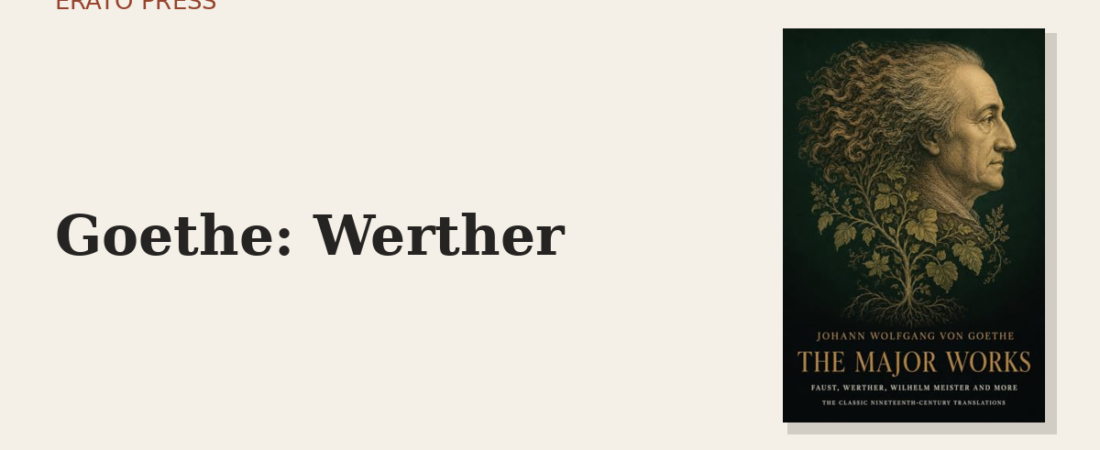
This edition gathers Goethe’s major works — Faust, Werther, Wilhelm Meister and more — in the classic translations. Begin with the book that taught the modern world how to feel.
Read The Major Works of Goethe →
Enjoyed this piece?
Get the next one — our essays on the classics and news of each new Erato Press edition — straight to your inbox.