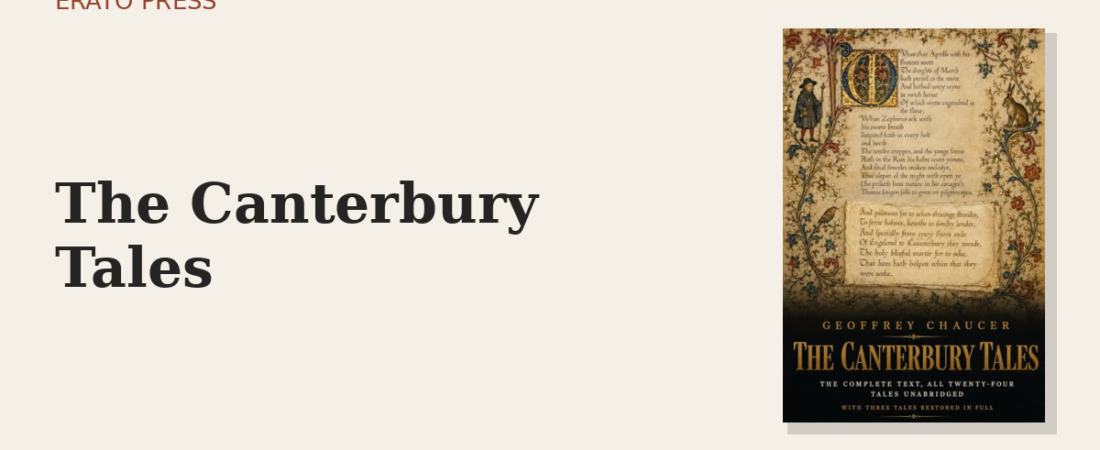

Six hundred years before the novel, a customs official named Geoffrey Chaucer had a simple, brilliant idea: gather a group of strangers on a pilgrimage to Canterbury — a knight, a miller, a cook, a lusty widow, a corrupt pardoner, a nun — and let each one tell a tale. The result, The Canterbury Tales, is the first great book written in English, and still one of the most alive.
What startles a modern reader is how funny and how earthy it is. This is no dusty monument. The Miller tells a filthy story of adultery and a misplaced kiss; the Wife of Bath, married five times and proud of it, delivers a roaring defence of women’s desire that feels centuries ahead of its time. Chaucer gives each pilgrim a distinct living voice, and through their tales — bawdy, pious, cruel, tender — paints the whole of medieval England, from the tavern to the church door.
He was the first to prove that English, then a rough vernacular beneath the dignity of Latin and French, could hold great literature. Every writer in the language, from Shakespeare on, stands on the ground Chaucer cleared.
This edition restores the complete text — all twenty-four tales unabridged, including the ones usually cut — with the help you need to read the Middle English and hear it laugh.
Enjoyed this piece?
Get the next one — our essays on the classics and news of each new Erato Press edition — straight to your inbox.