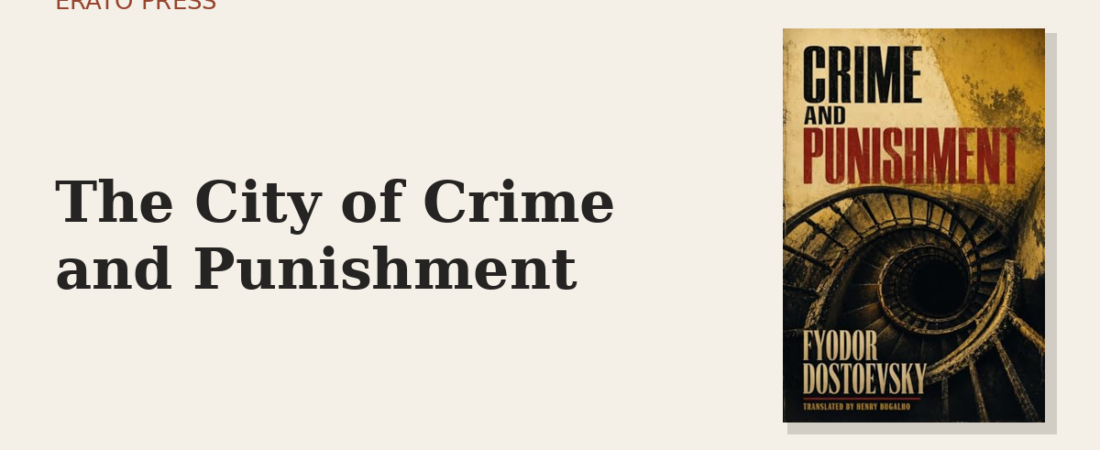

We have anatomized Raskolnikov’s guilty mind. But return to Crime and Punishment and notice how much of that mind is really the city — how St Petersburg itself, in the airless heat of a July, seems to squeeze the murder out of him.
Dostoevsky’s Petersburg is one of the great characters in fiction: a labyrinth of stinking canals, cramped garrets, crowded taverns and staircases, a place where a man can be surrounded by half a million people and utterly alone. Raskolnikov’s room is a coffin, a ‘cupboard’ six paces long, and his theory of the superman is the fantasy of a man who cannot breathe. The city does not cause the crime, but it presses on him until the idea in his head has nowhere to go but out, into the world, as an axe.
This is the invention that would echo through the whole modern novel: the metropolis as a state of mind, the way a place can make a certain kind of thought possible. Read the murder as architecture and you see how much of Raskolnikov was built by Petersburg before Dostoevsky ever put a weapon in his hand.
Read on with Notes from Underground, the same city seen from a different cellar.
Read Crime and Punishment — the Erato Press edition →
Enjoyed this piece?
Get the next one — our essays on the classics and news of each new Erato Press edition — straight to your inbox.