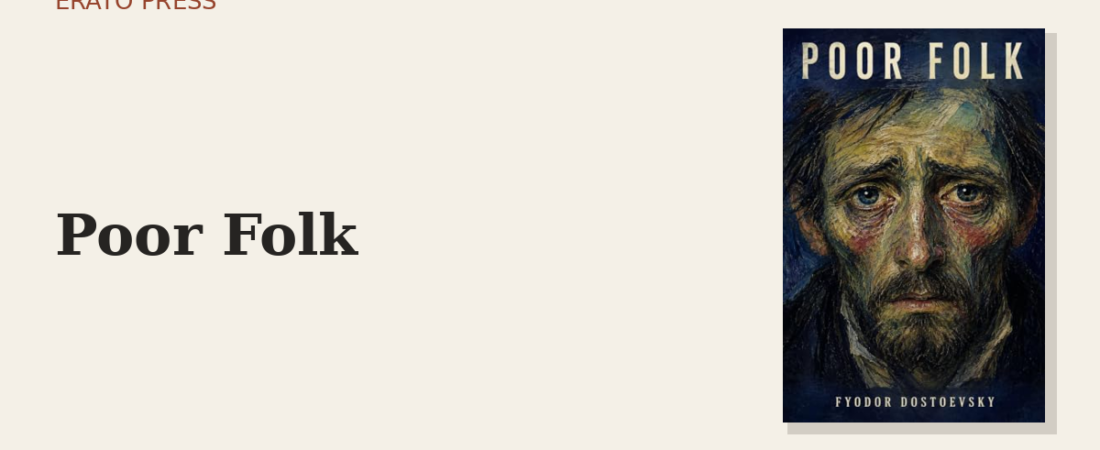

Dostoevsky was twenty-four and unknown when he finished his first novel and gave it to a friend to read. The friend stayed up all night, ran to the great critic Belinsky at four in the morning, and announced that a new Gogol had appeared. Overnight, Poor Folk made Dostoevsky famous. It is where the whole vast career begins.
It is a slender book, told entirely in letters between a poor middle-aged clerk and a young seamstress in a St Petersburg slum — two lonely, tender people clinging to each other across a courtyard, undone not by melodrama but by simple poverty. There is no crime, no philosophy, no Grand Inquisitor yet. There is only Dostoevsky’s astonishing gift, present from the first page: the ability to make you feel the exact texture of a humiliated human heart.
What he does that was new was to take the ‘little man’ of Russian fiction — the copying clerk, the nobody — and give him an inner life of overwhelming dignity and pain. The whole later Dostoevsky is here in seed: the obsession with the insulted and the injured, the belief that the last and least deserve the most attention.
Read it before the great novels — before Crime and Punishment and The Idiot — to see where the giant took his first step.
Read Poor Folk — the Erato Press edition →
Enjoyed this piece?
Get the next one — our essays on the classics and news of each new Erato Press edition — straight to your inbox.