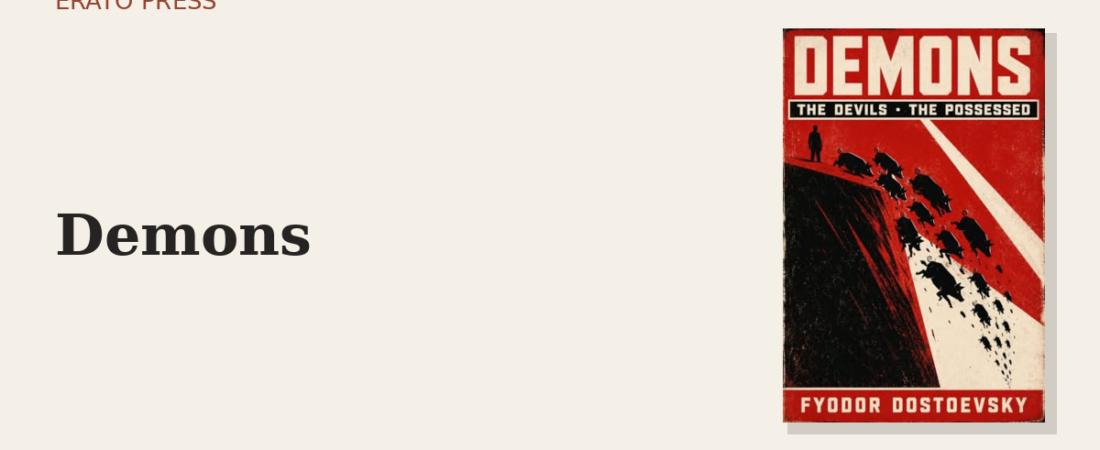

In 1872 Dostoevsky wrote a novel about a small cell of revolutionaries in a provincial Russian town who talk of liberating humanity and end by murdering one of their own to bind the group in blood. He called it Demons, and it reads less like a novel of its time than a prophecy of the next century.
Dostoevsky had himself been a young radical, marched to a firing squad and reprieved at the last second; he knew the intoxication of the idea that would remake the world. In Demons he turns on that intoxication with terrifying insight. His revolutionaries are not monsters but idealists whose love of an abstract humanity has hollowed out their capacity to love any actual person. Set a high enough end, he shows, and every atrocity becomes a means.
At the centre is Stavrogin, one of literature’s great enigmas — magnetic, exhausted, capable of anything and moved by nothing, a man who has killed God in himself and found only boredom on the other side. Around him the ideas swirl and curdle into violence.
It belongs beside Crime and Punishment and Notes from Underground — the trilogy in which Dostoevsky diagnosed the modern soul before the century that would prove him right.
Read Demons — the Erato Press edition →
Enjoyed this piece?
Get the next one — our essays on the classics and news of each new Erato Press edition — straight to your inbox.