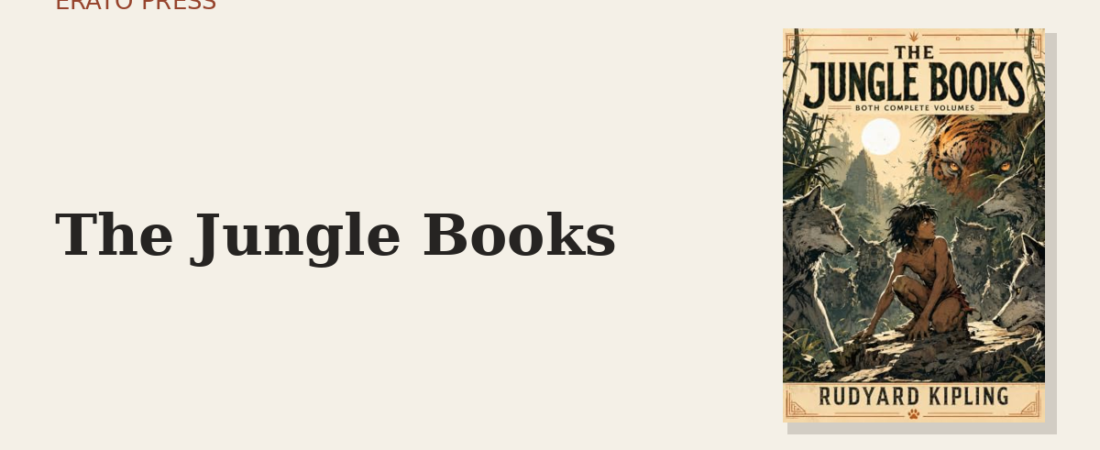

Forget the cartoon. Kipling’s Jungle Books are stranger, harder, and far more beautiful than any adaptation has dared to be — a set of fables about law, belonging, and the terrible loneliness of the creature who fits nowhere.
Mowgli, the man-cub raised by wolves, is not a happy Disney orphan. He is a being caught between two worlds, fully accepted by neither — too human for the pack, too wild for the village. The jungle has a Law, rigid and ancient, and Kipling clearly loves it; but the deepest note in the books is the ache of the one who cannot simply live inside it.
And the fifteen stories are not all Mowgli. There is Rikki-Tikki-Tavi, the mongoose who defends a household against cobras; there is the white seal, and the war elephants, each story a small, complete world with its own ferocity and tenderness. Kipling wrote about animals the way Aesop did — to tell the truth about us.
This edition collects both complete volumes, all fifteen stories, unabridged, with a critical study and a life of Kipling — a writer whose politics we may quarrel with, but whose ear for the music of English has few rivals.
Read The Jungle Books — the Erato Press edition →
Enjoyed this piece?
Get the next one — our essays on the classics and news of each new Erato Press edition — straight to your inbox.