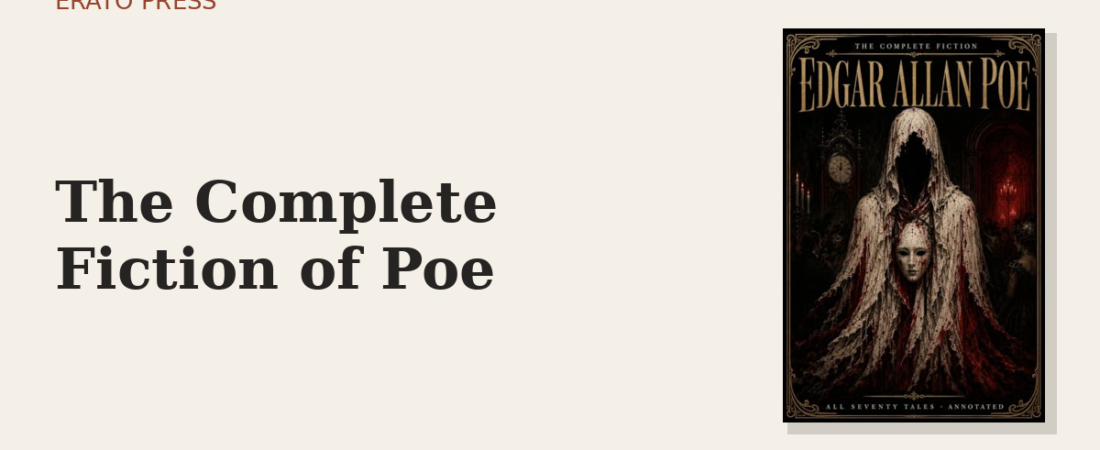

We tend to remember Edgar Allan Poe in fragments — a raven, a beating heart beneath the floorboards, a man walled up alive. But read his fiction whole, all seventy tales in one volume, and something larger appears: not a writer of scares, but the inventor of several of the ways we now tell stories.
He invented the detective story outright. Before Sherlock Holmes, before every procedural on television, there was Poe’s Auguste Dupin, solving crimes by pure ratiocination in ‘The Murders in the Rue Morgue.’ He wrote some of the first modern science fiction. And he theorized the short story itself — the idea that a tale should aim at a single, unified effect, and waste not a word that does not serve it.
The horror, read in bulk, turns out to be psychological before it is supernatural. Poe’s great subject is the mind turning on itself: guilt that will not stay buried, reason curdling into madness, the perverse impulse to do the very thing we must not. He is the poet of the divided self.
This edition gathers the complete fiction with a critical study and a life of the author. For the poems and the myth of the man, see our companion essay on The Raven and the making of Poe.
Read The Complete Fiction of Edgar Allan Poe →
Enjoyed this piece?
Get the next one — our essays on the classics and news of each new Erato Press edition — straight to your inbox.