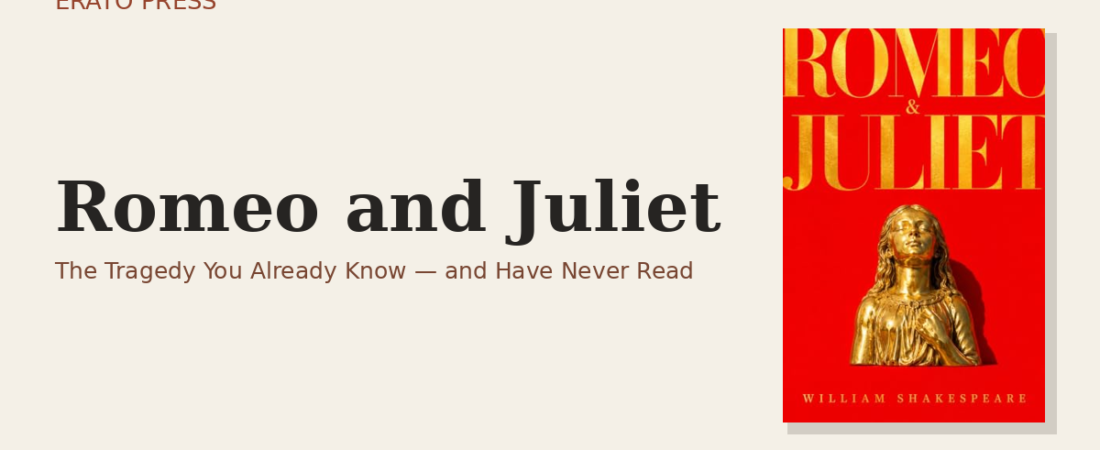

We all know Romeo and Juliet. That is precisely the problem. It is the most famous love story ever written — quoted at weddings, misquoted at funerals, taught to every fourteen-year-old on earth — and, for exactly that reason, one of the least actually read. Most people carry a version of it assembled from film posters, half-remembered classroom afternoons, and lines that aren’t quite what they think. To open the real text is to meet a stranger wearing a very familiar face.
Start with the two things everyone ‘knows.’ There is no balcony: the word appears nowhere in Shakespeare’s play; Juliet stands at a window, and the balcony was added by later stagings. And ‘wherefore art thou Romeo?’ does not mean ‘where are you, Romeo?’ — wherefore means why. She is not looking for him. She is asking why, of all the names in Verona, the one man she wants had to be a Montague. The single most quoted line in the play is, almost universally, misunderstood. That is the measure of how much of this play we have replaced with an idea of it.
The love story that isn’t only a love story
Read it fresh and the first surprise is how little of it is about love and how much is about hatred. The play does not open on the lovers. It opens on a street brawl — servants of two houses biting their thumbs and drawing swords over a quarrel so old no one can remember its cause. The feud is the first thing we see and the last thing that kills them. The lovers are born into a war they did not start; their love is the accident, and the hatred is the structure. The tragedy is not that they loved, but that they loved across a line their fathers had drawn in blood. The children die of their parents’ feud — and the parents discover their children’s love only over the corpses.
It is the oldest and cruelest machinery in literature: a family curse that grinds down the generation that inherited it, the same logic the Greeks built their tragic stage upon. Shakespeare simply moves it from the House of Atreus to a sunlit Italian town and hands the swords to teenagers.
A quiet trial of the adult world
Notice who fails these children. The Prince, whose law cannot stop the killing. Old Capulet — indulgent and warm one moment, a tyrant the next, threatening to throw his daughter into the street if she will not marry the man he has chosen. The Friar, whose clever, well-meaning half-measures — the sleeping draught, the letter that must arrive on time — are the very machinery of the catastrophe. Even the Nurse, who loves Juliet and then, at the first difficulty, counsels her to forget her husband and marry Paris. Every adult institution the play contains — church, family, state — either fails or betrays. Romeo and Juliet is, underneath the romance, a quiet trial of a world that makes instruments of its young and then weeps, sincerely, at their funerals.
Four days
The most shocking thing on the page is the speed. The whole tragedy — the meeting, the secret marriage, the banishment, the double suicide — unfolds in roughly four days. Haste is not just a feature of the plot; it is the murder weapon. Juliet names it herself on the night they meet: their love is ‘too rash, too unadvised, too sudden.’ The Friar warns, ‘Wisely and slow; they stumble that run fast.’ And then everyone runs. The catastrophe is engineered entirely out of minutes — a letter that arrives too late, a boy who reaches the tomb a few breaths too early. This is not the slow, grand doom we associate with fate. It is something more modern and more frightening: the tragedy of bad timing.
‘Star-crossed’ — destiny, or just terrible luck?
The Prologue calls them ‘star-crossed,’ and we have taken the phrase to mean the cosmos itself conspired against them. But look at the actual mechanism and it is almost unbearably contingent: a plague quarantine delays a messenger; two lovers miss each other at a tomb by moments. Shakespeare gives us the language of fate and the machinery of accident, and lets the two grind against each other without ever telling us which is true. Were they doomed, or merely unlucky? The play refuses to answer — and that refusal is the same unresolved question that sits at the heart of all Greek tragedy, now transplanted into a love story. What the Greeks argued about love over the drinking table, Shakespeare stages as a catastrophe of timing.
The comedy that curdles
Here is the structural secret almost no one notices: for two acts, Romeo and Juliet behaves like a romantic comedy. A masked party, disguises, wit flying in every direction, a bawdy Nurse, a scheming friar, a secret wedding. If the play stopped at the end of Act 2, it would sit comfortably beside Twelfth Night. Then Mercutio is killed — and the genre snaps shut like a trap. ‘A plague o’ both your houses,’ he says, three times, and the comedy dies with him. Mercutio, whose Queen Mab speech is the fastest, strangest wit in all of Shakespeare, is the play’s true hinge and perhaps its real victim: extinguished in a street fight over a quarrel that was never his. After his death the play can do only one thing, which is fall. That is a darker, stranger design than the ‘romance’ of reputation — closer to the way love and violence become inseparable in Wuthering Heights than to any valentine.
Why read the words
The idea of Romeo and Juliet is thin — young love, a tomb, a rose by any other name. The text is dense, strange, filthy, and far more adult than its reputation lets on. The Nurse and Mercutio are relentlessly obscene; the verse does things the four centuries since have never quite matched; and the famous window scene, actually read, is not sentimental at all — it is two frightened young people testing, in the dark, whether the thing they feel can survive daylight and names. You have been quoting this play your whole life. The point of a good edition is to let you finally read it.
Read it — properly, this time
The Erato Press Romeo and Juliet gives you the complete, unabridged play with a critical study and a life of Shakespeare — the tragedy you already know, restored to the strangeness you have never met. It joins our line of the great tragedies in single critical editions: Hamlet, Macbeth, Othello, and King Lear. And for the whole of him in one volume, there is the complete annotated Shakespeare.
Read the Erato Press Romeo and Juliet →
Enjoyed this piece?
Get the next one — our essays on the classics and news of each new Erato Press edition — straight to your inbox.